





MANFRED PERNICE
b. 1963, GermanyBorn in 1963 in Hildesheim, Germany, lives and works in Berlin, Germany.
Manfred Pernice studied from 1984 to 1987 graphics and painting at the Braunschweig University of Art, from 1988 to 1993 sculpture at the Berlin University of the Arts, 1994 master-class.
From 2004 to 2009 he was a professor at the Academy of Fine Arts Vienna, in 2012 he became a professor for sculpture at the Universität der Künste (University of Fine Arts) in Berlin.
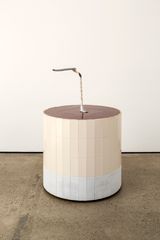
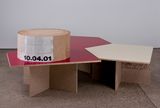
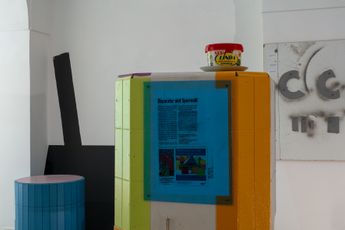
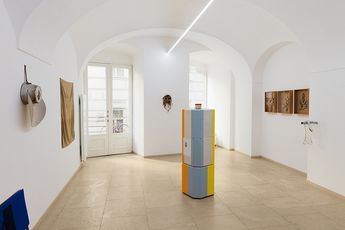
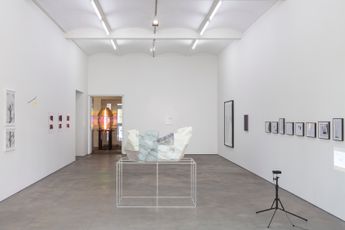
Manfred Pernice’s sculptures–primarily boxes and containers with cylindrical or cuboid shapes implying a ‘canned world’-have recently become more prismatic, plastic positions. The chipboard, plywood, tile, iron and concrete used in these sculptures are materials primarily associated with handicraft, but when combined with texts, drawings, newspaper clippings, photocopies, everyday objects (sometimes found) and other things, these structures create an open system of references that tap into specific socio-cultural codes, memories, or things that have meaning for a certain site. Manfred Pernice’s working methods, which have been described as ‘blurring’ and ‘direction finding,’ are practiced with deliberation. Direction finding means capturing a moment within a kind of order that openly gives in, powerless, to the world’s complexity-an order that could just as soon produce alternative contexts. Pernice’s direction finding locates history telling, sorting, separating, and preserving-also of minor or discarded things-and creates a poetic network of mutual references.
Manfred Pernice was represented in 2001 and 2003 at the Venice Biennale, in 2002 at the Documenta XI Kassel. Since 2007 his works has been regularly exposed at the KölnSkulptur. He participated at the Bienal de São Paulo (2011), the Skulptur Projekte Münster (2007), the Bienal de Sevilla (2006), the Manifesta 3, Ljubljana (2002), the Berlin Biennale (1998) and the Biennale de Lyon (1997)
Selected solo exhibition: Kunstmuseum St. Gallen, Switzerland (2016), Lulu, Mexico City (2016), Institut d’Art Contemporain Villeurbanne, France (2013), Haus der Kunst, Munich (2013), S.M.A.K., Ghent, Belgium (2011), n.b.k. Neuer Berliner Kunstverein, Berlin (2011), DCA Dundee Contemporary Arts, Dundee, Scotland (2011), Secession, Vienna (2010), Modern Art Oxford (2010), Salzburger Kunstverein, Salzburg (2010), Neues Museum, Nuremberg, Germany (2008), Museum Ludwig, Cologne (2008), Pinakothek der Moderne, Munich (2003), Sprengel Museum, Hanover, Germany (2001), Portikus, Frankfurt/Main, Germany (2000), Kunsthalle Zürich, Switzerland (2000), Kabinett für aktuelle Kunst, Bremerhaven, Germany (1997)
His works can be found in many museums and private collections, including the MoMA, New York City, Solomon R. Guggenheim Collection, New York City, S.M.A.K., Ghent, Belgium, Pinakothek der Moderne, Munich, Germany, Kunstmuseum Liechtenstein, Vaduz, Tate Modern, London, United Kingdom and others.
Text courtesy Galerie nächst St. Stephan Rosemarie Schwarzwälder.


Explore Manfred Pernice's Exhibitions





Explore and Follow Artists Shaping Contemporary Art
A respected voice in contemporary art discourse.
Focusing on ambitious storytelling and insightful art-world commentary. Ocula Magazine publishes in-depth interviews, critical essays and timely analysis on the artists, exhibitions and ideas driving the global art world.
Learn more about Ocula Magazine
Showcasing the best of the art world.
Ocula partners with galleries from around the world to highlight their artists, artworks and exhibitions. Gallery membership is by application and invitation, with each member vetted by an independent panel.
Learn more about Ocula Membership
Specialises in the sale of major artworks.
Led by a team with deep ties to the world’s leading auction houses, galleries and collectors. Ocula’s advisory team offers bespoke services to high-net-worth clients from around the world who are looking to acquire the best of contemporary and modern art.
Learn more about our team and services