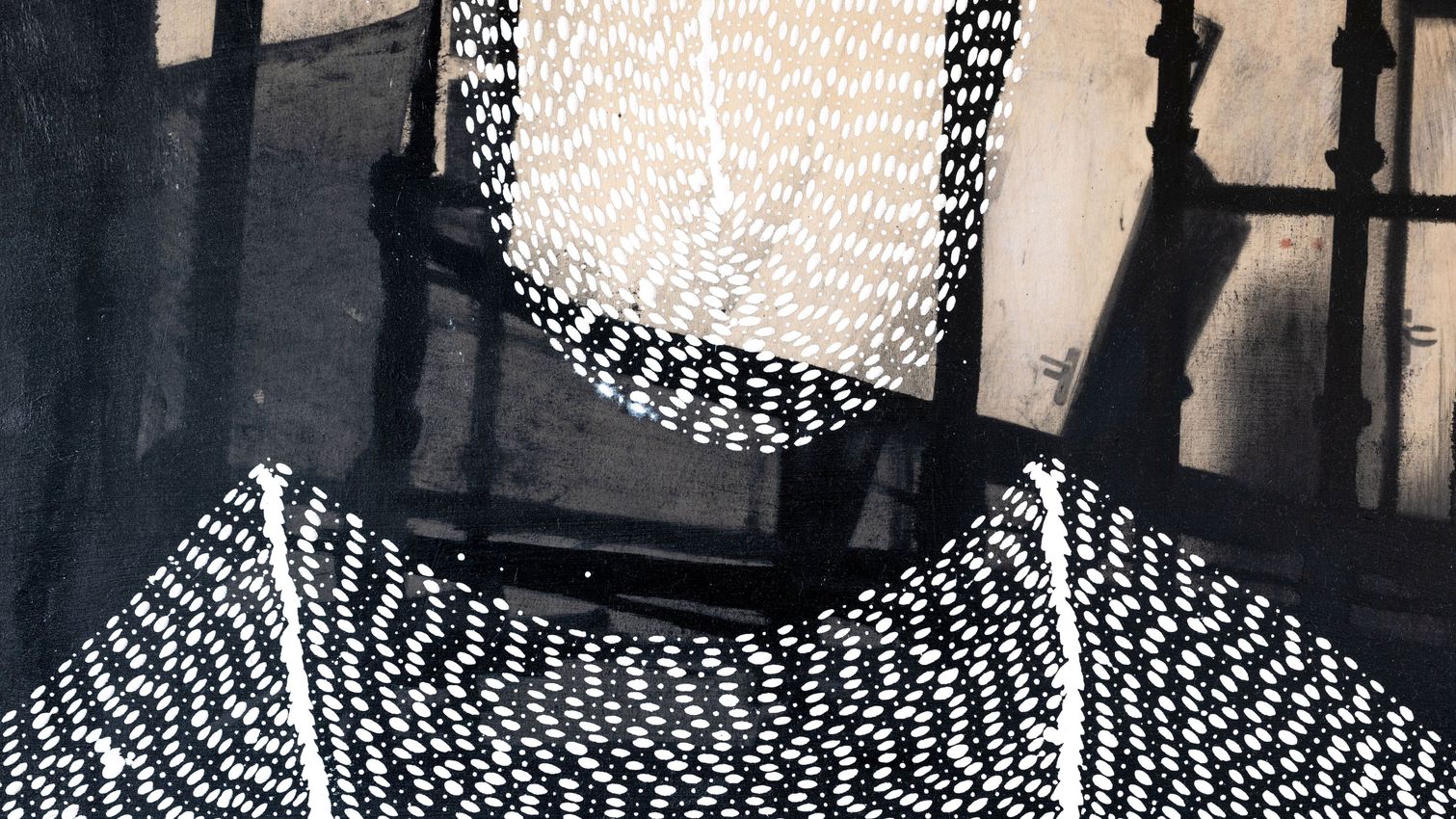
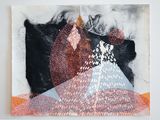
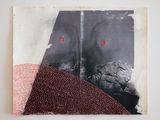
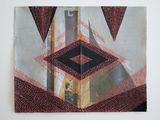
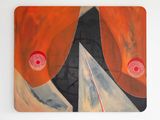
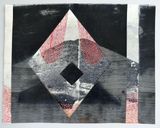
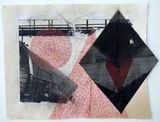
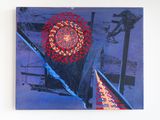
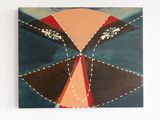
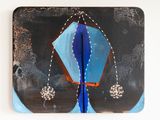
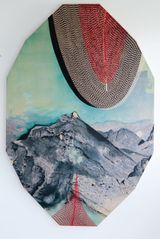
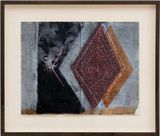
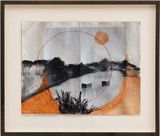
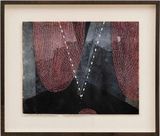
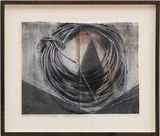
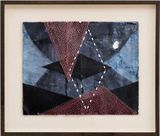
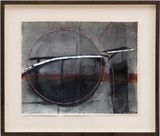
According to the artist’s statement, Radhika Khimji’s works are ‘at once painting, a drawing and a collage’ as well as ‘an embroidery and a sculpture’. Employing various mediums, Khimji constructs intentionally ambiguous artworks that evade categorisation.
Shifters
Khimji’s ongoing concern with the body traces back to ‘Shifters’, a series of plywood works that take the form of fragmented bodies in movement. Also known as the ‘Cut Outs’, ‘Shifters’ in turn derives from an earlier series of collages that the artist began in 2002, which also revolved around human forms and gestures.
In ‘Shifters’, Khimji moved beyond the rectangular confines of collage to create anthropomorphic cut-outs from plywood. Resembling dancing or moving bodies, they are often covered in brightly coloured and intricate patterns, as seen in the three distinct forms of Squat (2005), or painted with lumpy forms evocative of human musculature, as in Sitting (2009).
The dot is a recurring motif in Khimji’s work, which she describes as ‘the visualisation of a human gesture’ in her 2021 conversation with Ocula Magazine. In Right Leg Up (2008), for instance, the semi-translucent Plexiglas figure raises its leg up, from which emanates an orange and brown cloud perforated with dots made by burning holes into paper. Just as the act of raising a leg embodies the movement of a body in space, the holes or the cavities hint at the human gestures that created them.
Parachutes
Another recurring motif in Khimji’s practice is the parachute, which the artist considers as a metaphor for ‘an external drive’ and commonly drapes over walls, buildings, or even rocks. In Safe Landings (2010), her first solo exhibition in Oman, Khimji installed parachutes across Barka Fort in addition to her cut-out works; the parachutes also made their way to Marrakech as part of the 6th Marrakech Biennale in 2016, where they appeared at the El Badi Palace. In presenting parachutes in different places, Khimji raises questions about whether the parachutes, in relation to the specificity of their site, can be read as symbols of hope or abandonment.