





SANDY RODRIGUEZ
b. 1975, United StatesSandy Rodriguez is a Los Angeles–based Chicana painter, researcher, and educator whose work uses Indigenous pigments, watercolour, and mapping to tell visual histories of the Americas, from the U.S.–Mexico borderlands to the Gulf of Mexico. Inspired by shared experience and contemporary stories, she contextualises current events through materials and techniques rooted in the Americas, turning maps and large-scale works on paper into tools for re-reading history.
Early life and formative influences
Born in 1975 in National City, California, and raised between Tijuana, San Diego, and Los Angeles, Rodriguez draws on three generations of Mexican painters in her family. She and her mother attended CalArts together in the early 1990s, when artists such as Henry Taylor and Mark Bradford were students and Coco Fusco and Harry Gamboa Jr. were teaching, exposing her to both experimental practices and Chicanx and Latinx discourse. Her grandparents—her grandmother from Aguascalientes and her grandfather from Cintalapa, Chiapas—were trained in the European painting tradition, ran a small gallery in Tijuana, and supported themselves through commissions, surrounding her childhood with oil paintings and stories about art. This upbringing, steeped in oil painting, traditional recipes, and European techniques, later prompted her to ask what she knew about the history of image-making in the Americas and to redirect her practice toward that question.
In addition to her study at CalArts, Rodriguez spent many years as a museum educator, teaching with collections at institutions including the J. Paul Getty Museum while building her studio practice. In the mid-2010s, research into the 16th-century Florentine Codex and travel in southern Mexico led her to abandon synthetic paints and to revive historical recipes for natural colour, including cochineal, Maya blue, walnut ink, logwood, and other mineral and plant-based watercolours—a shift she links to recovering suppressed material histories of the Americas.
Methods and Working process
Rodriguez’s practice now centres on cartographic and codex-like formats: long panoramas, folding screens, and map-based compositions that function as dense, story-rich documents. Her process involves in depth research on landscapes, both in libraries and archives, and out in the field walking the land, and working with specialists—curators, historians, botanists, anthropologists, and even paleontologists—to understand lesser-known regional histories and to bring scientific and cultural knowledge together in her visual practice.
Projects often begin with close study of historical charts and manuscripts in collections such as The Huntington, the Hispanic Society Museum & Library, the Library of Congress, and Stanford’s Rumsey Map Center, tracing how specific regions have been mapped from the early modern period to the present. She then gathers local plants, soils, and sometimes seawater, which she processes into pigments and watercolours using Indigenous recipes so that water, soil, and flora from a place literally colour its depiction, relating also to the subject matter. Across exhibitions, she deliberately plays with art-historical tropes, centring Chicana and Indigenous knowledge systems while also referencing European traditions to reflect the collision of cultures that shaped the Americas. Each iteration of a series is tailored to the region it addresses, inviting contemporary viewers to read layered visual histories and to engage in critical conversations about narratives that have been silenced or erased from curricula.
Codex Rodriguez–Mondragón and key concerns
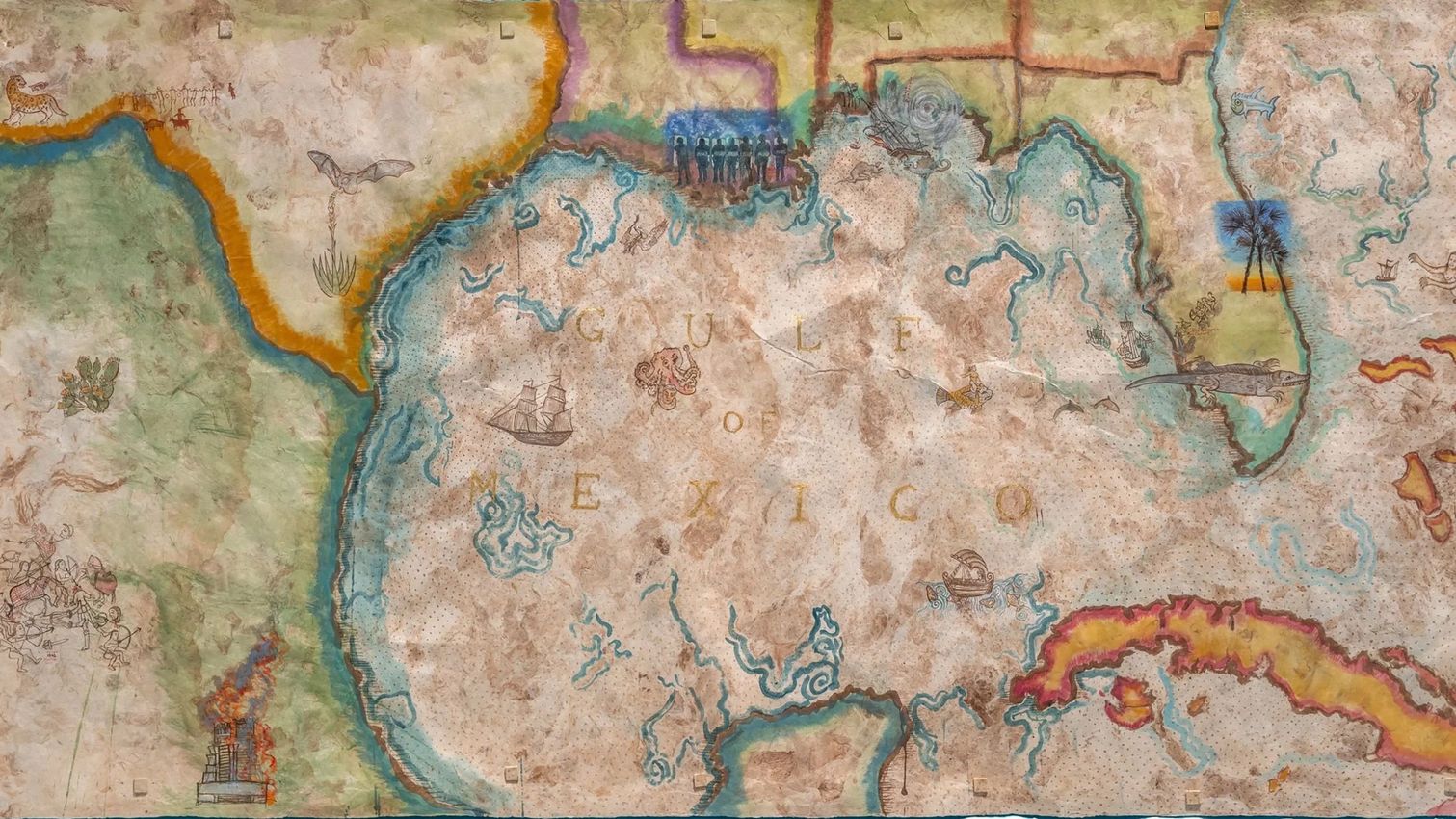
The ongoing Codex Rodriguez–Mondragón, begun in 2017, is a growing body of maps and specimen paintings that chart “ongoing cycles of violence” affecting communities of colour in California, the U.S.–Mexico borderlands, and the Gulf Coast. The works typically take the form of large, horizontally oriented maps on sheets or accordion-folds of amate paper, where coastlines, mountain ranges, roads, and detention infrastructure are drawn in fine ink lines and translucent watercolour washes, then overlaid with icons of helicopters, skulls, flames, and text that echo the visual language of colonial codices. Between these cartographic notations, Rodriguez paints meticulous portraits of native plants—roots, stems, leaves, and flowers labelled in both Spanish and Indigenous languages—so that fields of crimson cochineal, deep logwood purples, and earthy mineral tones sit alongside satellite-like views of towns, border walls, and ICE raids.
Detention centres, protest sites, and migration routes are plotted like coordinates across the surface, while bands of colour or storm-like clouds register wildfires, pandemics, and other natural and human-made disasters. Colours carry specific meanings—cochineal reds can suggest blood or sacrifice, while cool blues, greens, and browns derived from plants and earth signal healing, resilience, or ancestral presence—so reading these works involves deciphering a layered vocabulary about power, survival, and care. Painted with hand-processed earth, plant, and insect-based watercolours on “sacred (formerly outlawed)” amate paper, the codex functions less as a neutral map and more as an embodied object in which the materials of a place and its contested histories are literally embedded in the surface.
Major projects: Book 13, Tierra Insurgente, Currents of Resistance
Book 13, developed with Creative Capital and installed at The Huntington, extends the codex into an immersive environment of maps, landscapes, and plant studies that link the aftermath of conquest with contemporary human-rights abuses and climate crisis in the United States. Tierra Insurgente, her first solo exhibition in New York at the Hispanic Society Museum & Library in 2026, uses large-scale watercolour maps in natural pigments on paper—grounded in the institution’s colonial manuscripts—to propose an insurgent “map of the Americas” where land, plants, and communities act as protagonists rather than backdrop. Currents of Resistance, created for the John and Mable Ringling Museum of Art as the culmination of her Hermitage Greenfield Prize, turns this approach toward the Gulf of Mexico through a 40-foot paper panorama, a “cabinet of curiosities”, video, and audio that trace intertwined histories of colonial exploitation, environmental change, and cultural resilience, with some pigments mixed using Gulf seawater.
Overall Themes and Significance
Across these bodies of work, Rodriguez treats maps as instruments of power that can be repurposed to show how borders, land use, and resource extraction have been imposed and contested over centuries. By foregrounding native plants, natural watercolours, and the tradition of amate papermaking, she brings Indigenous knowledge systems back into view and insists on the richness of Mexican and Indigenous cultural production. Her paintings juxtapose detention centres, protests, and ecological disaster with meticulous botanicals and handwritten notes, insisting that beauty and struggle are inseparable in these landscapes and offering viewers a materially grounded picture of how history continues to shape the present—and how critical looking can open space for alternate, more informed futures.
Exhibitions and Recognition
Rodriguez has presented solo exhibitions at institutions including:
- Art, Design & Architecture Museum at UC Santa Barbara (Unfolding Histories: 200 Years of Resistance, 25 February 2023–3 March 2024)
- Amon Carter Museum of American Art in Fort Worth (Sandy Rodriguez in Isolation, 18 December 2021–17 April 2022)
- The Huntington Library, Art Museum, and Botanical Gardens (Sandy Rodriguez: Book 13, 22 March 2026–26 April 2027).
Tierra Insurgente opens at the Hispanic Society of America in New York in April 2026, coinciding with the presentation of Book 13 at The Huntington, underscoring her growing visibility within major U.S. museums. Her work has also been supported by research residencies and academic collaborations, such as a 2022 residency at Cornell University focused on Latinx, Indigenous, and Chicanx histories in the Americas.
Sandy Rodriguez FAQs
What is Sandy Rodriguez best known for?
Sandy Rodriguez is best known for Codex Rodriguez–Mondragón and related map-based works that combine Indigenous pigments, amate paper, and cartographic formats to address border violence, resistance, and environmental histories. Her practice brings together research into colonial Mexican codices with contemporary events, allowing viewers to see continuities between past and present on a single painted surface.
What is ‘Tierra Insurgente’ about?
Sandy Rodriguez’s Tierra Insurgente is a 2026 project at the Hispanic Society of America in New York that reimagines the Americas through insurgent maps centred on Indigenous knowledge, uprisings, and ecologies. Using hand-processed pigments and codex-like formats, Rodriguez challenges conventional hemispheric maps that prioritise borders and empires over land-based relationships and community histories.
How does Sandy Rodriguez make her pigments and materials?
Sandy Rodriguez researches and collects native plants, minerals, and insects, transforming them into natural inks and watercolours that echo pre-Columbian and colonial techniques. She often paints on amate and amate-fiber papers associated with sixteenth-century Mexican codices, so that the very supports and colours of her works are historically and geographically specific.
Where can I see Sandy Rodriguez’s work?
In 2026–27 her installations Book 13 and Tierra Insurgente are presented at The Huntington in San Marino, California, and the Hispanic Society of America in New York. Her work has also been shown at the Art, Design & Architecture Museum at UC Santa Barbara and the Amon Carter Museum of American Art and is included in museum collections and exhibitions across the United States.
What themes does Sandy Rodriguez explore in Codex Rodriguez–Mondragón?
Codex Rodriguez–Mondragón interweaves maps, specimen paintings, and historical references to address state violence, migration, detention, and uprisings in the U.S.–Mexico borderlands and California. At the same time, the series highlights plant knowledge, Indigenous sovereignty, and practices of healing, presenting the codex format as a living archive rather than a closed colonial document. Her overall intention is to use deep research and ‘find opportunities to inspire people to think critically and work toward an alternate and informed future’.

Explore and Follow Artists Shaping Contemporary Art
A respected voice in contemporary art discourse.
Focusing on ambitious storytelling and insightful art-world commentary. Ocula Magazine publishes in-depth interviews, critical essays and timely analysis on the artists, exhibitions and ideas driving the global art world.
Learn more about Ocula Magazine
Showcasing the best of the art world.
Ocula partners with galleries from around the world to highlight their artists, artworks and exhibitions. Gallery membership is by application and invitation, with each member vetted by an independent panel.
Learn more about Ocula Membership
Specialises in the sale of major artworks.
Led by a team with deep ties to the world’s leading auction houses, galleries and collectors. Ocula’s advisory team offers bespoke services to high-net-worth clients from around the world who are looking to acquire the best of contemporary and modern art.
Learn more about our team and services