





THE HAAS BROTHERS
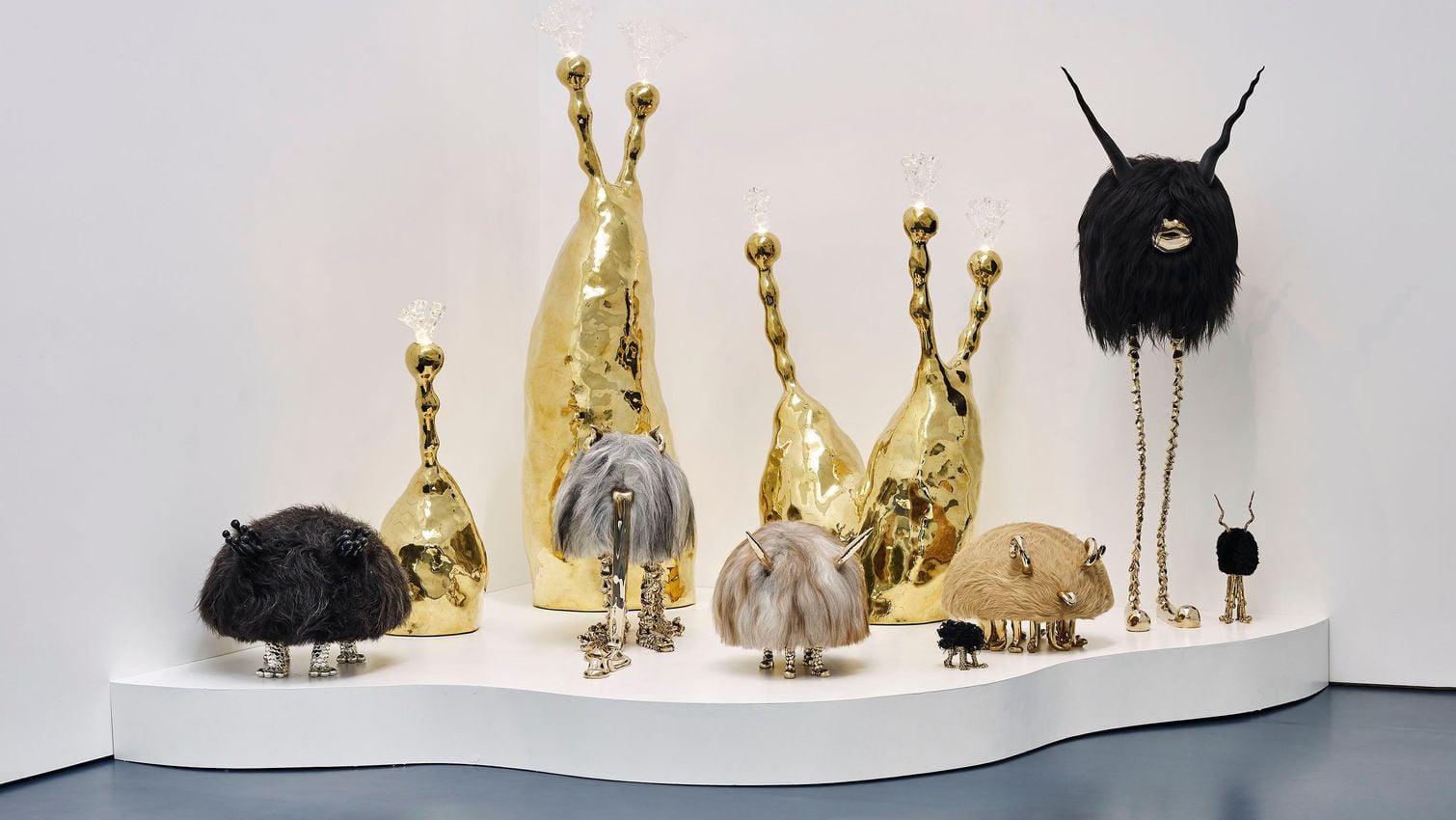
b. 1984, United StatesThe Haas Brothers are Los Angeles–founded, Austin-born twin artists whose collaborative practice moves fluently between sculpture, design, and contemporary art, best known for fantastical biomorphic creatures, irreverent furniture, and richly crafted environments. Working across cast bronze, porcelain, glass, wool, fur, and especially intricate beading, Nikolai and Simon Haas use humour, sensuality, and fantasy to probe themes of nature, sexuality, and the slippery line between fine art and functional design.
Early life and Career
Twins Nikolai and Simon Haas were born in 1984 and grew up in Austin, Texas, before founding their shared studio in Los Angeles in 2010, a move that helped connect their practice to the city’s design and entertainment industries. Drawing on training in fields such as carving, blacksmithing, and painting, they initially gained recognition as furniture designers, developing hybrid objects that blurred sculpture and function.
This early focus on design led to collaborations on custom interiors and collectible furniture, from zoomorphic seating to lights and mirrors that behave like characters in a narrative rather than neutral household fixtures. As demand grew and critical attention increased, the Haas Brothers gradually extended their scope into immersive installations and standalone sculptures, positioning themselves within the broader landscape of contemporary art while retaining a strong link to design fairs and galleries.
Works, Series and Methods
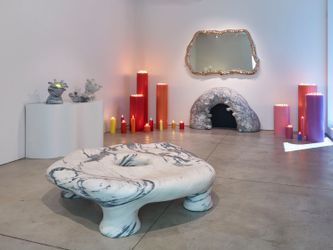
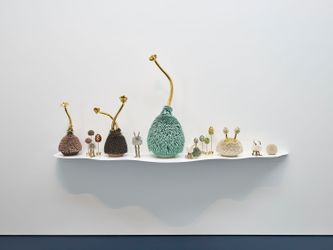
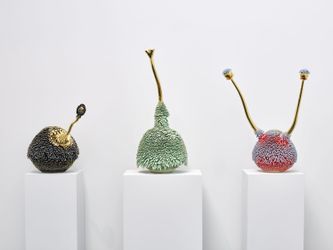
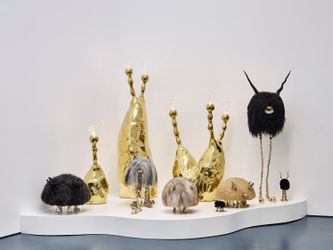
Across more than 15 years of practice, the Haas Brothers have become closely associated with riotously colourful biomorphic forms and furniture embellished with genitalia, fur, and pun-laden titles that disarm viewers while addressing desire, vulnerability, and bodily experience. Their objects often resemble mythic animals or plant-like organisms; rendered in materials such as porcelain, cast metals, wool, resin, and glass, these works invite tactile as well as visual engagement and frequently occupy a liminal space between sculpture, seat, and companion.
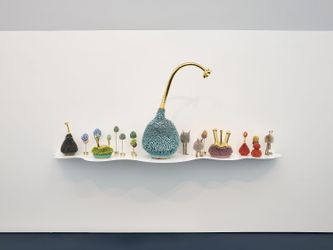
A key strand of their practice lies in intricately beaded sculptures, some encrusted with hundreds of thousands of Venetian or Murano glass beads laboriously applied in collaboration with specialised artisans. These works—including The Strawberry Tree (2023), whose cast-bronze trunk supports hand-beaded leaves and blown-glass strawberries—demonstrate the brothers’ investment in intensive craft processes and global networks of making, from glass studios in Seattle to stone workshops in Portugal.
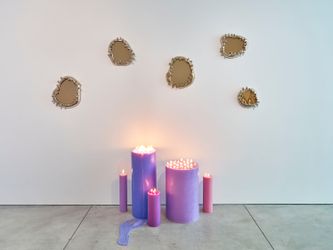
More recently, the Haas Brothers have developed painting and wall-based works that extend their vocabulary beyond three-dimensional design, signaling a growing presence in the contemporary art context separate from furniture and object design. These paintings and mixed-media pieces often carry forward their interest in speculative worlds and anthropomorphic forms, translating sculptural motifs into graphic, atmospheric compositions that further complicate distinctions between fine art, illustration, and decorative surface.
Uncanny Valley at MAD
Haas Brothers: Uncanny Valley is the artists’ first major mid-career survey, assembling around 85 works created between 2014 and 2025 to chart their evolution across sculpture, design, and immersive installation. The exhibition debuted at Cranbrook Art Museum in Bloomfield Hills in 2025 and is touring nationally, with the New York presentation opening at the Museum of Arts and Design (MAD) on 11 April 2026 and running through the summer.
At MAD, Uncanny Valley will present their genre-blurring practice in a sequence of vignettes that bring together major bodies of work, from early furniture-driven pieces to the beaded sculptures and recent paintings that underline their shift more fully into the contemporary art arena. The survey is accompanied by a substantial monograph—co-published by Cranbrook Art Museum and Monacelli Press—as well as a separate Phaidon book, offering extensive curatorial essays and visual documentation that frame the Haas Brothers’ role in the crossover between art, design, craft, and technology.
The Strawberry Tree and Recent Projects
Running concurrently with Uncanny Valley at MAD, Marianne Boesky Gallery will showcase The Strawberry Tree (2023) at its West 24th Street space in New York, reinforcing the artists’ presence within the city’s gallery landscape. Originally commissioned for their exhibition Moonlight at the Nasher Sculpture Center in Dallas and later highlighted as a special project at Design Miami, the life-size tree has become one of the Haas Brothers’ signature works.
The Strawberry Tree exemplifies their approach to ‘problem-solving fantasies’, a phrase often used to describe their process of engineering structurally complex, technically demanding works that nevertheless appear playful and otherworldly. Cast in bronze, wrapped in densely beaded foliage, and studded with internally lit glass strawberries, the sculpture distils many of the themes explored throughout Uncanny Valley: hybrid ecologies, the allure of ornament, and the emotional charge of objects that feel alive.
Themes, Ideas and Context
Throughout their practice, the Haas Brothers explore how fantasy and humour can open conversations about sexuality, identity, nature, and the subconscious without didacticism. Their zoomorphic and animistic figures suggest alternate ecosystems populated by creatures that are at once cute and unsettling, inviting viewers to reconsider conventional hierarchies between human and non-human forms.
The artists’ work is frequently described as ‘genre-blurring’, occupying a space where design history, craft traditions, pop culture, and speculative fiction coexist. By placing technically rigorous fabrication—casting, carving, beading, glass-blowing—at the centre of their practice, they align themselves with renewed interest in craft within contemporary art while also challenging assumptions about taste, kitsch, and the division between high and low culture.
Exhibitions and Recognition
Since establishing their studio in Los Angeles in 2010, the Haas Brothers have built a substantial institutional and gallery exhibition history that tracks their shift from collectible design to large-scale museum projects. Early solo presentations at Lora Reynolds Gallery in Austin (from 2012 onwards) and Marianne Boesky Gallery in New York (beginning in 2013) helped consolidate their reputation for genre-defying furniture and sculptural objects, while international fair appearances at Design Miami in the 2010s and early 2020s brought their biomorphic creatures and hybrid furnishings to a global audience.
A key milestone came with Ferngully at The Bass Museum of Art, Miami, which opened in 2018 as their first solo museum exhibition and transformed the galleries into an immersive environment of fantastical animal-like forms and dense sculptural landscapes. This was followed by solo presentations at institutions including the Katonah Museum of Art in New York State and the SCAD Museum of Art in Savannah in the late 2010s, and by the Nasher Sculpture Center’s exhibition Moonlight (11 May–25 August 2024) in Dallas, each expanding the scale and ambition of their installations. Their work has also appeared in group exhibitions at venues such as the San Jose Museum of Art, Anderson Ranch Arts Center, the Shelburne Museum, Sculpture Milwaukee, the Boca Raton Museum of Art, and KMAC Museum over the past decade, embedding their practice within a broader conversation around contemporary sculpture and craft.
In 2025, the opening of the mid-career survey Haas Brothers: Uncanny Valley organised by Cranbrook Art Museum in Bloomfield Hills, Michigan, marked a significant consolidation of this trajectory. The exhibition featured around 85 works produced between 2014 and 2025 and is accompanied by a monograph co-published by Cranbrook and Monacelli Press. Following its 2025 debut, Uncanny Valley will travel to the Museum of Arts and Design in New York (11 April–13 September 2026), then to the Blanton Museum of Art in Austin (September 2026–January 2027) and the Mint Museum in Charlotte (July 2027–January 2028), underscoring growing institutional demand for the brothers’ work across the United States.
In parallel with these museum projects, the Haas Brothers continue to maintain an active gallery programme. Recent exhibitions include presentations at Jeffrey Deitch in Los Angeles in the early 2020s, ceramic-focused shows with Carpenters Workshop Gallery around 2023–24, and special projects at Design Miami where works like The Strawberry Tree (2023) have been highlighted as signature pieces that bridge design and sculpture. The Nasher Sculpture Center’s 2024 exhibition Moonlight extended this trajectory outdoors, installing ‘Moon Towers’ and other illuminated sculptures across the museum’s garden and surrounding streetscape, with The Strawberry Tree emerging as a focal work that will subsequently be shown at Marianne Boesky Gallery in New York to coincide with Uncanny Valley at MAD in 2026.
The Haas Brothers FAQs
What are the Haas Brothers best known for?
The Haas Brothers are best known for their fantastical biomorphic sculptures, genitalia-adorned furniture, and intricately crafted objects that fuse art, design, and craft. Their work frequently combines humour and sensuality with meticulous fabrication in materials such as bronze, porcelain, glass, fur, and beads.
What is ‘Haas Brothers: Uncanny Valley’?
Haas Brothers: Uncanny Valley is the artists’ first major mid-career survey, bringing together around 85 works from 2014 to 2025 in immersive vignettes that trace their evolution across sculpture and design. After opening at Cranbrook Art Museum in 2025, the exhibition will be presented at New York’s Museum of Arts and Design, the Blanton Museum of Art, and the Mint Museum.
When and where can I see ‘Uncanny Valley’ in New York?
The New York presentation of Haas Brothers: Uncanny Valley will be on view at the Museum of Arts and Design (MAD) from 11 April 2026, running through the summer season. MAD will also host related events such as an artist talk and book signing that further contextualise the brothers’ practice.
What is ‘The Strawberry Tree’ (2023) by the Haas Brothers?
The Strawberry Tree (2023) is a life-size cast-bronze tree adorned with hand-beaded leaves and glowing blown-glass strawberries, conceived as a purely sculptural work that merges fantasy and rigorous craft. It reflects the Haas Brothers’ interest in light, ornament, and imagined ecologies, and will be exhibited at Marianne Boesky Gallery in New York in 2026 to coincide with Uncanny Valley at MAD.
How do the Haas Brothers use craft and collaboration in their work?
The Haas Brothers’ practice depends on intensive collaboration with specialised fabricators and craftspeople, from beadworkers to glass-blowers and metal casters. This network of expertise allows them to realise technically ambitious works whose apparent playfulness is underpinned by sophisticated material experimentation and engineering.
Ocula | 2026


Representative Artworks

Explore and Follow Artists Shaping Contemporary Art
A respected voice in contemporary art discourse.
Focusing on ambitious storytelling and insightful art-world commentary. Ocula Magazine publishes in-depth interviews, critical essays and timely analysis on the artists, exhibitions and ideas driving the global art world.
Learn more about Ocula Magazine
Showcasing the best of the art world.
Ocula partners with galleries from around the world to highlight their artists, artworks and exhibitions. Gallery membership is by application and invitation, with each member vetted by an independent panel.
Learn more about Ocula Membership
Specialises in the sale of major artworks.
Led by a team with deep ties to the world’s leading auction houses, galleries and collectors. Ocula’s advisory team offers bespoke services to high-net-worth clients from around the world who are looking to acquire the best of contemporary and modern art.
Learn more about our team and services