





VIJA CELMINS
b. 1938, LatviaCarnegie Prize-winning artist Vija Celmins’ meticulous drawings, paintings, print and sculpture bring to life the detail of nature, bringing viewers’ attention to the complexity of the visible world. Her painstakingly produced work has also been inspired by found photography and the ephemera of art-studio life.
Early Years
Vija Celmins was born in Riga, Latvia in 1938. Her family fled first to Stuttgart in 1944 and finally to Indianapolis (via New York) in 1948. As a child, she enjoyed collecting comics as a way of teaching herself to read English, although this also marked the start of a lifelong fascination with images. Celmins studied at the John Herron School of Art between 1955–1962, including a summer spent at Yale in 1961, where she met artists such as Brice Marden and Chuck Close. She gained her BFA from John Herron, followed by her MFA from UCLA in 1965.
Vija Celmins: Artworks
Post-graduation, Celmins found inspiration from her studio surroundings, using focus and observation to create muted, contemplative paintings. A key example is 1964’s Lamp #1, where the bulbs of the Pixar-esque desk light appear as bright, questioning eyes. Although nothing else features in the painting apart from the lamp, and the colour palette is based around tones of grey, the detail in the artwork creates a compelling image that invites meditation.
During the 1960s, Celmins began to use found imagery as a source for her artworks. Celmins wasn’t a Pop Artist but other 1960s artists (notably Andy Warhol) were making paintings of found images and objects. Celmins’ work was perhaps more reminiscent of René Magritte’s object paintings, although her chosen inspirational images often included violence, such as guns, riots and military aircraft (1966’s Suspended Plane).
She also diversified her practice into sculpture: Untitled (Comb) (1970) is a strong example of the meticulous nature of her work, made by drawing the shape of a comb on to wood, then hand-sanding it and adding many layers of lacquer to give the appearance of tortoiseshell.
Celmins’s artistic work continued to evolve: inspired by nature, she painted deserts, oceans and the surface of the moon. Continuing to use a monochrome palette, although adding hints of silver, Celmins has experimented with layering her pigments, sanding down in the canvas before applying another coat. During the 1990s she began the Night Sky series, bringing the vastness of the stars and their backdrop to relatively small-sized canvases.
Vija Celmins: Select Exhibitions
Select Solo Exhibitions
- Prints 1983–1985, Matthew Marks Gallery, New York City (2026)
- Fondation Beyeler, Basel (2025)
- Winter, Matthew Marks Gallery, New York City (2024)
- Glenstone, Potomac (2021)
- Ocean Prints, Matthew Marks Gallery, New York City (2019)
- Matthew Marks Gallery, Los Angeles (2018)
- Artist Rooms: Vija Celmins, The New Art Gallery Walsall (2018)
- To Fix the Image in Memory, San Francisco Museum of Modern Art (2018) (and touring)
- Secession, Vienna (2015)
- Intense Realism, Saint Louis Art Museum (2014)
- Double Reality, Latvian National Art Museum, Riga (2014)
- Artist Rooms, Tate Britain, London (2012) (and touring)
- Prints and Works on Paper, Senior and Shopmaker Gallery, New York City (2011)
- The Paradise, Douglas Hyde Gallery, Trinity College, Dublin (2003)
- The Prints of Vija Celmins, The Metropolitan Museum of Art, New York (2002)
- Gezeichnete Bilder (Drawn Images), Museum für Gegenwartskunst, Basel (2001)
- Anthony d’Offay Gallery, London (1999)
- Works 1964–1996, Institute of Contemporary Art, London (1996) (and touring).
- Prints, 1970–1992, Cirrus Gallery, Los Angeles (1994)
- Institute of Contemporary Art, Philadelphia (1992) (and touring)
- New Paintings, McKee Gallery, New York City (1988)
- Drawings and Painted Bronzes, McKee Gallery, New York City (1983)
- A Survey Exhibition, Newport Harbour Art Museum, Newport Beach (1979) (and touring)
- Felicity Samuel Gallery, London (1975)
- Complete Lithographic Works, 1970–1975, Broxton Gallery, Los Angeles (1975)
- Drawings, Whitney Museum of American Art, New York City (1973)
- Riko Mizuno Gallery, Los Angeles (1969)
- Dickson Art Centre, University of California, Los Angeles (1965)
Select Group Exhibitions
- Exposition Générale, Fondation Cartier pour l’art contemporain, Paris (2025)
- Land Sea Sky: Ingrid Pollard, JMW Turner and Vija Celmins, The Box, Plymouth (2024)
- Taking Space: Contemporary Women Artists and the Politics of Scale_, Pennsylvania Academy of the Fine Arts, Philadelphia (2021)
- America Will Be!: Surveying the Contemporary Landscape, Dallas Museum of Art (2019)
- Documenta 14, Kassel and Athens (2017)
- Take an Object, MoMA, New York City (2015)
- Pink Caviar, Louisiana Museum of Modern Art, Humlebaek (2012)
- Out of this World, Museum Pfalzgalerie, Kaiserslautern (2010)
- The Painting of Modern Life, Hayward Gallery, London (2007)
- From Here to Eternity, Ingleby Gallery, Edinburgh (2004)
- From the Observatory, Paula Cooper Gallery, New York City (2002)
- Paint / Land / Beauty, Northern Gallery for Contemporary Art, Sunderland (1999)
- Open Secrets: Seventy Pictures on Paper, 1815 to the Present, Matthew Marks Gallery, New York City (1996)
- Art for the Nation: Gift in Honor of the Fiftieth Anniversary of the National Gallery of Art, National Gallery of Art, Washington DC (1991)
- Individuals: A Selected History of Contemporary Art, 1945–1986, Museum of Contemporary Art, Los Angeles (1986)
- Great Big Drawings, Hayden Gallery, Massachusetts Institute of Technology, Cambridge (1982)
- The Decade in Review: Selection of the 1970s, Whitney Museum of American Art, New York City (1979)
- Painting and Sculpture in California: The Modern Era, San Francisco Museum of Modern Art (and Smithsonian American Art Museum, Washington DC (1977) *Surrealism is Alive and Well in the West, California Institute of Technology, Pasadena (1972)
- Paperworks, MoMA, New York City (1970)
- 13 Views of the West, Philadelphia Arts Council (1966)
Further Reading
- Vija Celmins’ Instagram
- Artist profile page at Matthew Marks Gallery
- Artist profile page at Tate Britain
Vija Celmins FAQs
What is the significance of the spider’s web in Vija Celmins’ work?
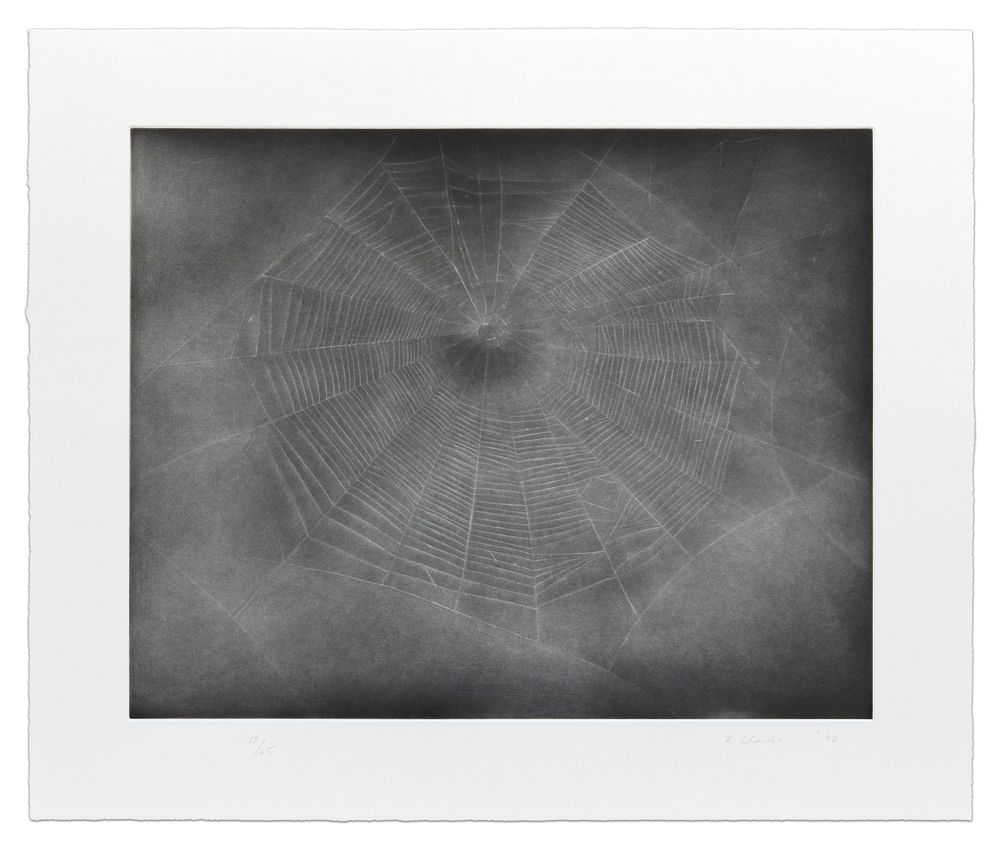
Celmins began to explore spiders’ webs from the 1990s, and she created a hyperrealistic series of works using charcoal, graphite, screenprints and mezzotints. She said in 2002: “Maybe I identify with the spider. I’m the kind of person who works on something forever and then works on the same image again the next day.”
How do stones feature in Vija Celmins’ art?
Between 1977 and 1982, Celmins produced a set of sculptures called To Fix the Image in Memory. These combined found stones with bronze casts of the stones, painted with acrylic to match their inspiration and asking viewers to examine what is real, and what appears to be.
How does Vija Celmins use photography in her practice?
Celmins’ meticulous approach to creating artwork translates into a thorough examination of her source images—whether these are found, or photographed herself. Even though her subject matter (oceans, deserts) often appears infinite, she concentrates on detail and adds variations as she creates her finished pieces.
Ocula

Explore Vija Celmins' Exhibitions




Explore and Follow Artists Shaping Contemporary Art
A respected voice in contemporary art discourse.
Focusing on ambitious storytelling and insightful art-world commentary. Ocula Magazine publishes in-depth interviews, critical essays and timely analysis on the artists, exhibitions and ideas driving the global art world.
Learn more about Ocula Magazine
Showcasing the best of the art world.
Ocula partners with galleries from around the world to highlight their artists, artworks and exhibitions. Gallery membership is by application and invitation, with each member vetted by an independent panel.
Learn more about Ocula Membership
Specialises in the sale of major artworks.
Led by a team with deep ties to the world’s leading auction houses, galleries and collectors. Ocula’s advisory team offers bespoke services to high-net-worth clients from around the world who are looking to acquire the best of contemporary and modern art.
Learn more about our team and services