





Jacqueline De Jong, Artist of Reinvention, Dies at 85

Jacqueline de Jong, Le Salo et les Salopards (Bastards and Scumbags) (1966). Acrylic on canvas, plastic mirror and wooden frame. Collection les Abattoirs, Musée-Frac Occitanie Toulouse. © Courtesy the artist and Château Shatto, Los Angeles (USA). Photo: Renato Elon Schoenholz.

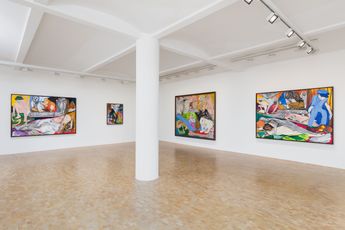
Jacqueline de Jong died in Amsterdam on 29 June following a brief illness.
Her practice, which included painting, printmaking, and sculptures of sprouting potatoes in silver and gold, received renewed interest in recent years, including exhibitions at Mostyn in Wales, Ortuzar Projects in New York, Galerie Lelong & Co in Paris, and Pippy Houldsworth Gallery in London, who are exhibiting works by De Jong through 10 July.
On Instagram, Pippy Houldsworth shared that ‘for over 60 years, Jacqueline was at the forefront of the European avant-garde, renowned for her raw and surrealistic expressions of contemporary life.’
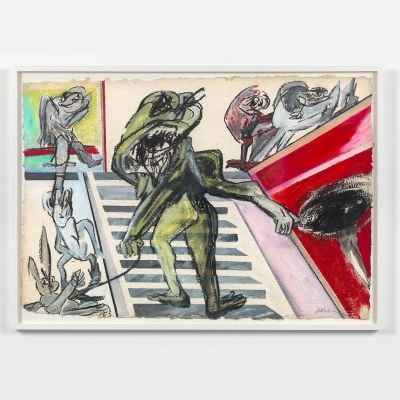
Born to Jewish parents in the Netherlands in 1939, De Jong fled to Switzerland following the Nazi invasion, but returned after the war.
In 1959, she met Danish painter Asger Jorn, a serial founder of avant garde movements—Cobra, International Movement for an Imaginist Bauhaus, and Situationist International, a Marxist collective concerned with capitalist uses of images.
De Jong and Jorn began a relationship that would last over a decade. When they were kicked out of Situationist International in 1962—after co-founder Guy Debord derided art as a commercial enterprise—De Jong founded the publication Situationist Times. Run from their apartment, the Times endured for five years, publishing issues based on shapes such as the knot or the labyrinth.
De Jong’s painting was guided by the Situationist notion of dérive, or drift, an openness to encountering her surroundings with all her faculties engaged—curiosity, sexuality, humour, morality, and so on.
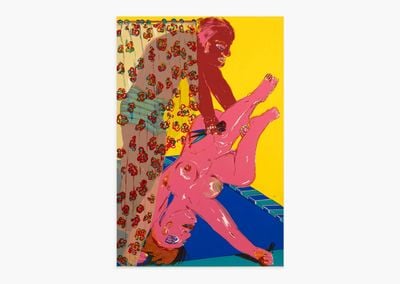
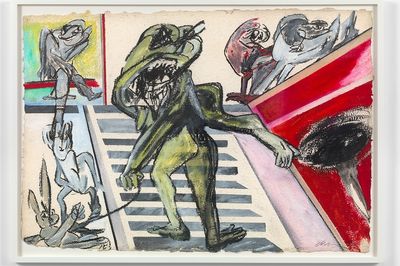
Her ‘Billiards’ (1970s) paintings—men with big sticks—were described as ‘a very sexual body of work’ by curator Devrim Bayar, while her ‘Série Noire’ (1980s) paintings of French paperbacks evoked something more mysterious than the tightly plotted mysteries of the texts.
Images from war zones have been a recurring theme in De Jong’s work, including paintings from photos of the Gulf War, and the invasions of Ukraine and Gaza.
‘It’s the images that really get to you,’ she told ARTnews in April.
Galerie Lelong & Co are exhibiting her prints in Paris through 13 July. They said that, following her death, ‘what remains is her work: rich, abundant and inventive, in the image of the free woman she always was.’ —[O]
Main image: Jacqueline de Jong, Le Salo et les Salopards (Bastards and Scumbags) (1966). Acrylic on canvas, plastic mirror and wooden frame. Collection les Abattoirs, Musée-Frac Occitanie Toulouse. © Courtesy the artist and Château Shatto, Los Angeles (USA). Photo: Renato Elon Schoenholz.




A respected voice in contemporary art discourse.
Focusing on ambitious storytelling and insightful art-world commentary. Ocula Magazine publishes in-depth interviews, critical essays and timely analysis on the artists, exhibitions and ideas driving the global art world.
Learn more about Ocula Magazine
Showcasing the best of the art world.
Ocula partners with galleries from around the world to highlight their artists, artworks and exhibitions. Gallery membership is by application and invitation, with each member vetted by an independent panel.
Learn more about Ocula Membership
Specialises in the sale of major artworks.
Led by a team with deep ties to the world’s leading auction houses, galleries and collectors. Ocula’s advisory team offers bespoke services to high-net-worth clients from around the world who are looking to acquire the best of contemporary and modern art.
Learn more about our team and services