





I’ll Be Your Mirror
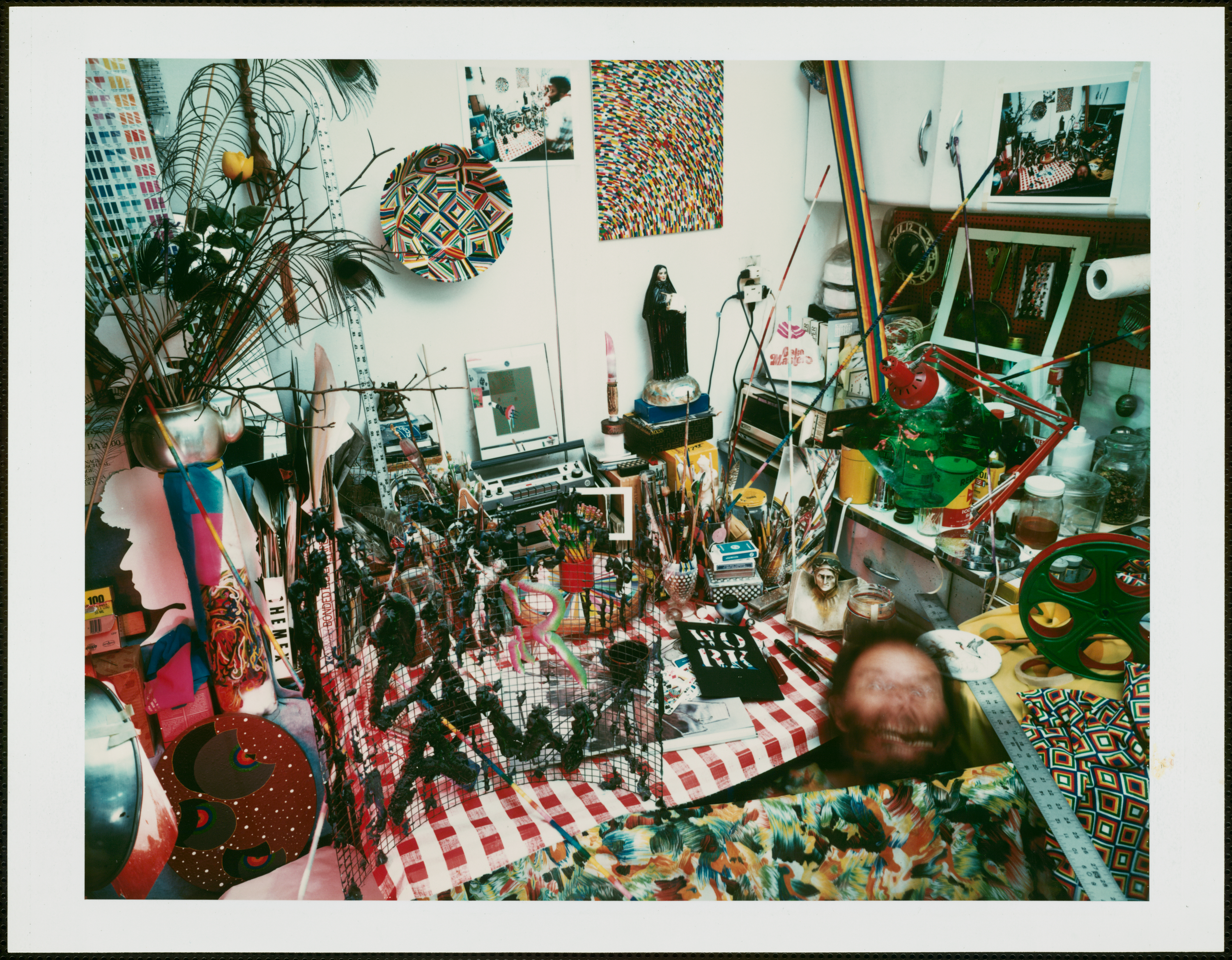
Four decades before the first selfie, Lucas Samaras was experimenting with ‘AutoPolaroids’ of his own face and body. But his photographs were more than portraits—they were explorations of identity. Save to My OculaHis kitchen table is his studio and it’s packed to the brim. Paintbrushes and religious figurines clutter the red-and-white chequered tablecloth, pushed all the way up to the kitchen counter, itself covered in cans containing grounds of the Nuyorican coffee of choice, Café Bustelo. There are decorative bowls, film reels, sculptural wiring and paint-colour swatches. This mess is intermedia as frenzy. And just as frenetic is the artist, caught crouching, peering out from under the table like Twin Peaks’ fictional antagonist Bob, mid-movement. Like, he can’t even pause for the flash of his own shutter. As if none of these methods can appease the visions that he harbours. Inserted here, he becomes material. But, conversely, the necessity of his inclusion in a studio still life speaks volumes.
It was in this manner that Lucas Samaras spent his days, a solitary, moustachioed dandy, high atop the 62nd floor of a midtown tower in New York City. The artist, who died in 2024 at the age of 87, purchased his West 56th Street flat in 1988. And there he embarked on an ascetic artist’s existence on Billionaire’s Row, dedicating scant energies to any sort of social life or the business of the world outside. Every inch was covered in work benches and material drawers. He laboured day and night to realise his works. Interiority became the prevailing subject for Samaras, whose lean into space reimagined Narcissus for late-stage capitalism.
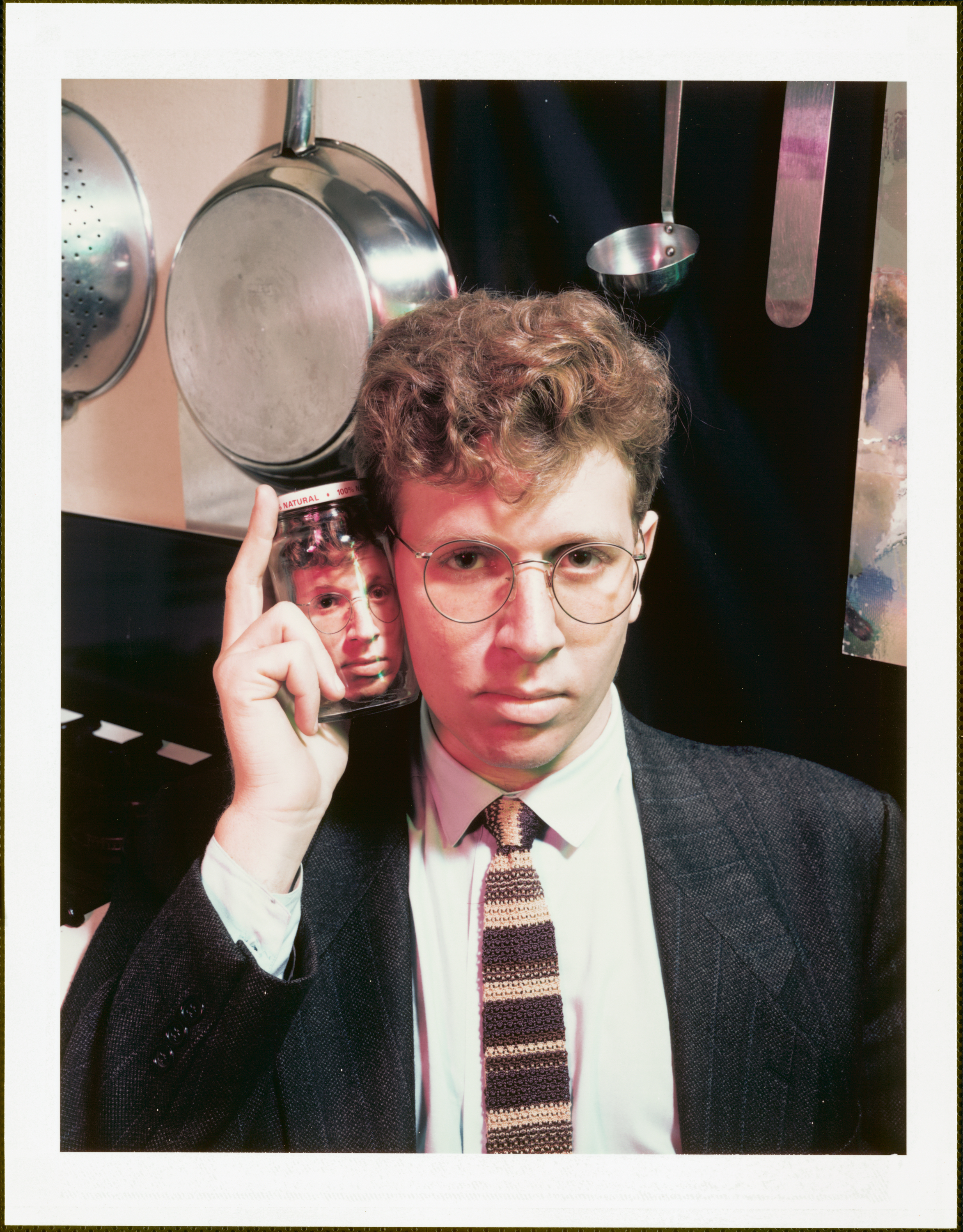
Born the son of a furrier in Kastoria, Greece, Samaras emigrated to New Jersey in 1948 aged 12. He studied at Rutgers University, at that time when it was the nucleus of the Happenings movement, which blended everyday life with avant-garde theatre to break down boundaries between artist and audience and entered the art world during a waning period of Manhattan modernity. He would pose as Abraham for a life-sized plaster sculpture by American artist George Segal. He was also cast in his professor, American performance artist Allan Kaprow’s origin performance event, 18 Happenings in 6 Parts (1959). There, Kaprow broke apart time as fragmented architecture. As Samuel R Delany has written of his own attendance at the event, the artist choreographed materials to abandon “the late romantic sensibility we call modernism”, replacing plenitude with something more “strenuous”.
These conceptual takes on space and home were fertile ground for Samaras, whose 60-year practice is currently the subject of a photographic exhibition at The Art Institute of Chicago curated by Grace Deveney. Lucas Samaras: Sitting, Standing, Walking, Looking emphasises the artist’s early work in analogue photography. This runs the gamut of approaches, from identity modulation to surface manipulation. AutoPolaroids (1969–71) crowd together 18 black-and-white glimpses at posturing, Samaras inventing different studio personae who mug for the camera 40 years before the popularisation of the selfie.
“In Samaras’ fledgling hands, identity feels far more fixed than we know today”
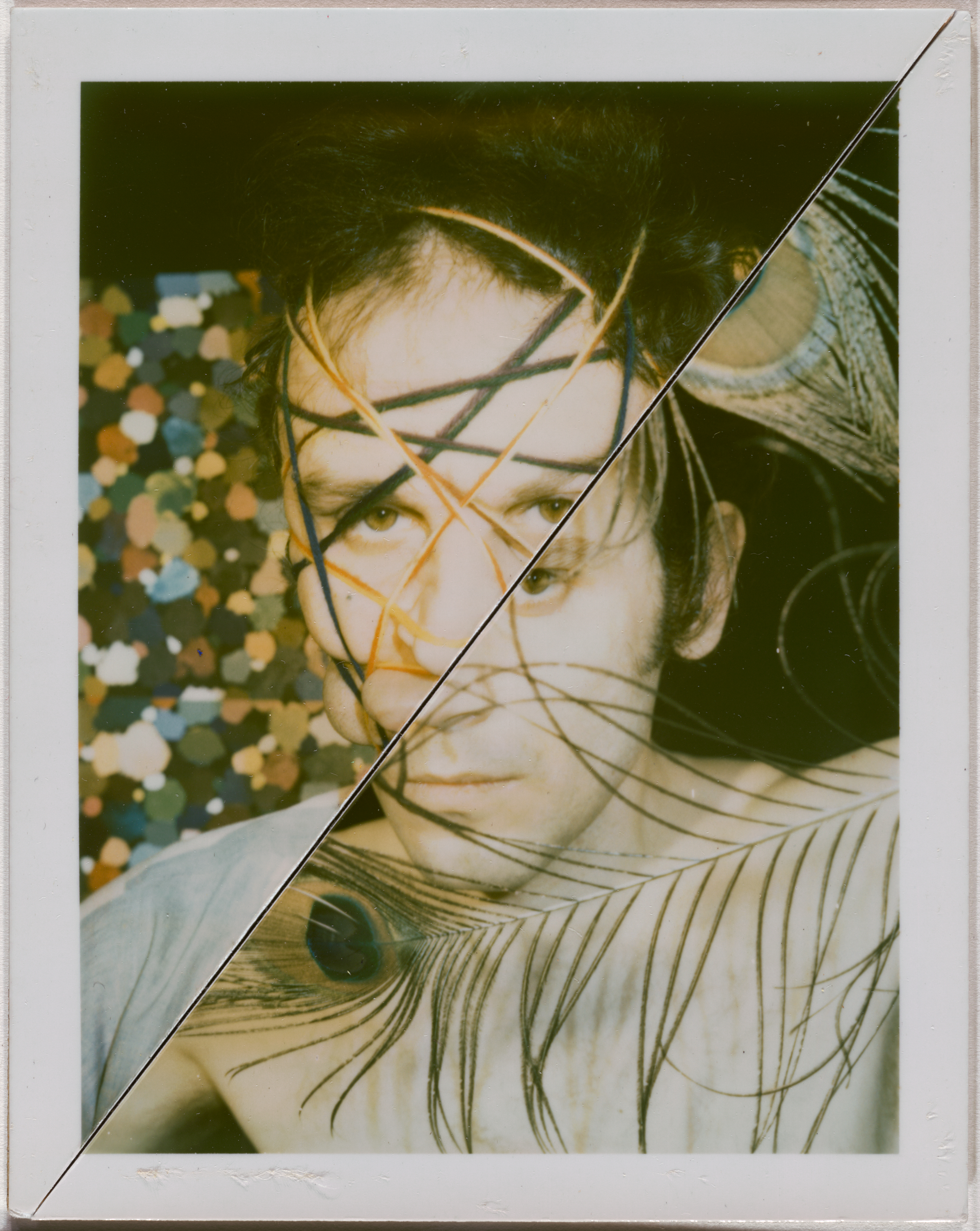
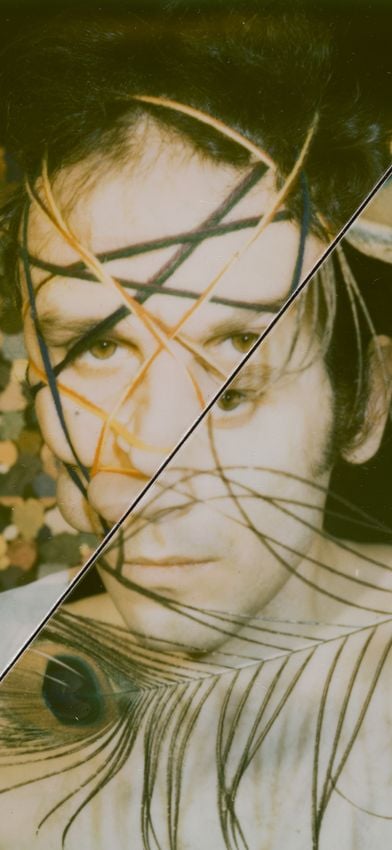
In Samaras’ fledgling hands, identity feels, as a construct, far more fixed than we know today; its forfeiture in his photographs recalls the outré self-invention styles mocked by the San Francisco genderfuck theatre group The Cockettes, founded in 1969, right at this fulcrum moment. Split (1973), a series of collaged works by Samaras in which two instant prints are fused together, bifurcates the artist’s self-portraiture with a sever, joining the two slashed snaps on the diagonal plane. In one of these works, Samaras’ head is bound in black and brown leather cord. Behind him is a sequined backdrop. The lower quadrant captures the artist shirtless, flirtingly filling the bottom of the frame with a peacock feather. It’s the artist’s gaze, rather than his face, that truly marries these two performances for the camera, a directness that cuts across the format (photography) towards a less medial meditation.
“This mess is intermedia as frenzy”
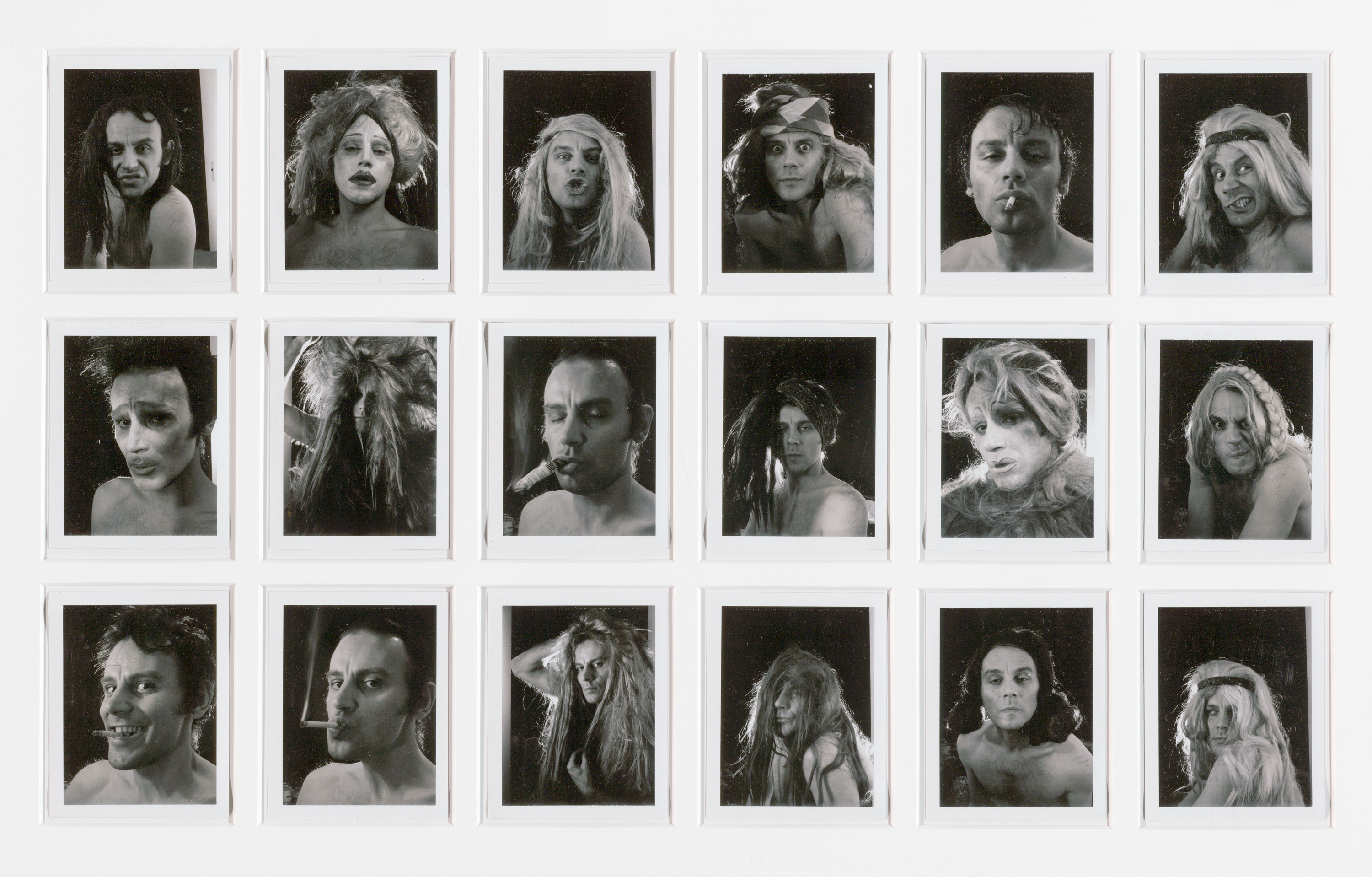
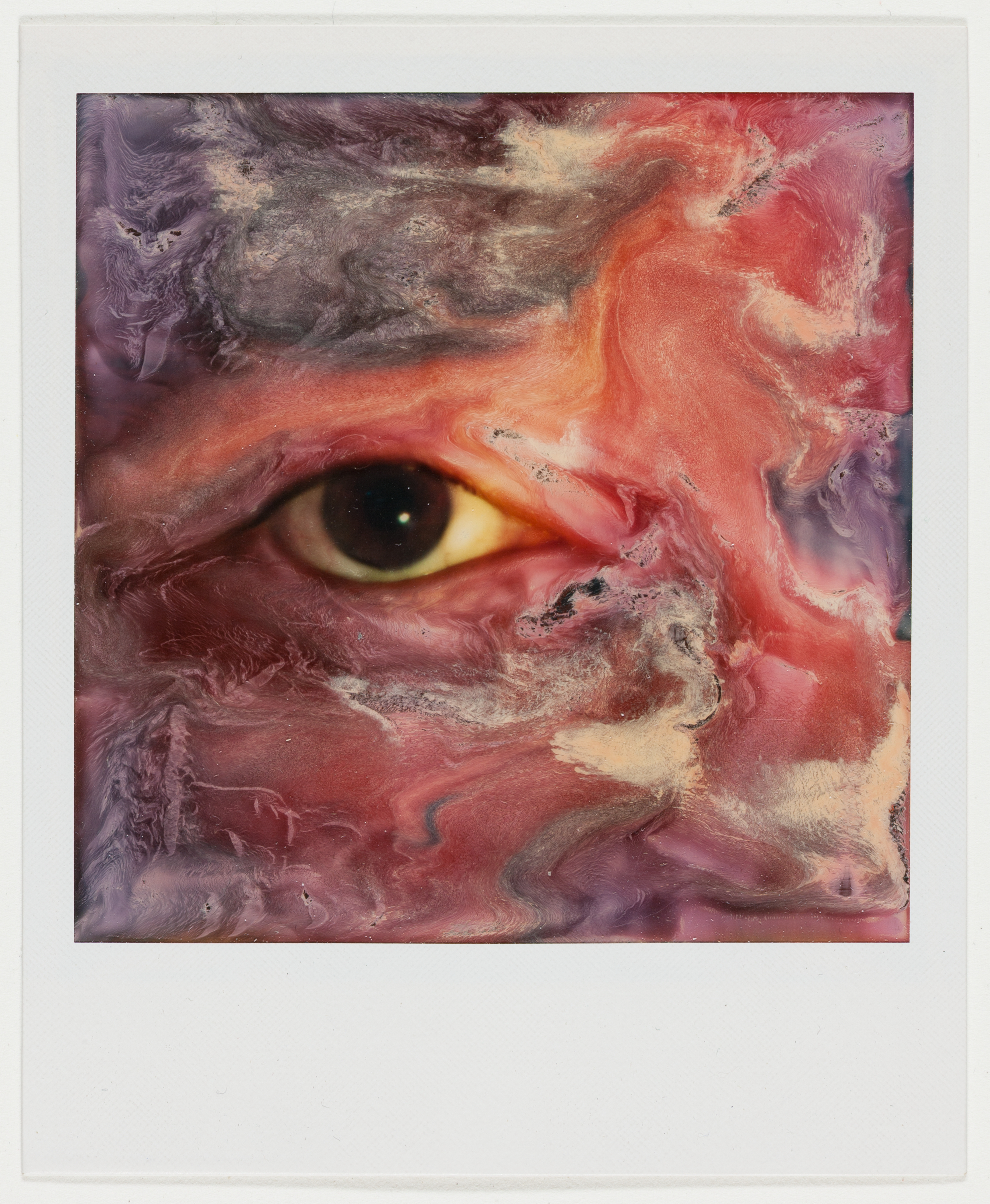
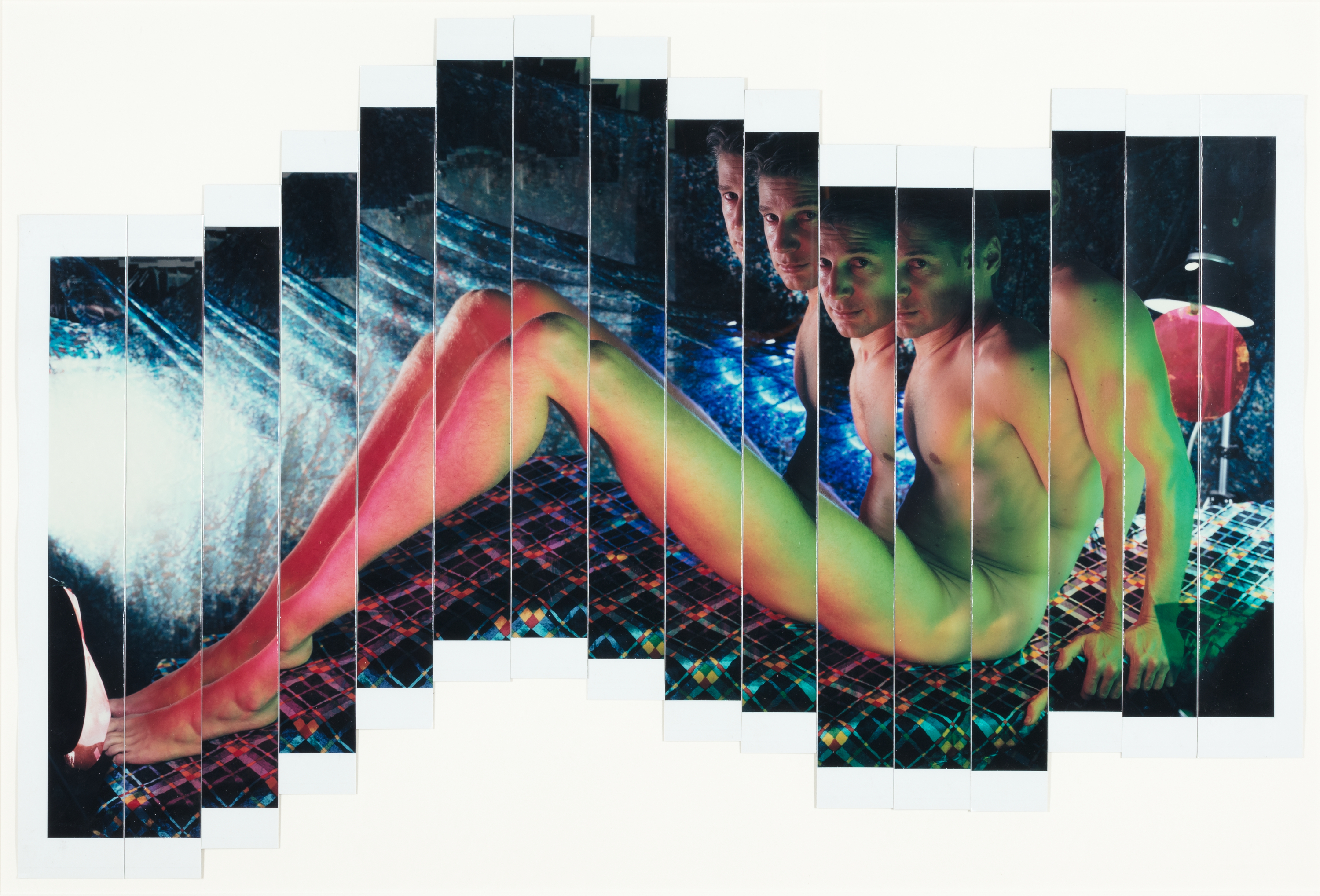
Which really feels like the point here. Working from the photograph’s material properties, Samaras mucked with the surface from the start of his photo explorations, the earliest of which is showcased in a hand-painted AutoPolaroid (1969–71) featuring the artist adorned in a loincloth of a commercially produced depiction of the Last Supper. The negative space around him is a swarm of red and green dots. Elsewhere, the artist’s manipulation of the photochemical surface conveys more ethereal dematerialisation. Producing beyond the surface, like spirit photography, these techniques push the apparatus for truths that conflict with the camera’s scientific integrity. Another black-and-white studio portrait from the same era features the artist in a double exposure of self-love.
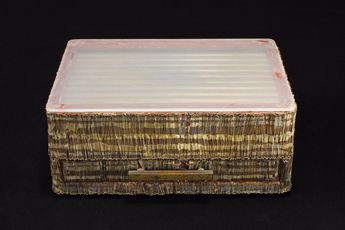
Absent from the Chicago exhibition are the meticulous boxes, for which the artist is perhaps best known. Bedazzled reliquaries of kitsch, they resemble his cluttered home studio. Tiny indexes of his antic prodigiousness, I have a hard time situating their aesthetics beyond a framework of queerness. Which, I think, is a crux of Samaras’ enduring project: to produce self-reflexive materials that push within, rather than culturally without. The artist was elusive and, by many accounts, asexual. Which makes for an easy leap to a number of influences on photography and video who are often accused of narcissism—performative American self-portraitists Cindy Sherman and Mark Morrisroe spring most readily to my mind.
“Samaras stares both outwards and inwards in self-obsessed wonder”
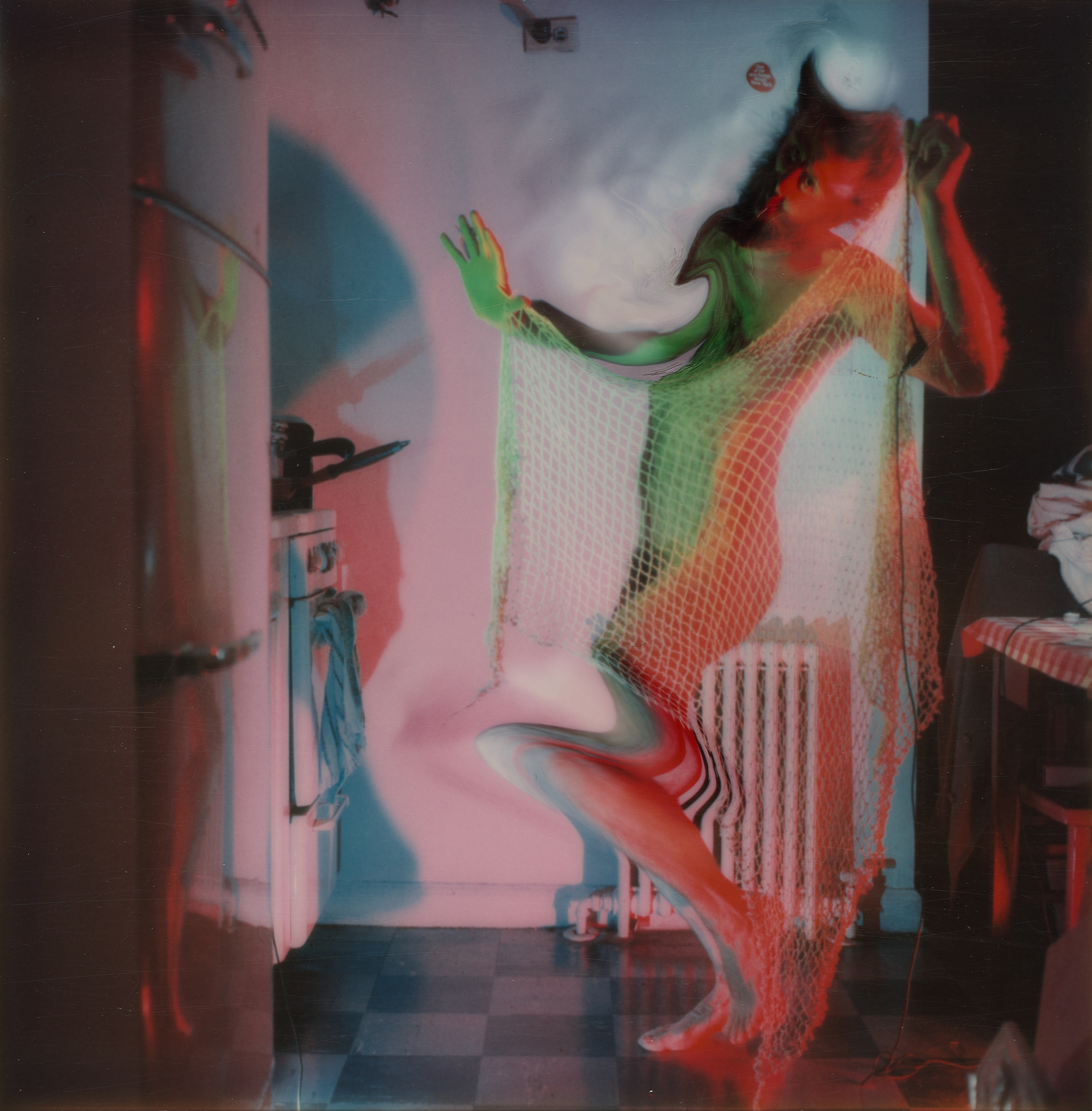
Painting the photographic emulsion into an abstracted whorl or blasting intensely-coloured studio lighting on to subjects (largely, himself) becomes Samaras’ dominant strategy in the works on view. And many photographs remind me of the “orientalist” studio portraits of experimental filmmakers Jack Smith or James Bidgood, the latter of whom released the dreamlike Pink Narcissus in 1971, which he shot using sets constructed entirely in his apartment. But, while those artists were inventing a visual imaginary or fighting to express the energies of their nascent queer undergrounds, the insistence in Samaras’ biography on a monastic artist’s life grounds betrays a kind of pre-social narcissism behind their imagistic drive. Samaras stares both outwards and inwards in self-obsessed wonder, not pursuing the jouissance of Bidgood’s erotic entanglements, but more so a theatre of the interior, a more primordial zone of id play and discovery.
In this way, these don’t feel like the queer fantasies that plumb worldly imagery, but evocative, elemental psychologies, and smeary phantasmagorias that work to deconstruct the nature of identity formation in culture. Samaras depicts a far more platonic zone, where light and colour presage meaning through abstraction. They offer a sensation of relief from the choreographed sex drive, and a diversion before, perhaps, one arrives to an integrated inscription of the self. —[O]
Main image: Lucas Samaras, Phototransformation (4 April 1976) (detail). The Art Institute of Chicago, gift of Lannan Foundation.





A respected voice in contemporary art discourse.
Focusing on ambitious storytelling and insightful art-world commentary. Ocula Magazine publishes in-depth interviews, critical essays and timely analysis on the artists, exhibitions and ideas driving the global art world.
Learn more about Ocula Magazine
Showcasing the best of the art world.
Ocula partners with galleries from around the world to highlight their artists, artworks and exhibitions. Gallery membership is by application and invitation, with each member vetted by an independent panel.
Learn more about Ocula Membership
Specialises in the sale of major artworks.
Led by a team with deep ties to the world’s leading auction houses, galleries and collectors. Ocula’s advisory team offers bespoke services to high-net-worth clients from around the world who are looking to acquire the best of contemporary and modern art.
Learn more about our team and services