





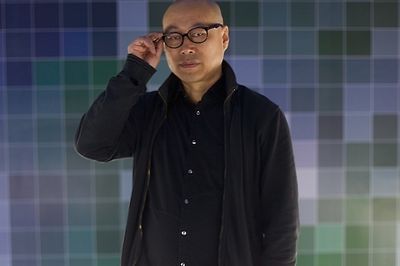
Following the Chinese artist Wang Guofeng’s recent intervention in the gallery space at de Sarthe Beijing, the artist has just opened a new show at de Sarthe Gallery, Hong Kong. While for the Beijing show (entitled Probe) the artist presented a large site-specific installation, for the Hong Kong exhibition (entitled Probe II), he presents a selection of his conceptual image works, focusing primarily on images of the Hong Kong protests.
Marking a shift in his method of production, these new works—from his Pixelated series—are created via the appropriation of images from the web. While the artist previously spent time staging his images, emphasising their visual impact and the subject, for Probe II the artist has ‘re-arranged’ the images, using computer software to pixelate them, creating vast prints that appear to be no more than a sea of multi-coloured squares, but which when viewed through a phone or from a distance combine to form a recognisable image.
In a world where we are overwhelmed with imagery, Wang Guofeng’s latest works enable the viewer to re-engage with images and help us make sense of an event. As a viewer, you are forced to pause and quite literally take a step back from the mass of pixels and look again; producing a sense of slowness in the engagement, which Wang Guofeng feels is not typically offered to viewers in contemporary society. It is through this process of re-composition the artist brings our attention to the nature and structure of the image.
You place considerable emphasis on the conceptual. Please could you explain what inspired you to make these works and the concept behind them?
When I first started, I was looking at Soviet architectural buildings and how they were symbolic of political systems. I really wanted to come and document the events taking place in Hong Kong during the 2014 protests, but I could not come. So instead I was really trying to see as much coverage on all sorts of different media and news channels, to look at the way the protests were rendered or translated into images.
On the internet in China I could only see low-resolution images, and didn’t have any access to larger high-resolution images. So I made those small images big using my computer, and because of the low-resolution when I made them big they ended up being pixelated. In my practice, from [the] beginning, it was never just about shooting an image, never just documenting. Every time I take a picture I am trying to render exactly what I want, and a concept behind it, so every time it’s not just a photograph. The resulting artwork is not just shooting a picture. Rather, I distinguish between the photograph and concept, with the concept being about treating the image, the very nature of the image, and how we receive it. So when I saw these images destructed by pixels, I realised pixels can be a language for re-treating and re-processing an image, and make us think differently about image.
No matter how we look at an image, each and every person will look at one image completely differently. I believe that whenever a picture is taken it carries the subjective perspective of the photographer, which takes the viewer further from the topic, and acts like a filter. Whenever we are in a certain context, the minute we step out of it we have a different perspective. With these works, initially they are large and pixelated, but if we use our phone we can redefine them, putting the pixels back together again, translating them to show a different interpretation.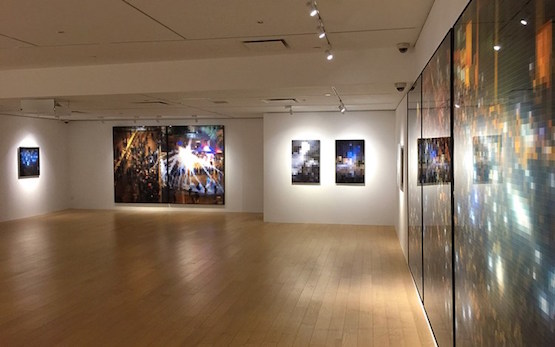
This exhibition follows on from your show earlier this year at de Sarthe Gallery Beijing, Probe, where you created a number of spatial interventions. How does this exhibition in Hong Kong of your conceptual images compliment and also develop from the previous exhibition?
Probe II in Hong Kong presents the works I created in 2014. In fact, the exhibition in Beijing stemmed and developed from the series shown in Hong Kong. This exhibition is actually [a] sequel to the show that opened earlier, and is still running at de Sarthe Gallery Beijing, Probe. The show in Hong Kong is also discussing and questioning the nature of [the] image.
Your earlier work was architectural photography. What motivated the shift in your practice from capturing photographs yourself to manipulating appropriated images?
The artistic language and methods are changing, but the message of my works, challenging political and social issues, has never changed. Therefore, concept and language are parallel and indispensable in my art practice. I am expressing my perspective, as well as discussing the creativity of the artistic language in a broader way. For the series showing in Hong Kong, the further you stand from the work, the better you understand its significance. While with my earlier works, you have to get closer to discover all the details of the landscape.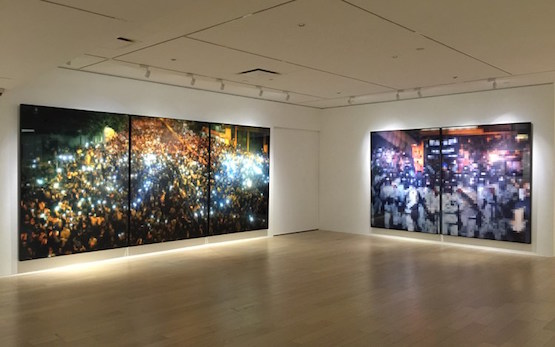
As mentioned a moment ago, your last two exhibitions have been interlinked, progressing from Beijing to Hong Kong. Will your next show follow on or will it be a new concept? If it will be different, where do you plan to go from here?
I have many ideas for future works, and I have not decided yet about the direction of my next show. It is likely I will present new concepts in the future. —[O]
Main image: Wang Guofeng. Image courtesy de Sarthe Gallery.




A respected voice in contemporary art discourse.
Focusing on ambitious storytelling and insightful art-world commentary. Ocula Magazine publishes in-depth interviews, critical essays and timely analysis on the artists, exhibitions and ideas driving the global art world.
Learn more about Ocula Magazine
Showcasing the best of the art world.
Ocula partners with galleries from around the world to highlight their artists, artworks and exhibitions. Gallery membership is by application and invitation, with each member vetted by an independent panel.
Learn more about Ocula Membership
Specialises in the sale of major artworks.
Led by a team with deep ties to the world’s leading auction houses, galleries and collectors. Ocula’s advisory team offers bespoke services to high-net-worth clients from around the world who are looking to acquire the best of contemporary and modern art.
Learn more about our team and services