





Wang Xingwei’s Tawdry Theatre of the Everyday
Ren Yue discusses how the artist’s latest exhibition at Galerie Urs Meile in Beijng is laced with both innocence and vulgarity. Save to My Ocula
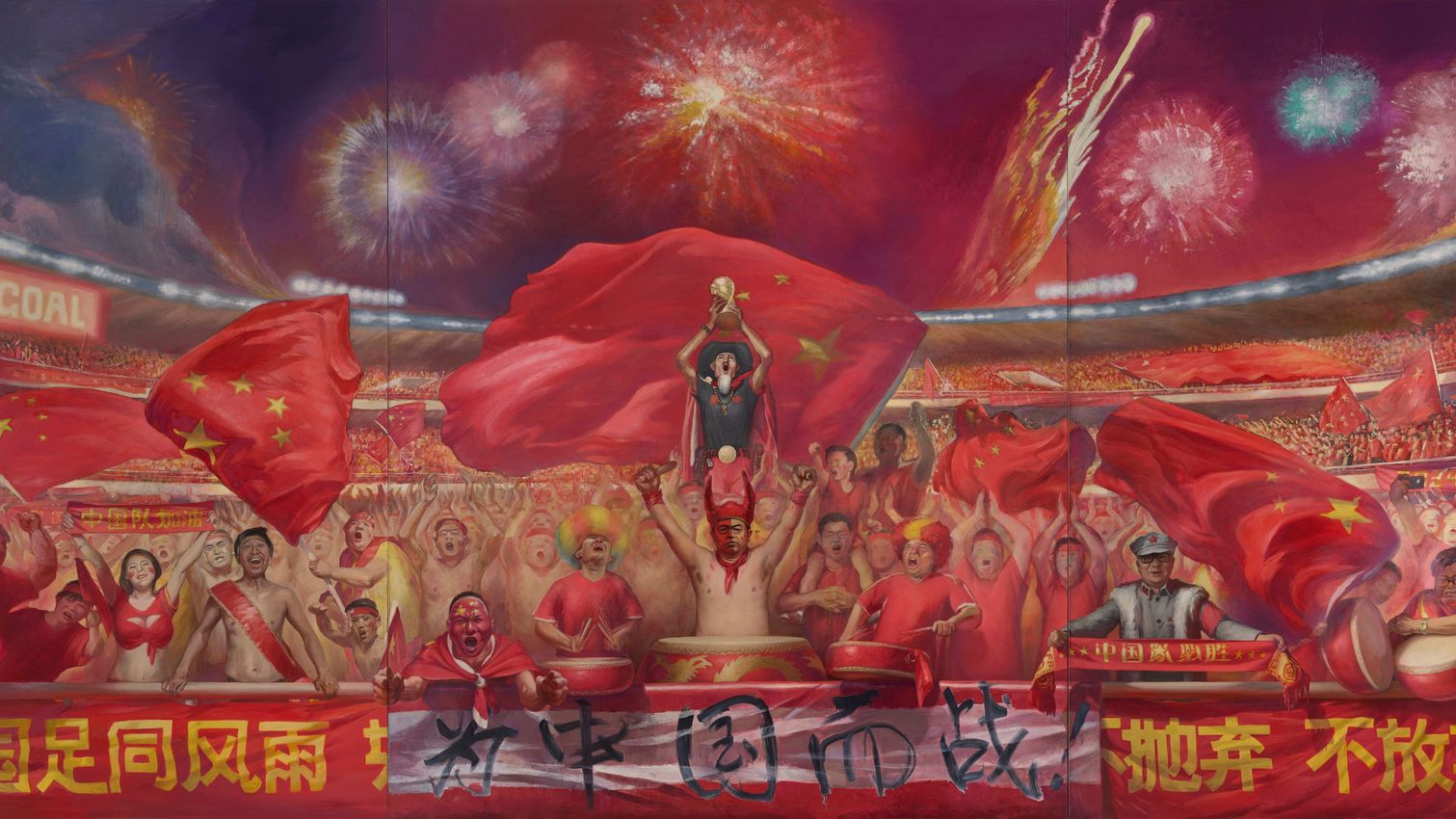
From half-naked male fans displaying their fervour on the soccer field, to elderly men taken care of by young women, the provocative scenes in Wang Xingwei’s exhibition at Galerie Urs Meile offer a characteristically oblique yet revealing inquiry into a much-despised breed of masculinity in Chinese society—one that blends misogyny with arrogance, often related to patriotism.
A leading figure in Chinese contemporary painting since the 1990s, Wang is known for his ironic reworking of socialist realist imagery and his embrace of a ‘bad painting’ aesthetic. Titled New Works, the show features a series of the artist’s latest oil paintings. Ranging in scale, they are marked by frozen gestures and overt theatricality, while demonstrating the isomorphism of the individual and the state.
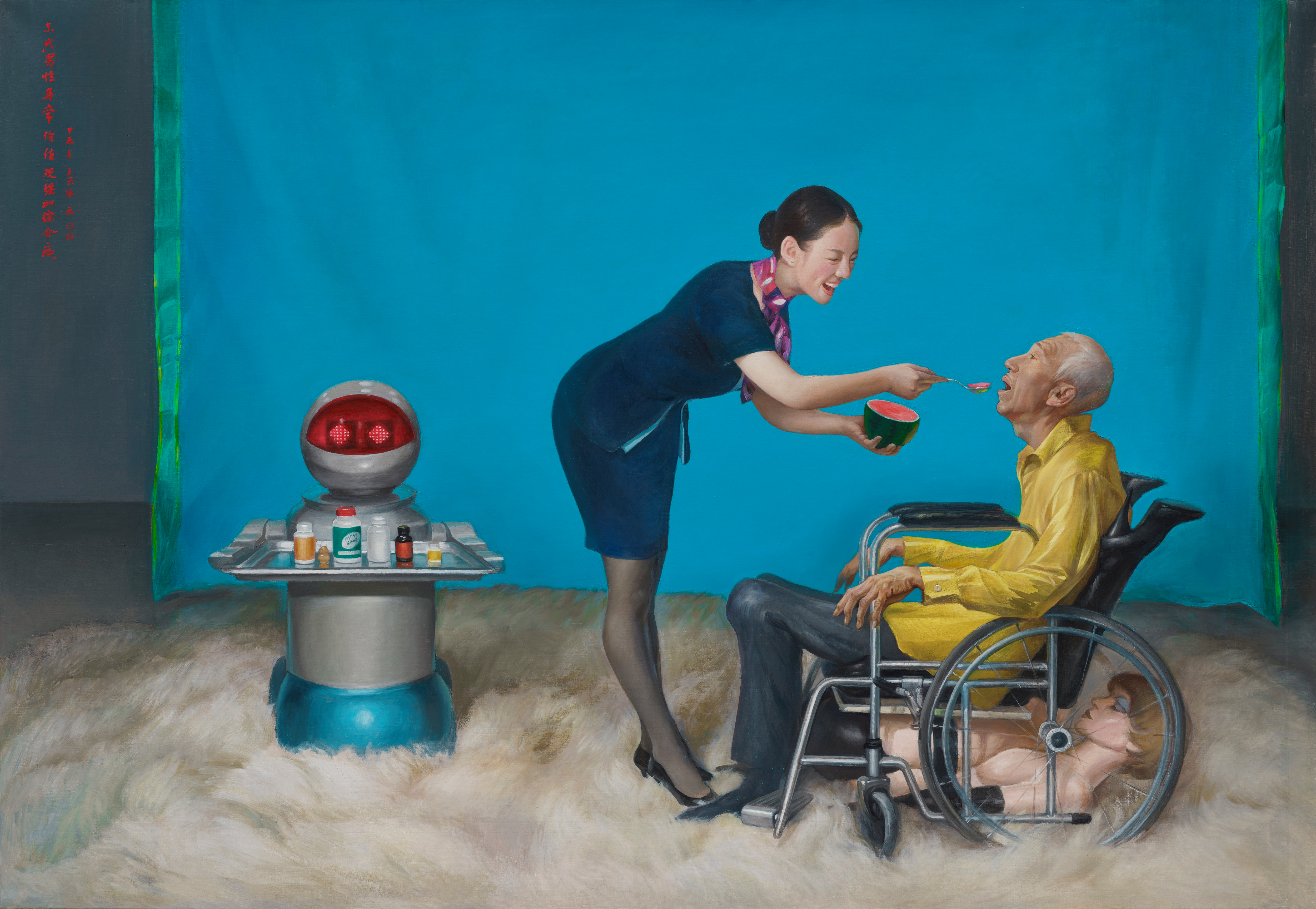
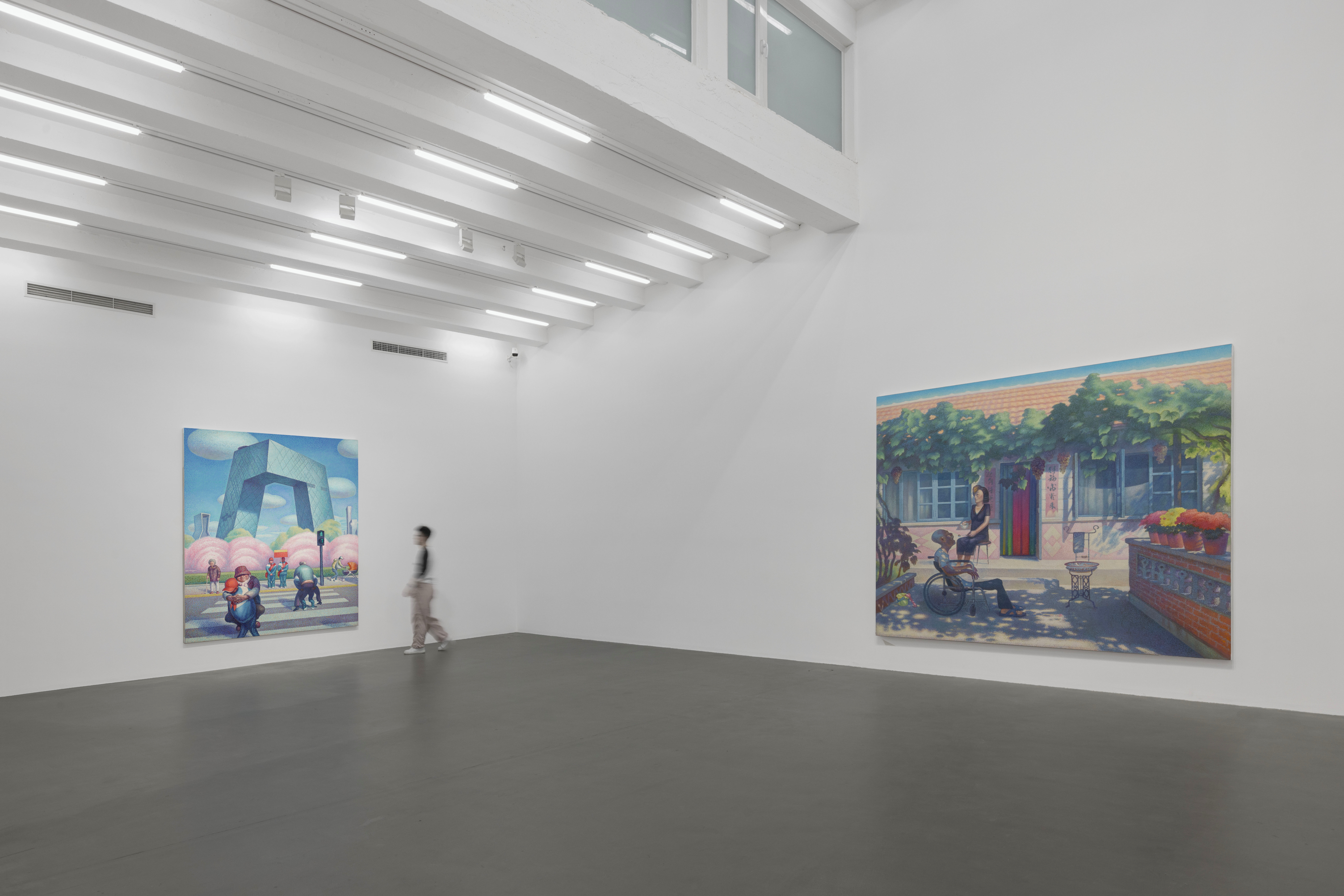
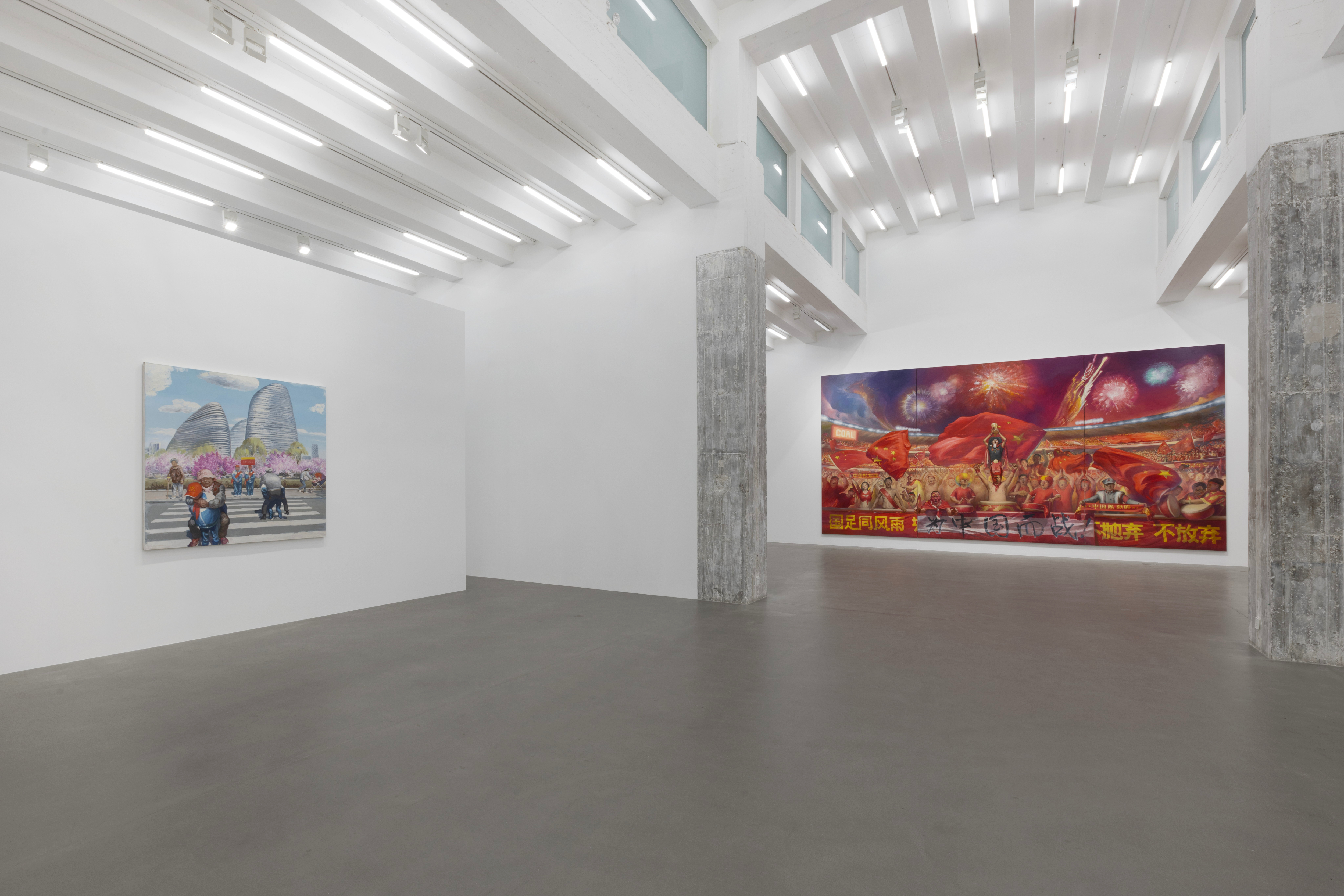
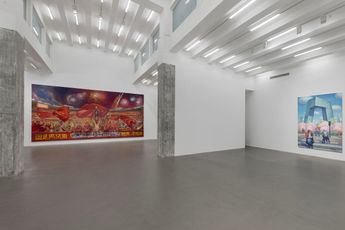
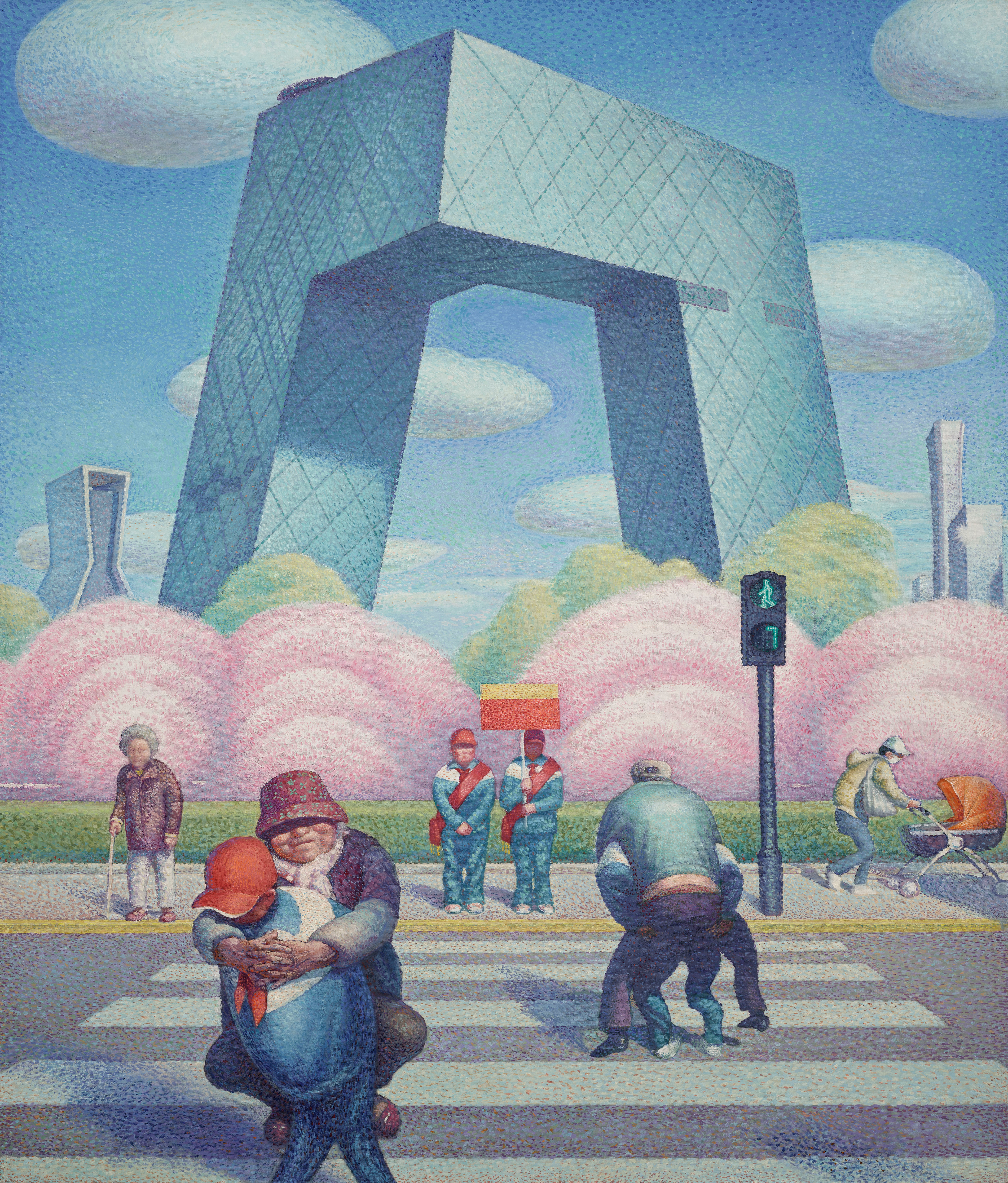
At Urs Meile’s entrance, Battle City (2014/2022) faces off against Last-Generation “Male Syndrome of Imposed Abnormal Values” (2024), forming an intriguing preface: a lone elderly man playing vintage video games turns his back on a man who is being tended to. The two works establish an immediate tension between historical absurdity and contemporary neurosis. This tension is developed in the central hall, where two paintings depicting moments of guidance at urban crossroads are set against iconic Beijing landmarks: ‘Big Pants’ (nickname for China Central Television Headquarters) and Wangjing Soho. The figures are borrowed and re-scripted from the artist’s own visual lexicon, together amplifying scenes of public virtue. Mutual aid, as championed by the ‘core socialist values’, is evoked here, albeit with a touch of irony.
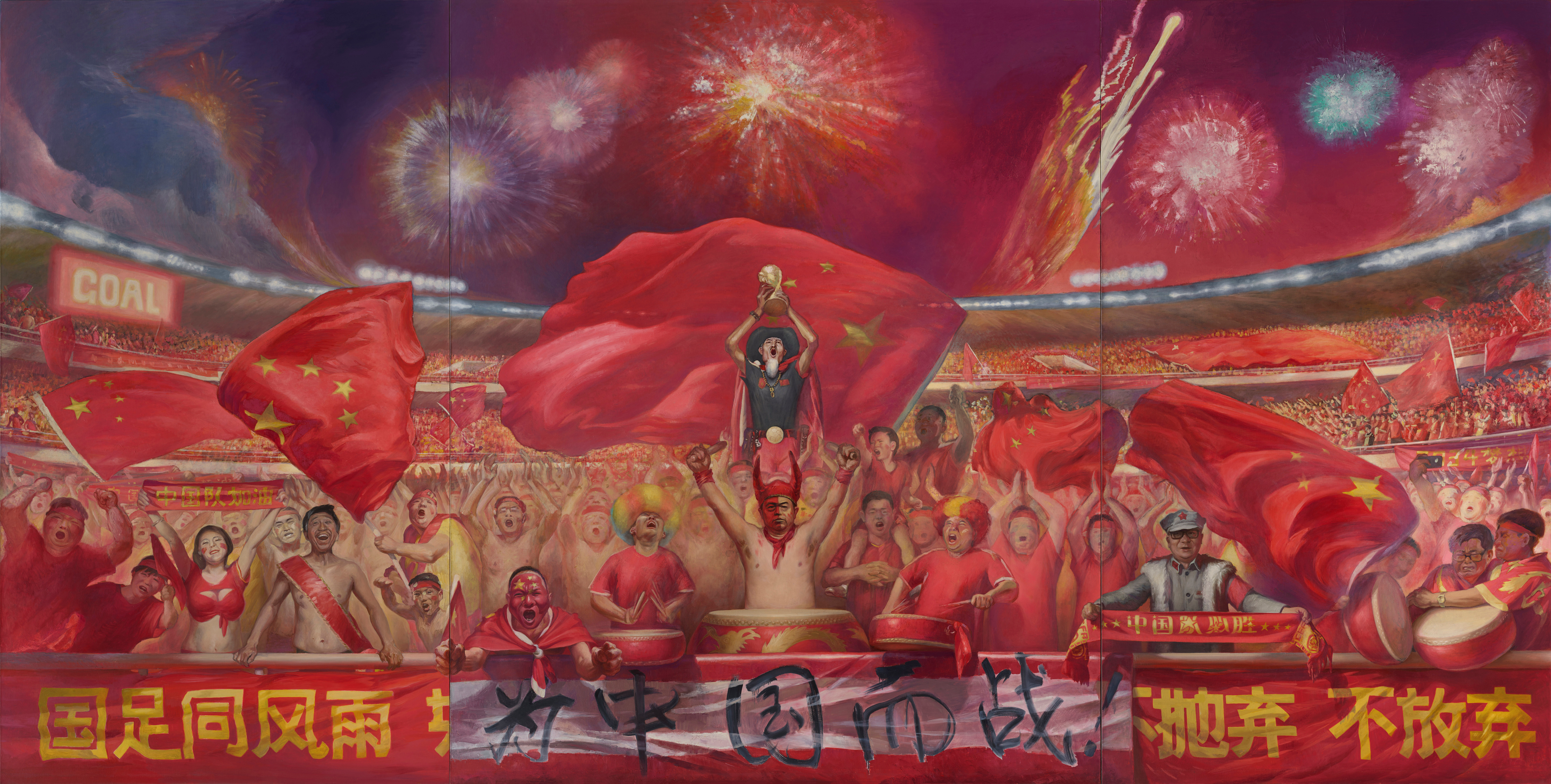
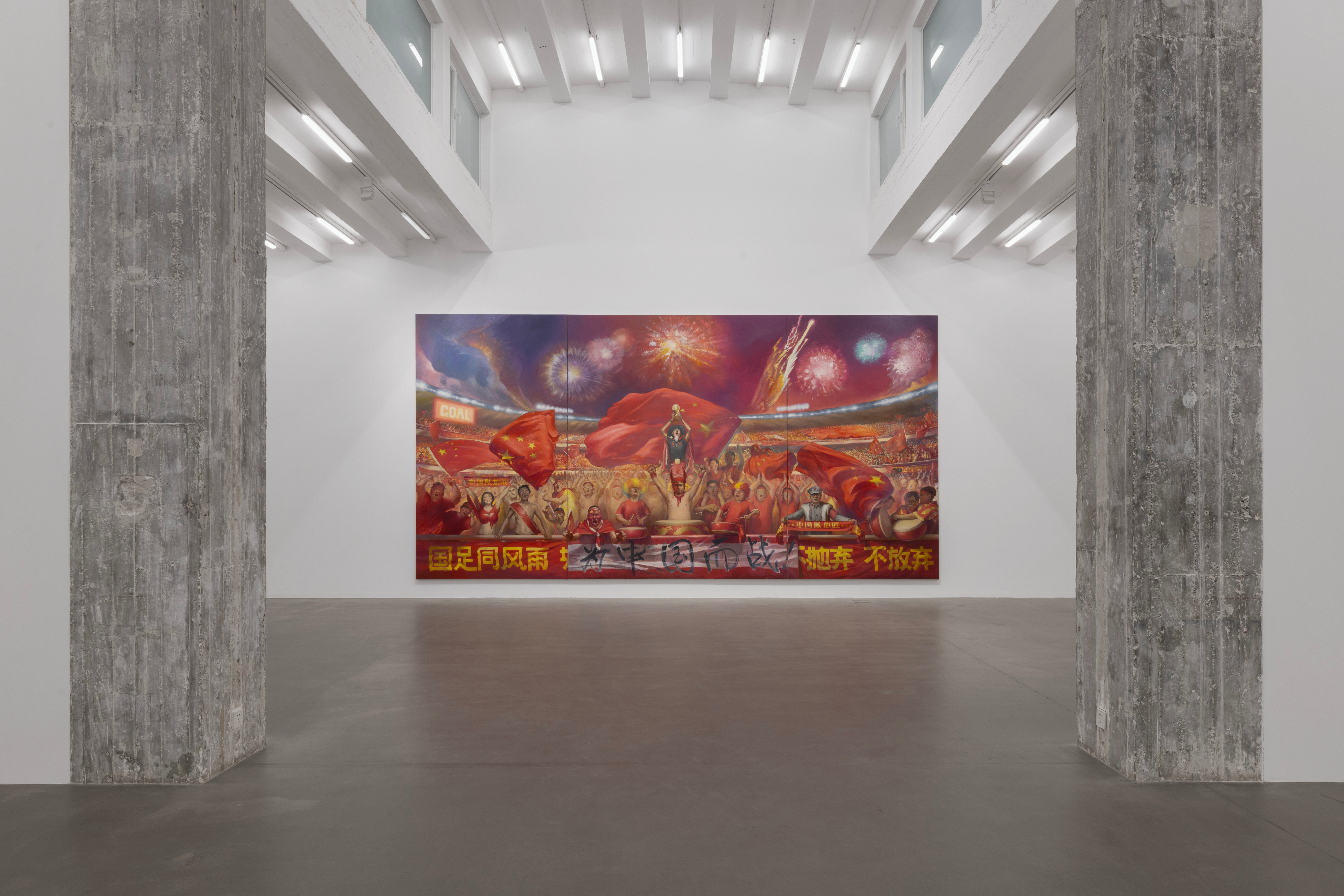
The theatricality culminates in a monumental triptych depicting a grand ceremonial scene with clearly recognisable elements: fireworks, a trophy, China’s national flag, banners full of combative yet empathetic words to cheer up the national men’s football team. With its dark red hues, Chinese Soccer Fans (2024) is marked by Wang’s characteristic mix of anachronous absurdities—people cluster together in subtle friction, suggesting not unity but crowding, not allegory but choreography. Wang seems less interested in describing societal masculinity than in dramatising its semiotic confusion—how roles are inhabited, misread, and ultimately exhausted.
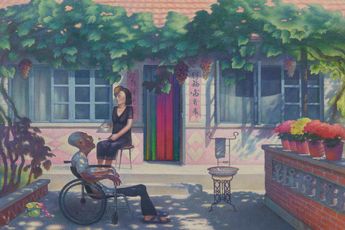
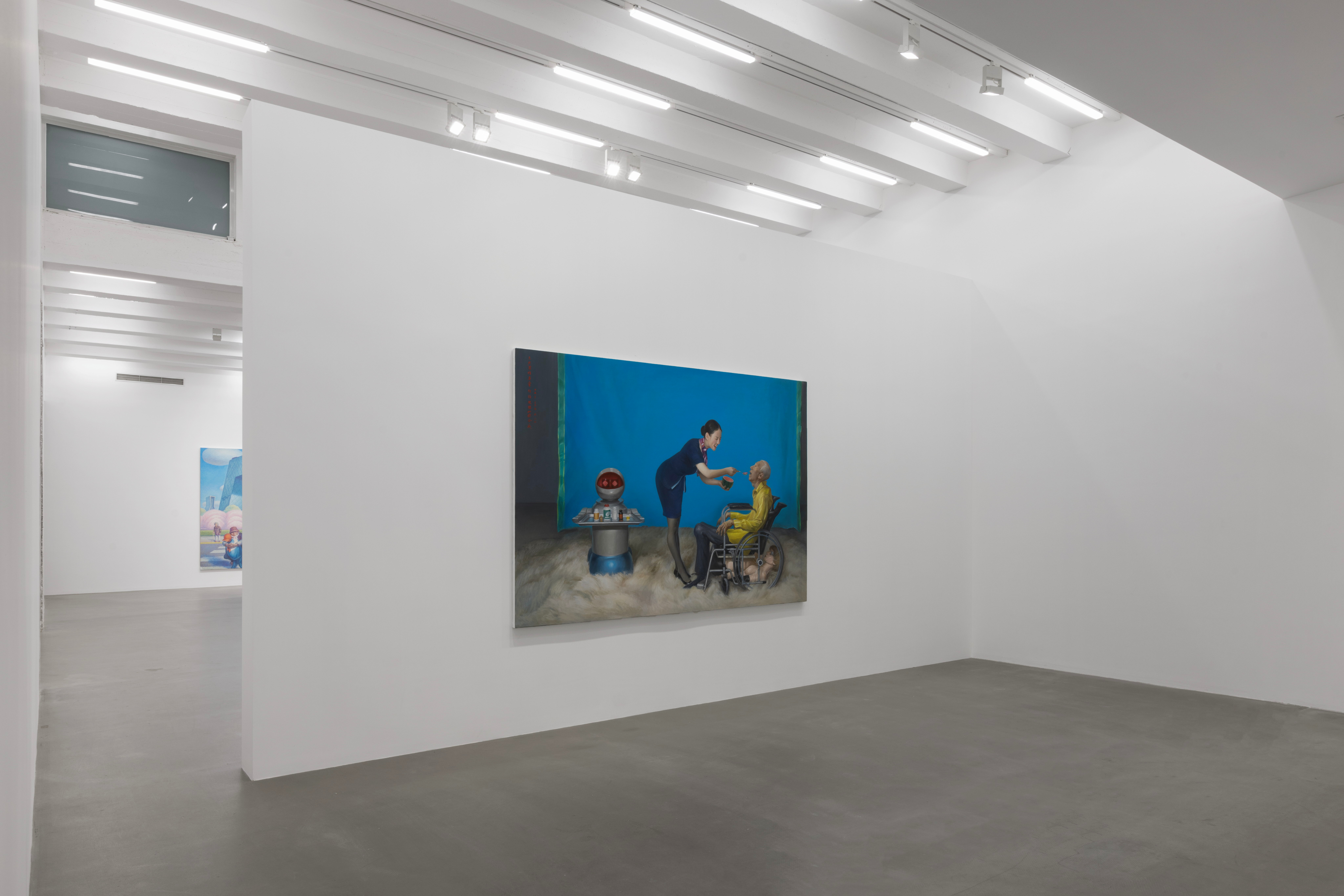
Most intriguing of all are two works that depict weirdly intimate dyads formed around acts of care between young women and elderly men. Rendered in a pointillist style, A Devoted Daughter-in-law (2024) reflects the ambivalence of familial roles, drawing its projected utopian tableau into an ambivalent register of intimacy and care. Last-Generation “Male Syndrome of Imposed Abnormal Values” (2024) seems to dramatise the artist’s time-warped lament: a beautiful female mannequin torso, barely visible beneath the man’s wheelchair, and a young woman in a flight attendant uniform, feeding him, each present an archetype of male desire: the caregiver and the mute, ideal body. Together, these works stage a performance of the social identity of young women and elderly men as both overdetermined and absurdly under-explained.
What binds Wang’s works is a particular mode of humour, one that resists both laughter and analysis. Those familiar with Wang’s practice might recognise this humour not as a punchline, but a residue: an awkward smudge left after history, ideology, and our spoiled eyes collide. His casts of characters—pilots, monks, flight attendants, socialists—are seen in costume, but their roles are evacuated of function; they are avatars of cultural misalignment. In this sense, Wang’s humour is not spontaneous but socially constructed. It arises from a very specific cultural position, forged by a collapsing socialist visual culture and rapid commodification of images in post-1980s China. That said, Wang’s painterly language oscillates between the solemnity of state aesthetics and the gaudy optimism of 1990s advertising, but instead of sustainable reconciliation, what emerges is a jarring friction that resists resolution.

A crucial part of Wang’s strategy is his use of ‘梗’ (geng)—memetic fragments, shared motifs, and quotes populate his paintings. From uniforms, a flowering courtyard, and an old-fashioned basin rack to the almost defiant masculinity, these are not symbols in the classical sense but mnemonic prompts accessible only to those who have lived through certain cultural regimes. Each painting is a signal to a viewer who knows. But the knowing is partial, always suspended between recognition, forgetfulness, and suspicion.
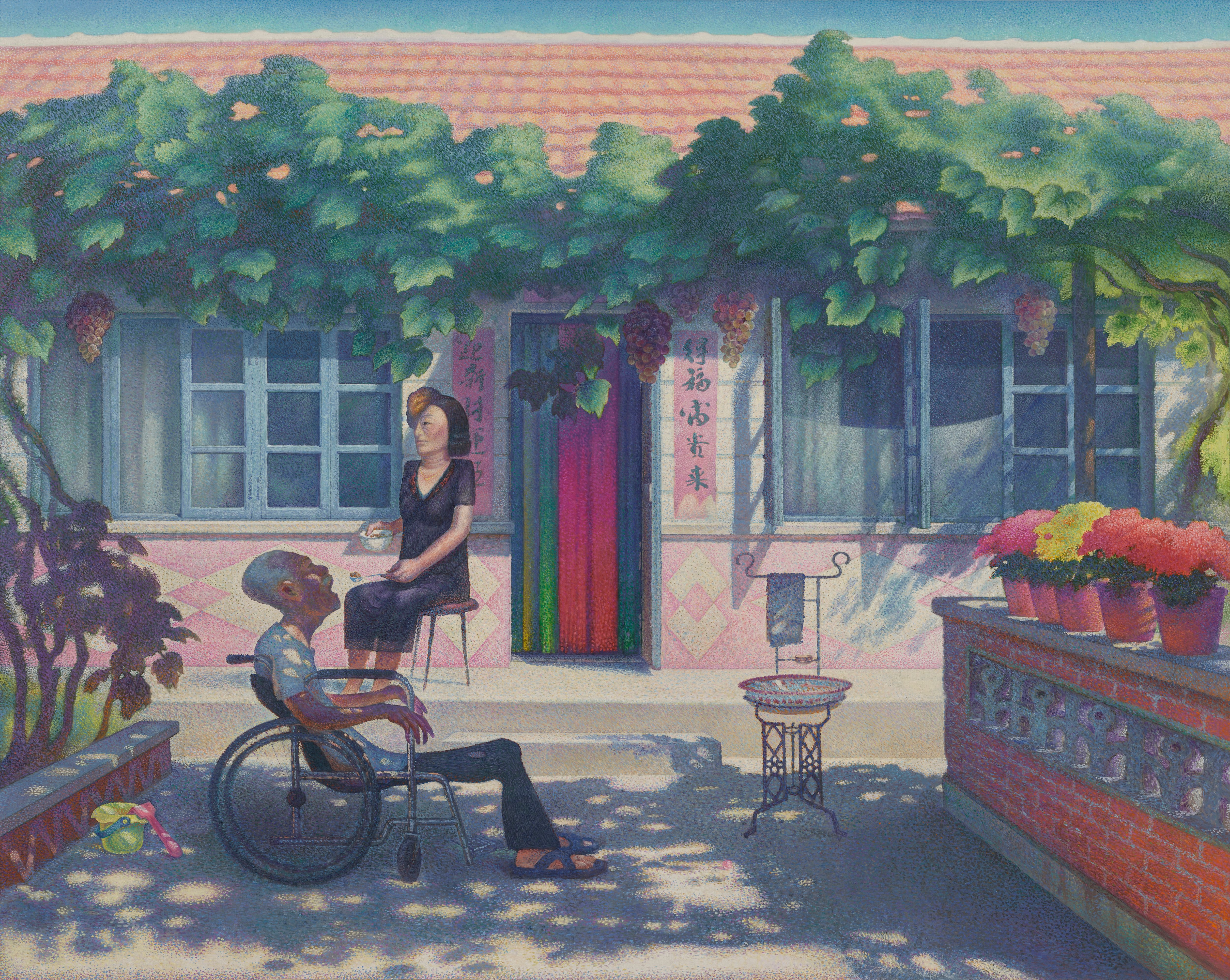
Close up, a subtle visual plot unfolds across both A Devoted Daughter-in-law and Last-Generation “Male Syndrome of Imposed Abnormal Values”; in each we see young women feeding elderly men who appear immobilised, even though the composition of the former work complicates this gesture by disrupting normal spatial continuity. And in Chinese Soccer Fans, Wang places his own parody next to a full-busted cheerleader—here the female figure is rendered mere visual ornament, titillating but voiceless.
Read together, the daughter-in-law, flight attendant, and voluptuous fan girl all suggest that Wang’s staging of Chinese masculinity is in fact contingent on the presence of women—not as subjects, but as props. In this light, masculinity ludicrously becomes a performance necessitated by the silent labour of the feminine. Far from autonomous, the artist’s male figures depend on this gendered backdrop to appear coherent at all. Still, Wang’s visual language is not reducible to gender performance. His work forces the viewer into a state of aesthetic discomfort—one that is neither ironic nor sincere, but unsettlingly in-between. —[O]
Wang Xingwei: New Works is on view at Galerie Urs Meile in Beijing from 21 May through 3 August 2025.
Main image: Wang Xingwei, Chinese Soccer Fans (2024) (detail). Oil on canvas. Three panels 350 × 690 cm (each). Exhibition view: New Works, Galerie Urs Meile, Beijing (21 May–3 August 2025). Courtesy the artist and Galerie Urs Meile.






A respected voice in contemporary art discourse.
Focusing on ambitious storytelling and insightful art-world commentary. Ocula Magazine publishes in-depth interviews, critical essays and timely analysis on the artists, exhibitions and ideas driving the global art world.
Learn more about Ocula Magazine
Showcasing the best of the art world.
Ocula partners with galleries from around the world to highlight their artists, artworks and exhibitions. Gallery membership is by application and invitation, with each member vetted by an independent panel.
Learn more about Ocula Membership
Specialises in the sale of major artworks.
Led by a team with deep ties to the world’s leading auction houses, galleries and collectors. Ocula’s advisory team offers bespoke services to high-net-worth clients from around the world who are looking to acquire the best of contemporary and modern art.
Learn more about our team and services