





House of Braka
The inimitable British art dealer and collector Ivor Braka opens the door to his new home in London, filled with the delights of a lifetime of influential collecting, and reflects on a career surrounded by art. Save to My OculaThe house of Ivor Braka is high-Victorian, opulent, and exactly what he wanted. ‘Impractical for a family; perfect for a party,’ he declares. Built by Sir Ernest George in 1886 the house was designed for businessman Thomas Andros de la Rue, a printer of postage stamps, banknotes, and playing cards. Its position on the street at number 52 was no accident, honouring the number of cards in a standard deck. Wedged between its red-brick neighbours in Chelsea, the five-storey Northern Gothic building exudes an eccentricity that matches that of its latest resident.
Braka represents a bygone era in the art world, when you turned up to openings on Cork Street in the early 1980s dressed in a suit and tie, drank lots, and quarreled more, revelling in the cut and thrust of a pavement debate. He was buying works by artists like Francis Bacon and Lucian Freud, not because they were fashionable, but because he’d read about them, and liked them, and that was enough. His opinions have remained trend-free, much like his style, which has not changed since leaving school: leather waistcoat, blue-striped shirt, and black skinny jeans. Today is no different.
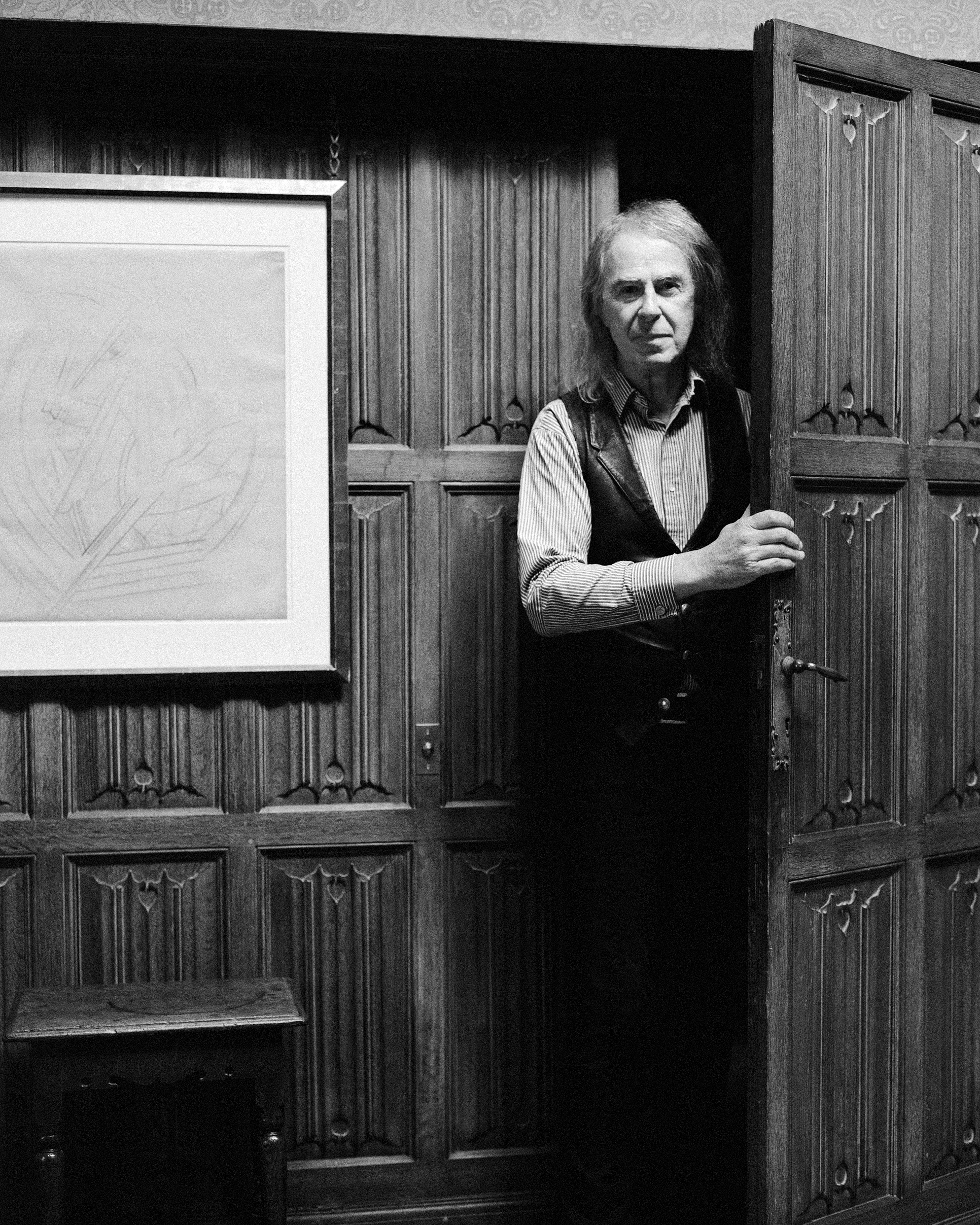
Braka invites us to join him upstairs in the billiard room. He takes a seat on a sofa, his back to a stained-glass window. On a coffee table next to him is a lamp designed by Quentin Bell. Tournaments are umpired under the auspices of paintings by Walter Sickert, Edward Wadsworth, and Vanessa Bell. Opposite stands an Elizabethan cupboard given to him by his mother.
At 70 years old, Braka is tall and slender, with a full head of grey hair that he keeps shoulder-length. His eyes, which have a wicked mischief, suddenly spark into action as he assumes a position behind a wooden lectern in the corner of the room, launching into an unsolicited roleplay as host to a drinks party in aid of the Royal Osteoporosis Society—a responsibility he assumed in earnest in 2019 at his old home across the street. Just as suddenly, they sharpen in thoughtful scrutiny as he rattles off recent auction results, dissecting the increasingly distorted prices paid for the work of overly hyped contemporary artists. Resuming his seat, he speaks of his love for the ‘Apollonian harmony’ of Piet Mondrian and Carl Andre, while reclining on an elaborately designed Baroque sofa—one that, no doubt, has doubled up as a bed for a wayward reveller, after a night that even Dionysus himself might have envied.
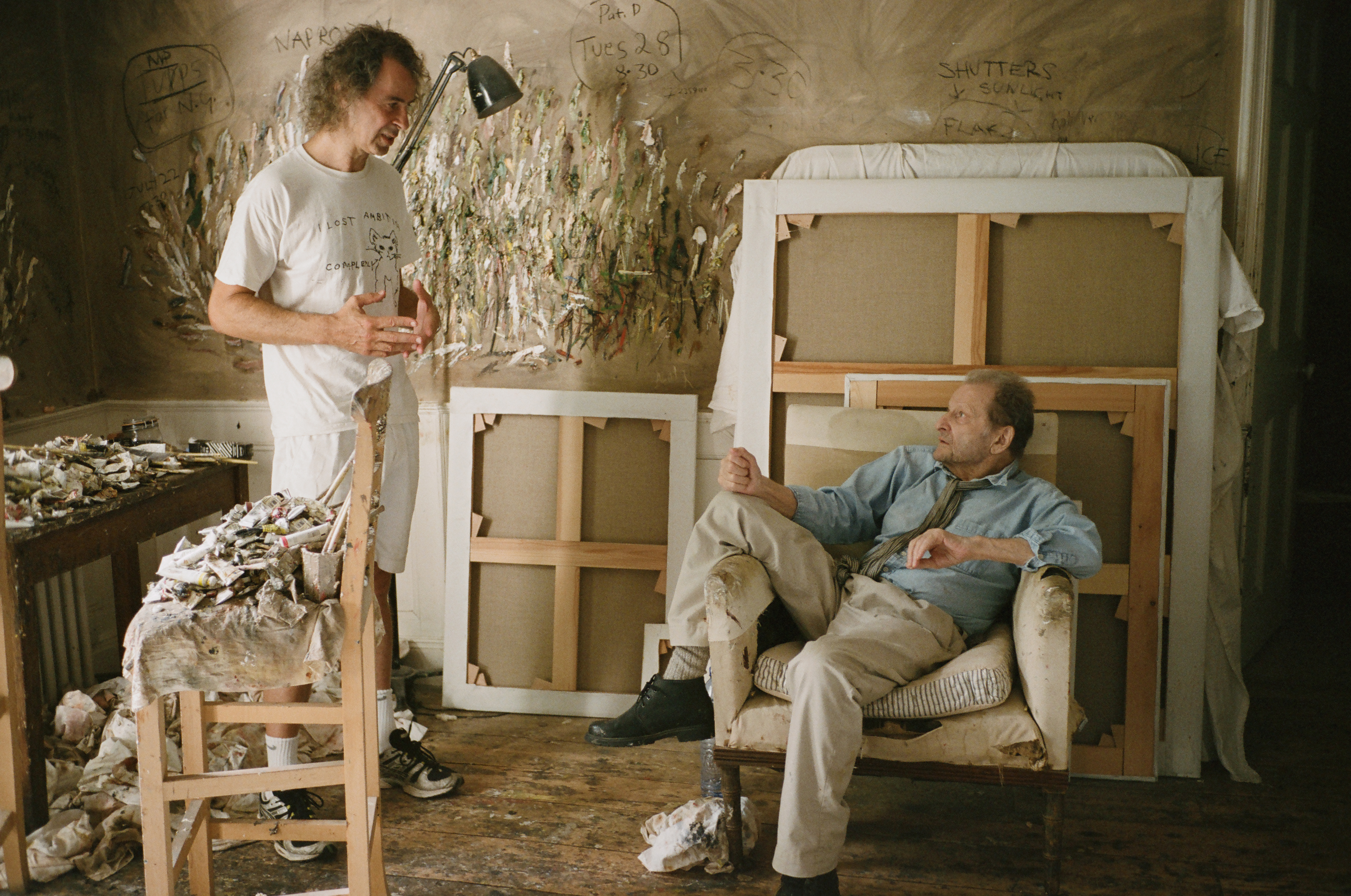
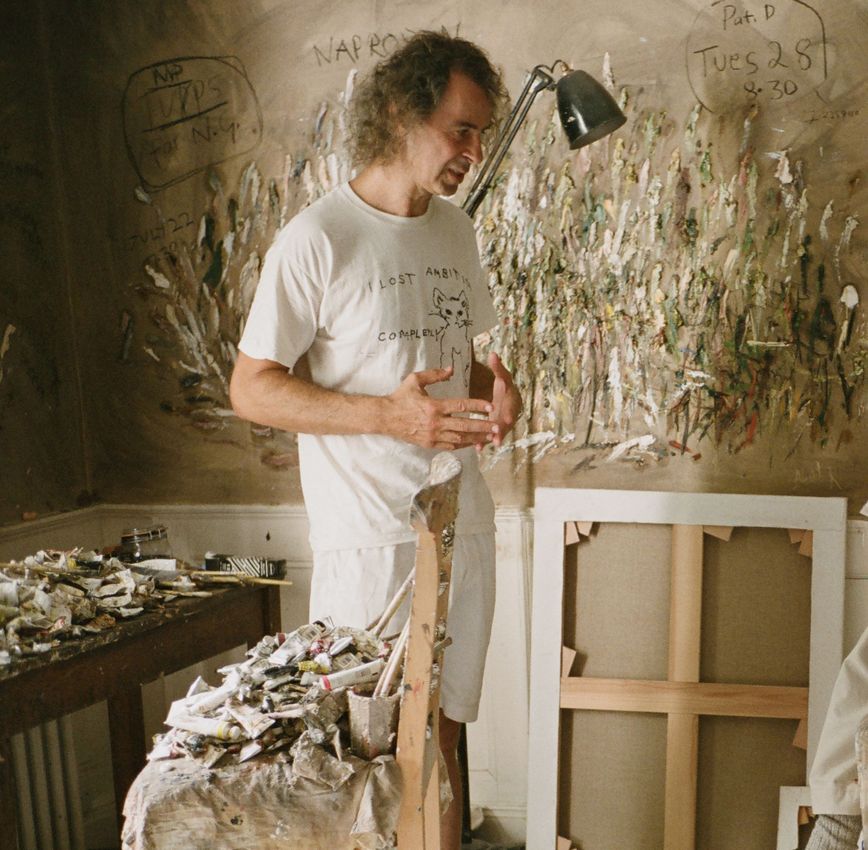
Artworks by friends hang on walls elsewhere. A rather haunting Tracey Emin self-portrait keeps him company in his office, while a photograph of a young Braka with Freud—captured in the artist’s studio in 2009 by his assistant David Dawson—hangs halfway up the Jacobean staircase. Braka, in tennis whites and trainers, stands beside an older Freud who sits slumped in a chair.
Braka bought his first painting by Freud at the age of 24, at a time when it was possible to do so for just £5,000, though few had the foresight. Bacon was another artist Braka collected early on, using money borrowed from his father and cornering the market before anyone else. Walking into a Bacon show today, you’d be hard-pressed to find a preeminent work with a provenance devoid of ‘Ivor Braka Collection’, or one whose quality he had not been consulted on.
‘I was trained to look,’ says Braka, who, at the encouragement of British art dealer Andras Kalman, enrolled in a master’s course at Sotheby’s after earning an English literature degree from Oxford University. ‘We would visit houses across the country, pulling out drawers from 18th-century furniture to study how dirt had settled—distinguishing untouched areas from restored ones. We learned to determine the spurious from the authentic.’
This education has defined Braka’s studious approach to art dealing, developing in him a sharp instinct for the most powerful examples of an artist’s work—often with price tags to match. ‘When collectors complain about my pricing,’ Braka says, ‘I tell them, “Look, you’re going to make far more money from me than I’ll ever make from you.”’
That adage has largely held up. One of Braka’s earliest acquisitions, encouraged by the late German art dealer Annely Juda and bought on behalf of his father, was Mondrian’s Composition: No. II with Yellow, Red and Blue (1927) for $300,000 (all figures USD) from Christie’s New York in 1981. Six years later, Braka sold the work to the Swiss art dealer and collector Ernst Beyeler for around $1 million. That same picture sold at Christie’s in 2021, at a hammer price of nearly $28 million. Similarly, last year, Bacon’s Landscape near Malabata, Tangier (1963), which Braka acquired at Sotheby’s in 1985 for a then-record $517,000, sold at Christie’s in London for $21.5 million.
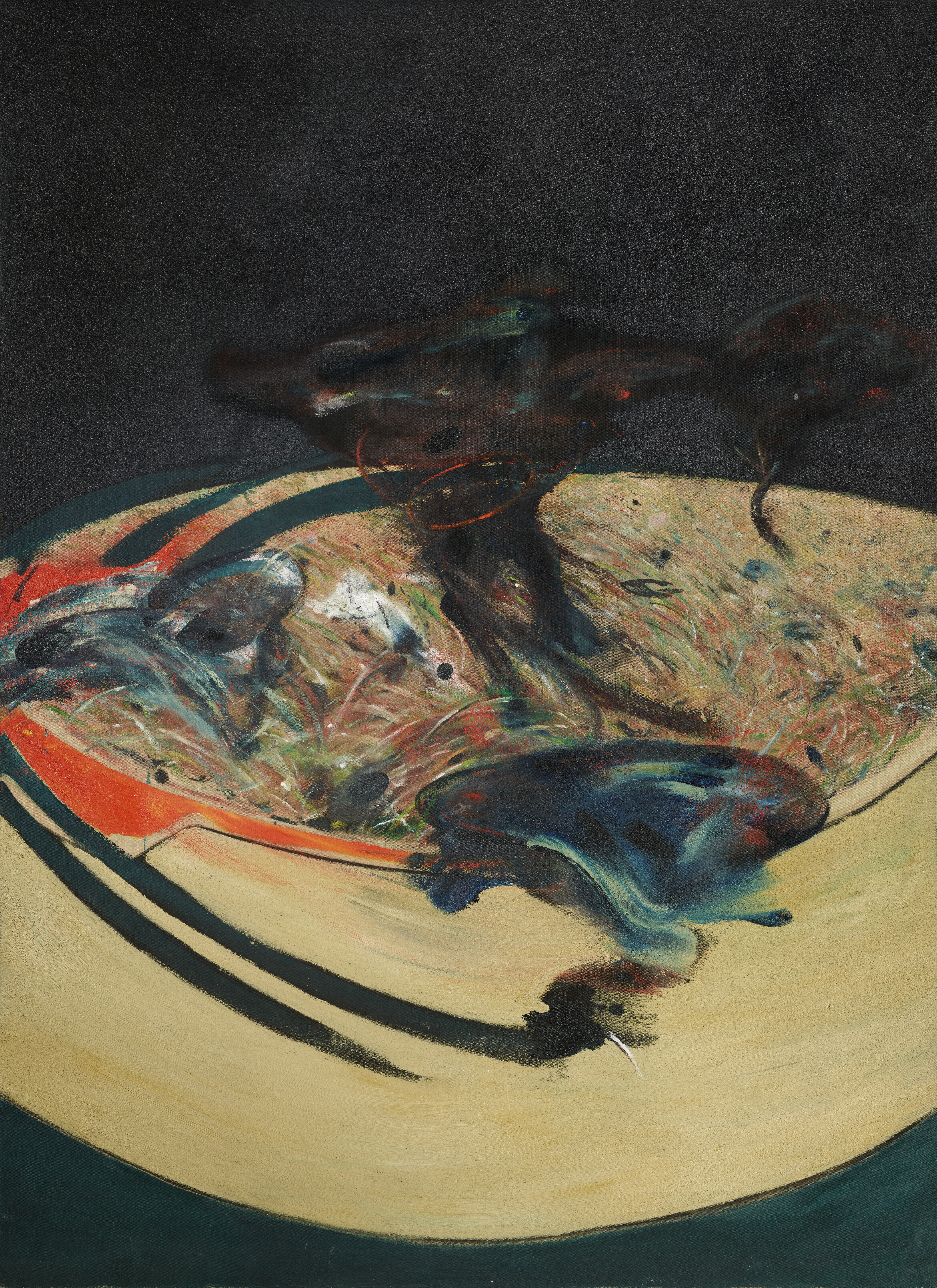
‘My job as a dealer is to steer people into buying artworks that are exceptional—often those that contribute to the advancement of art history—over what they like, but it’s a difficult lesson to communicate.’ Some need more persuasion than others. David Bowie, who used to come and see Braka—more often to talk about English literature than art—challenged this philosophy on one visit. I totally disagree with you when you talk about a ‘good’ Picasso, Braka recalls him saying. How can you have a hierarchy in terms of these great geniuses?
That idea—living with art that unsettles or resists easy appreciation—sticks with me as I look around Braka’s own collection. His walls are hung with complex paintings by complicated artists, like Bacon and Paula Rego. I wonder whether, among these exceptional paintings, there are any he struggles to live with.
Frank Auerbach’s painting Smithfield Meat Market (1962), apparently. ‘I remember being repelled by it. It was several inches thick—hovering between sculpture and painting—in very excremental shades of brown. However, every time I stood in front of it, I couldn’t stop looking; it had an inner life that was completely unforgettable.’ When the painting came to auction—after a public falling-out between the two British art dealers, James Kirkman and Anthony d’Offay, who co-owned the painting—Braka bought it for £7,000, grew to love it, and sold it 20 years later for around £400,000.
‘I have the same mentality about people as I do paintings,’ says Braka. ‘I’ll meet someone and think they’ve got an attractive personality, only to realise later—oh god, you’re boring. Then there are those I’ve clashed with from the start who end up becoming my closest friends. It’s more rewarding when you have to fight for something, over the things that are superficially attractive.’
This is a mindset that visitors to Braka’s two pubs in north Norfolk may need to adopt, albeit just for the duration of their lunch. ‘Intellectually challenging and provocatively amusing’ is how Braka describes the selection of artworks hanging across both The Gunton Arms and The Suffield Arms. Diners eat under Paula Rego’s ‘O Vinho’ (Wine, 2007) lithographs: one captures a mother pouring brandy down her baby’s throat; another depicts a woman hunched over a loo, spewing red vomit. In the men’s bathroom, a topless woman straddles a motorbike in an image from Richard Prince’s ‘Girlfriends’ series of the 1990s, while the Kray twins look on from a 1960s David Bailey photograph. ‘I couldn’t stand the thought of having another picture of nearby Cley Windmill or dogs playing on a dreary Norfolk beach.’
Gunton Park—within which these two pubs sit—has been Braka’s life’s work since 1986. ‘It was in a sorry state,’ he recalls. He has since spent years slowly buying back the farmland, planting more than half a million trees, and restoring the 1,200-acre estate to its former glory. ‘When I take something on, I want to do it properly,’ he says. It’s a perfectionism he recognises in fellow dealers such as Larry Gagosian and David Zwirner, both of whom have renovated magnificent Manhattan buildings into galleries that, if they weren’t so successful, would have bankrupted them five times over. ‘When you’ve got a good thing going, it’s difficult not to keep walking the plank,’ he says. ‘Even if it leads to financial hardship.’
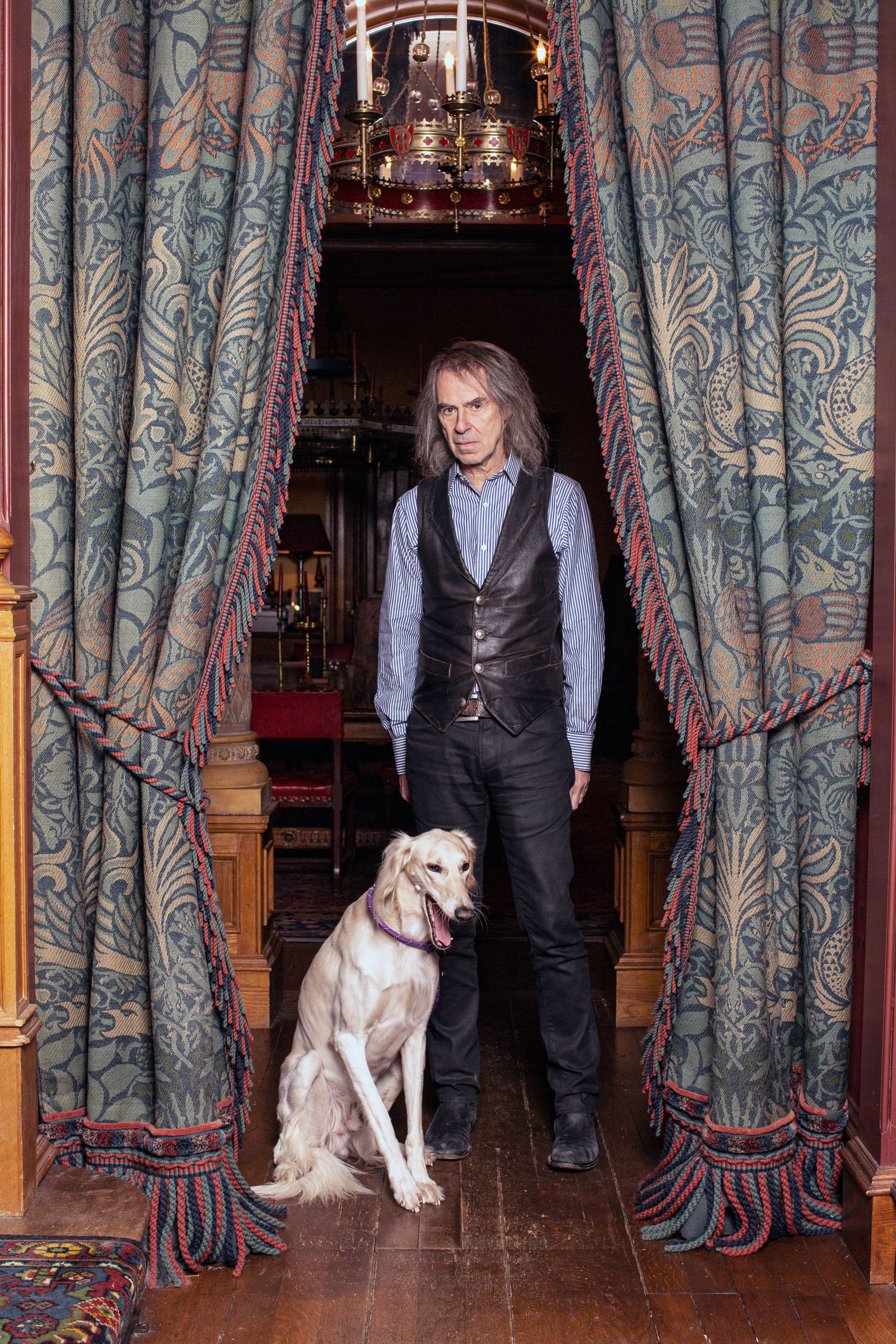
Up against the clock—he has a tennis lesson booked with an ex-professional at midday—Braka leads us to a low vestibule near the front door which opens up into the large entrance hall, a hallmark of George’s theatrical design. Braka’s dog Sami—a sleek, willowy Saluki—had joined us. On one side of the vestibule hangs Wyndham Lewis’ Red Duet (1914), a swirling pink, red, black, and blue vortex of geometrical sharps and flats. ‘It’s probably the most definitive example of what the American poet Ezra Pound termed Vorticism,’ Braka remarks. ‘And one of my prized possessions.’
What he really wants to talk about, however, are the three framed drawings on the opposite wall. Lightly sketched in blue pencil, these individual studies, he explains, were Jacob Epstein’s preparatory studies for his sculpture The Rock Drill (c. 1913), comprising a plaster figure perched atop the titular drill. Widely regarded as one of the greatest artworks of the 20th century, The Rock Drill was later dismantled by the artist, the drill element sold, and the figure cast in bronze. Today, this truncated iteration of the original, Torso in Metal from Rock Drill (1916), takes pride of place at Tate Britain—a sculptural marvel.
By comparison, the preparatory drawings initially seem less compelling. But, as Braka encourages us to look more closely, triple takes follow double takes. We see the robotic, mandrill-like head of the drill; we see the Concorde-like machine soaring through the air; and, from the low viewpoint of the third drawing, we feel the raw, megalomaniac power surging from man and machine’s violent invasion of Mother Earth. Of all the art in this masterpiece-filled house, Braka tells me these are the works he intends never to sell.
‘Bowie had a point,’ Braka concedes. ‘Any sketch by Picasso has got that genius behind it and who am I to say that I’m the arbiter. But it’s about finding those works that have an enduring quality—one that bursts through the quotidian into a realm of gods.’ With that, Sami slinked off to the kitchen. —[O]
Main image: Ivor Braka with Lucian Freud in the artist's studio (October 2009). Courtesy Ivor Braka. Photo: © David Dawson.

A respected voice in contemporary art discourse.
Focusing on ambitious storytelling and insightful art-world commentary. Ocula Magazine publishes in-depth interviews, critical essays and timely analysis on the artists, exhibitions and ideas driving the global art world.
Learn more about Ocula Magazine
Showcasing the best of the art world.
Ocula partners with galleries from around the world to highlight their artists, artworks and exhibitions. Gallery membership is by application and invitation, with each member vetted by an independent panel.
Learn more about Ocula Membership
Specialises in the sale of major artworks.
Led by a team with deep ties to the world’s leading auction houses, galleries and collectors. Ocula’s advisory team offers bespoke services to high-net-worth clients from around the world who are looking to acquire the best of contemporary and modern art.
Learn more about our team and services