



MARIA NEPOMUCENO
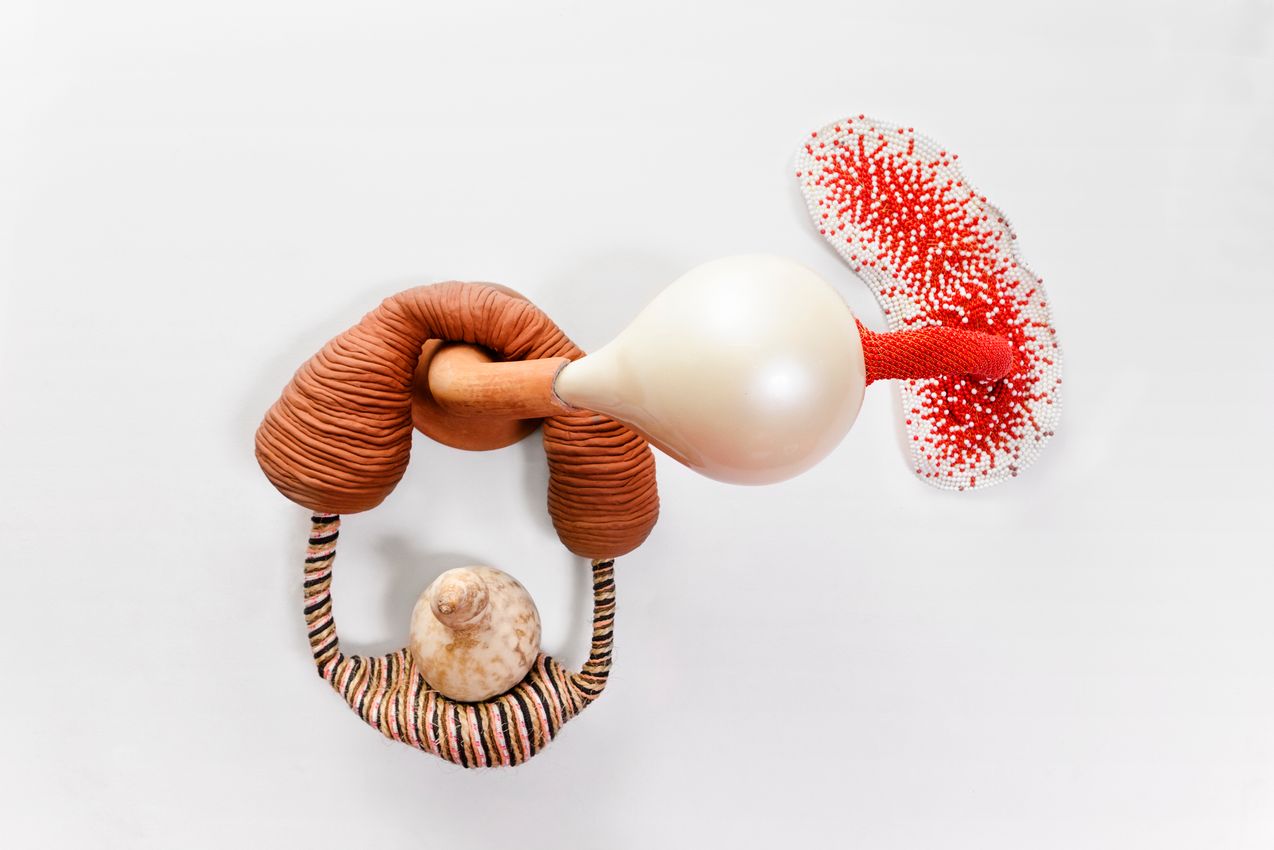
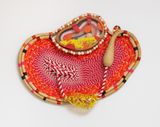
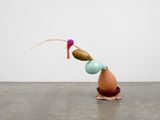
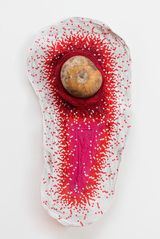
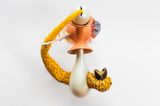
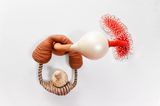
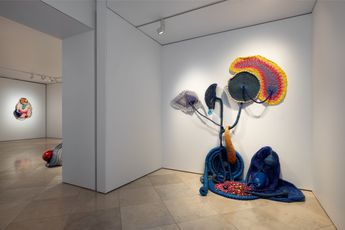
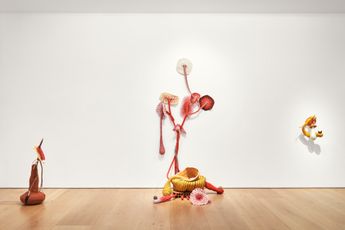
b. 1976, BrazilUsing traditional methods of rope weaving and straw braiding as well as techniques of her own design Maria Nepomuceno has, since the the early 2000s, developed a process of sewing coils of coloured rope in spirals. She explores the potentially endless permutations of this adaptable form in sculptures and installations that incorporate beads, playful ceramic forms and found objects of varying sizes. Often realised in carnival-bright colours, these works are chromatically, culturally and metaphorically rich, suggesting animals, plants, the human body and landscape ranging from the microscopic to the macrocosmic.
Nepomuceno’s fluid forms articulate space in a playful way, sometimes inviting tactile exploration. The notion of the rope as a connecting thread is as conceptual as it is literal in Nepomuceno’s practice. In recent years collaboration has become a more overt factor in her work. She has worked with indigenous Huni Kuin people in the state of Acre in the north of Brazil to develop weaving techniques and has also formed links with community groups to realise projects for her exhibitions. For instance, elements of Nepomuceno’s installation Tempo para Respirar (Breathing Time), 2012–2013, at Turner Contemporary, Margate, were made in collaboration with a local artist studio group brought together by the artist specifically to learn her techniques and work on the commission. This spirit of cooperation and openness has extended to the display of several of her large-scale installations, where visitors are invited to interact directly with her elements of her work.
Nepomuceno was born in 1976 in Rio de Janeiro, where she continues to live and work. Venues for recent solo presentations include Stavanger Art Museum, 2017; Barbican Centre, London, 2016; Museu de Arte Moderna, Rio de Janeiro, 2013; Turner Contemporary, Margate, 2012; Magasin 3, Konsthall, Stockholm, 2010; Galeria Karsten Greve, Cologne, 2009; Steve Turner Contemporary Gallery, Los Angeles, 2009 and Paço das Arte, São Paulo, 2008. Nepomuceno’s work has featured in group exhibitions at venues including Kunsthal KAdE, Amersfoort, 2016; Auckland Art Gallery, 2016; Museum of Fine Arts, Boston, 2015; the International Biennial of Contemporary Art of Cartagena de Indias, Colombia (2014); Wexner Arts Centre, Ohio, 2014; Schirn Kunsthalle, Frankfurt, 2013–2014; Hangzhou Triennial of Fiber Art (2013); IFA Institut, Berlin, 2010; Lehmann Maupin Gallery, New York, 2010; Toyota Museum of Contemporary Art, Nagoya, 2008; Galeria Luisa Strina, San Paulo, 2007; Museu de Arte Contemporânea do Paraná, 2007 and Paço Imperial, Rio de Janeiro, 2007.
Text courtesy Victoria Miro.

















Explore and Follow Artists Shaping Contemporary Art
A respected voice in contemporary art discourse.
Focusing on ambitious storytelling and insightful art-world commentary. Ocula Magazine publishes in-depth interviews, critical essays and timely analysis on the artists, exhibitions and ideas driving the global art world.
Learn more about Ocula Magazine
Showcasing the best of the art world.
Ocula partners with galleries from around the world to highlight their artists, artworks and exhibitions. Gallery membership is by application and invitation, with each member vetted by an independent panel.
Learn more about Ocula Membership
Specialises in the sale of major artworks.
Led by a team with deep ties to the world’s leading auction houses, galleries and collectors. Ocula’s advisory team offers bespoke services to high-net-worth clients from around the world who are looking to acquire the best of contemporary and modern art.
Learn more about our team and services