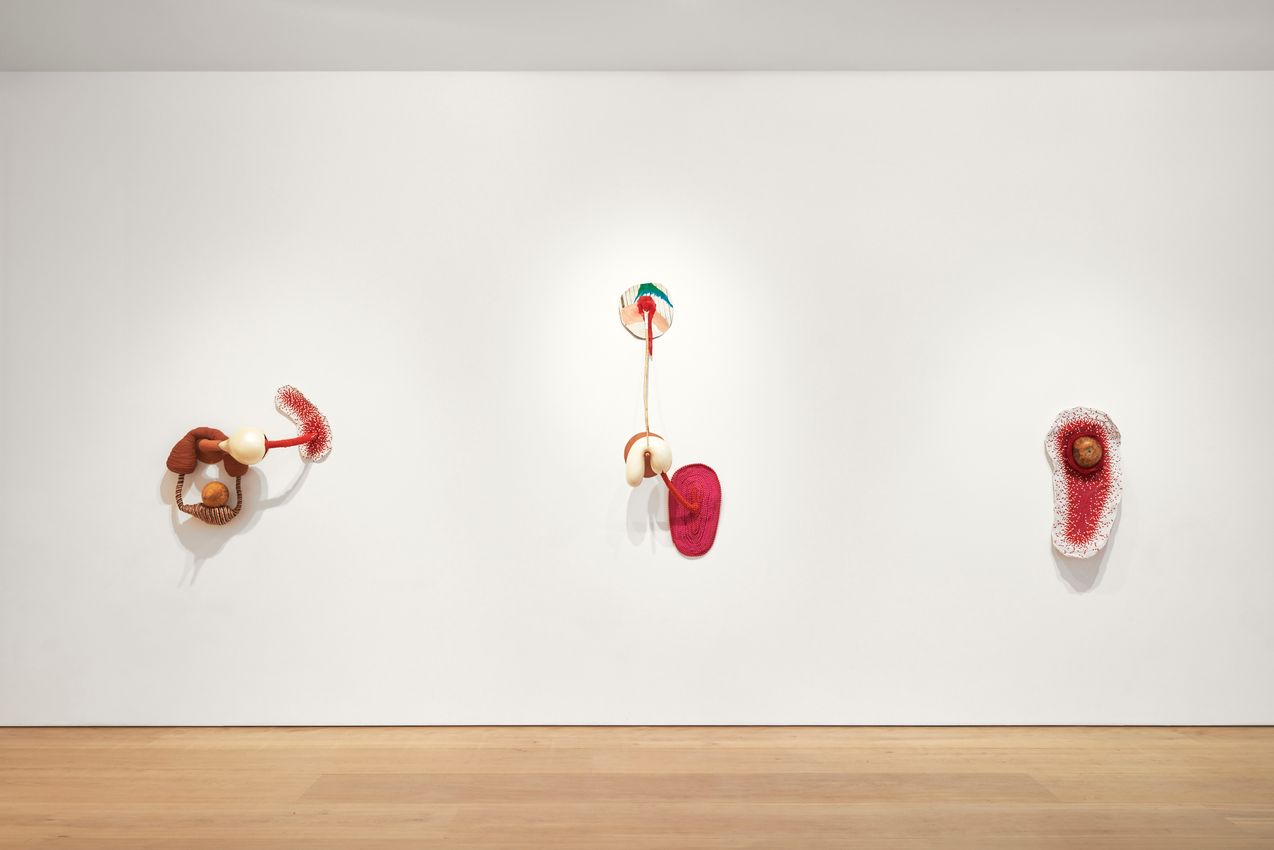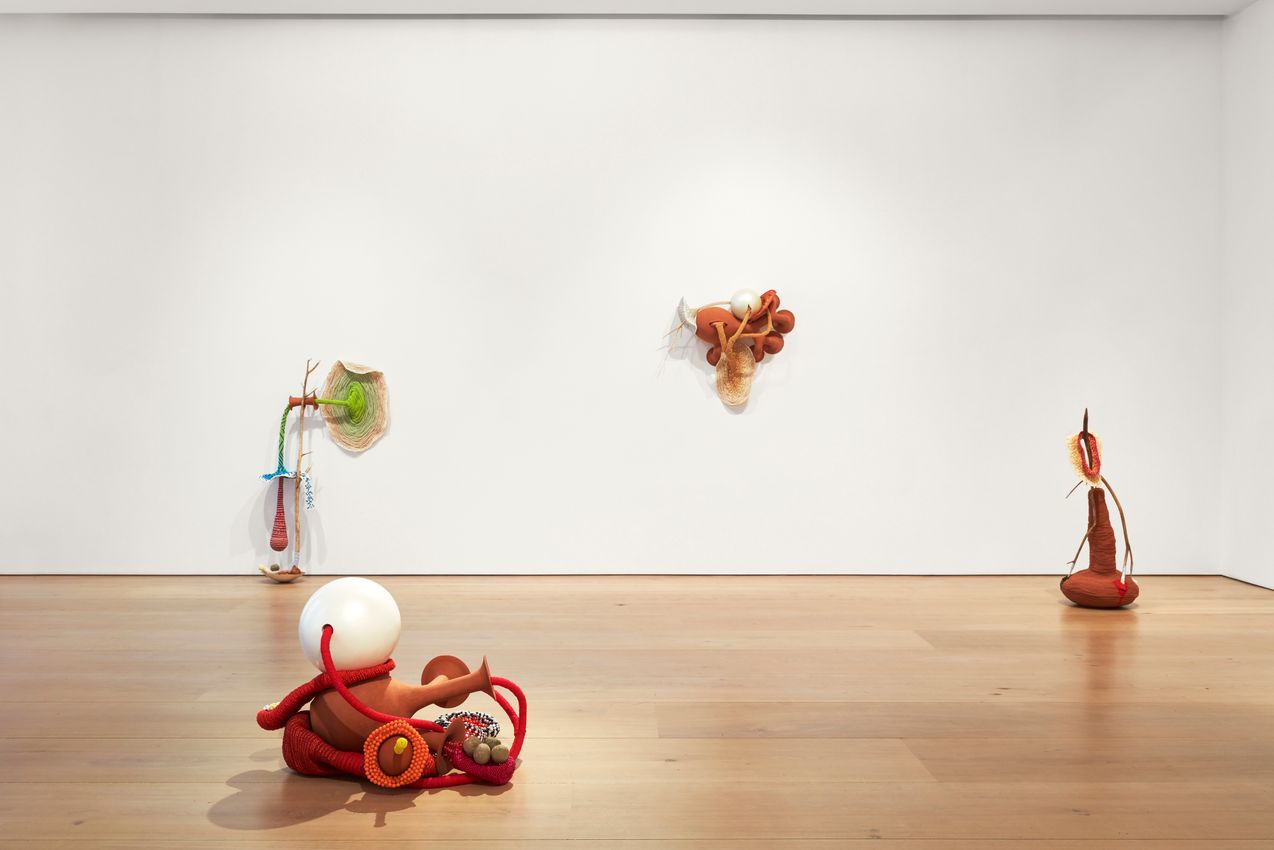




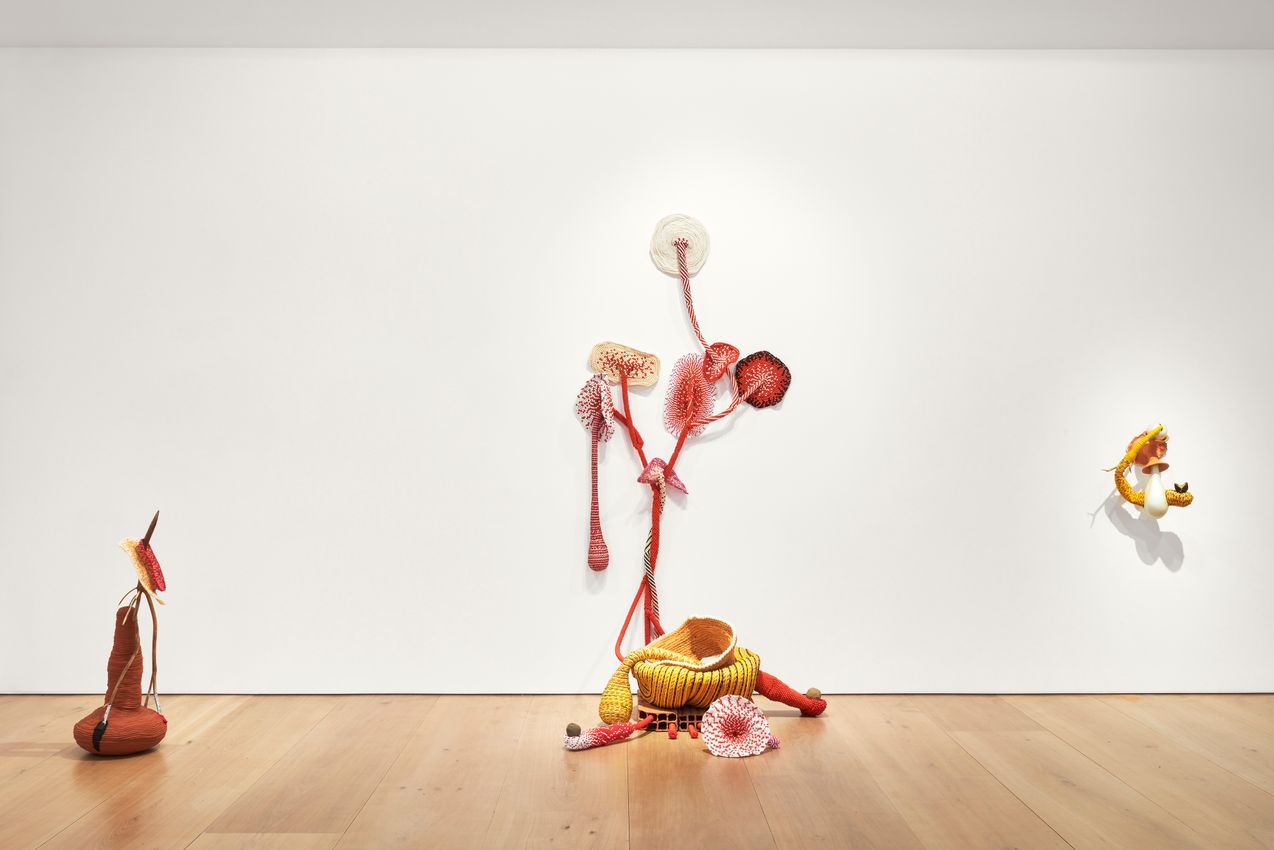
Displaying a characteristically dynamic approach to form, these new works expand upon the Rio de Janeiro-based artist’s methods of rope weaving and straw braiding, in which pre-existing and found elements such as branches, twigs, seed pods, playful ceramic forms and paint brushes merge with the organic forms of the sculptures. Nepomuceno’s works are chromatically, culturally and metaphorically rich, suggesting animals, plants, the human body and landscapes ranging from the microscopic to the macroscopic. That the sculptures appear anthropomorphic and organic is essential to a reading of the work: the spiraling central to Nepomuceno’s process relates to the spirals occurring naturally throughout the universe, giving shape to entire galaxies as well as the blueprint for existence, DNA.
Working across scales, Nepomuceno pushes ancient traditions and complex craft techniques into a wholly contemporary engagement with space and structure, form and concept. Following Cosmic Teta, 2016, her recent large-scale commission for the Barbican Centre, which extended through levels of the building, the works in Sim foreground a more intimate aspect of her practice. The results are intended to harness the extended time of their making while simultaneously inviting the viewer to pause, draw close and engage with complex cycles of energy and creation. The small beads used in her woven threads, for instance, are echoed in large, pearl-like forms made of fiberglass and resin which occasionally appear to crack and burst open, spilling their contents like seeds. Elsewhere, faults and cracks built into her ceramic forms point to the artist’s interest in failure as a source of fruitful opportunity, of things being given new life through the resourceful creative process. An affirmative act of repurposing is borne out by the exhibition title, Sim - meaning yes in Portuguese - which underscores a spirit of generosity in all of Nepomuceno’s work, not least in the artist’s desire to “catch time and give it back to the viewer”.
In Nepomuceno’s work linear time gives way to a more cyclical sense of connectedness, while notions of subject and object, form and function, cause and effect are made deliberately ambiguous. For example, a paintbrush appears as both a creative tool - used to apply paint to the ceramic vessel containing beads and gourds on which it sits - and a structural component holding aloft the antler-like branch of a tree. Used in her work since 2012, the paintbrush relates to Nepomuceno’s initial training as an artist. Similarly, the ropes and coils that she employs are both physical and metaphorical connecting threads and containers of meaning and history in their own right, rich with references to the artist’s ancestry. Holding in exquisite tension the personal and universal, natural and manmade, sensual and cerebral, Nepomuceno’s works are at once static and highly rhythmic. Each work, each sculptural moment, pulses with a continuous flux of energies.
Maria Nepomuceno was born in 1976 in Rio de Janeiro, where she continues to live and work. Recent solo exhibitions have taken place at venues including Barbican Centre (2016); Museu de Arte Moderna, Rio de Janeiro (2013); Turner Contemporary, Margate (2012). Nepomuceno’s work has featured in group exhibitions at venues including Kunsthal KAdE, Amersfoort (2016); Auckland Art Gallery (2016); Museum of Fine Arts, Boston (2015); the International Biennial of Contemporary Art of Cartagena de Indias, Colombia (2014); Wexner Arts Centre, Ohio (2014); Schirn Kunsthalle, Frankfurt (2013 - 2014).
Using traditional methods of rope weaving and straw braiding as well as techniques of her own design Maria Nepomuceno has, since the the early 2000s, developed a process of sewing coils of coloured rope in spirals. She explores the potentially endless permutations of this adaptable form in sculptures and installations that incorporate beads, playful ceramic forms and found objects of varying sizes. Often realised in carnival-bright colours, these works are chromatically, culturally and metaphorically rich, suggesting animals, plants, the human body and landscape ranging from the microscopic to the macrocosmic.


Since Victoria Miro founded her eponymous gallery in Cork Street, Mayfair, in 1985, the gallery has grown to represent over 40 artists and estates. With a reputation for presenting ground-breaking artworks from around the world, Victoria Miro has exhibition spaces in Mayfair and Wharf Road in London, and a further gallery space in Venice.

A respected voice in contemporary art discourse.
Focusing on ambitious storytelling and insightful art-world commentary. Ocula Magazine publishes in-depth interviews, critical essays and timely analysis on the artists, exhibitions and ideas driving the global art world.
Learn more about Ocula Magazine
Showcasing the best of the art world.
Ocula partners with galleries from around the world to highlight their artists, artworks and exhibitions. Gallery membership is by application and invitation, with each member vetted by an independent panel.
Learn more about Ocula Membership

Specialises in the sale of major artworks.
Led by a team with deep ties to the world’s leading auction houses, galleries and collectors. Ocula’s advisory team offers bespoke services to high-net-worth clients from around the world who are looking to acquire the best of contemporary and modern art.
Learn more about our team and services