
“The vice called surrealism is the immoderate and passionate use of the drug which is the image.” (Louis Aragon)
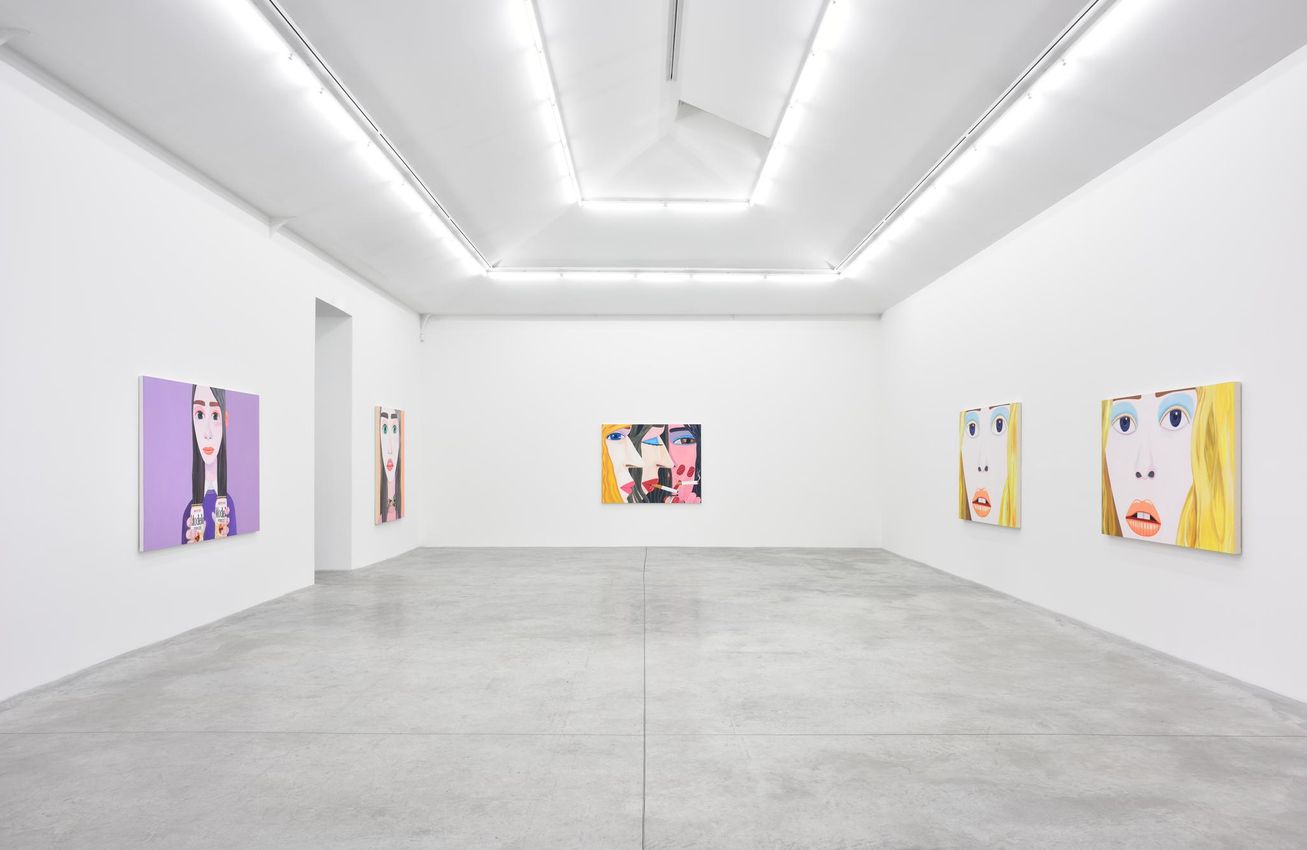
Imagine an exhibition with paintings of Brian Calvin in Paris and during the opening one would follow bits of conversations between guests coming from different worlds. Philip Guston for instance, would explain to Louis Aragon how we inherited ‘back in the future’ the myth of abstract art: “There is something ridiculous and miserly in the fact that painting is autonomous, pure and for itself. Painting is ‘impure’. It is the adjustment of ‘impurities’ which forces its continuity. We are image-makers and image-ridden.” Aragon would agree with the last words, smile and walk further. A number of small paintings with lips, entitled Mouthfeel, caught his eye.
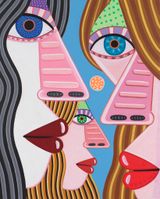
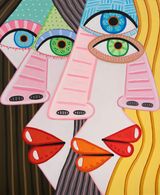
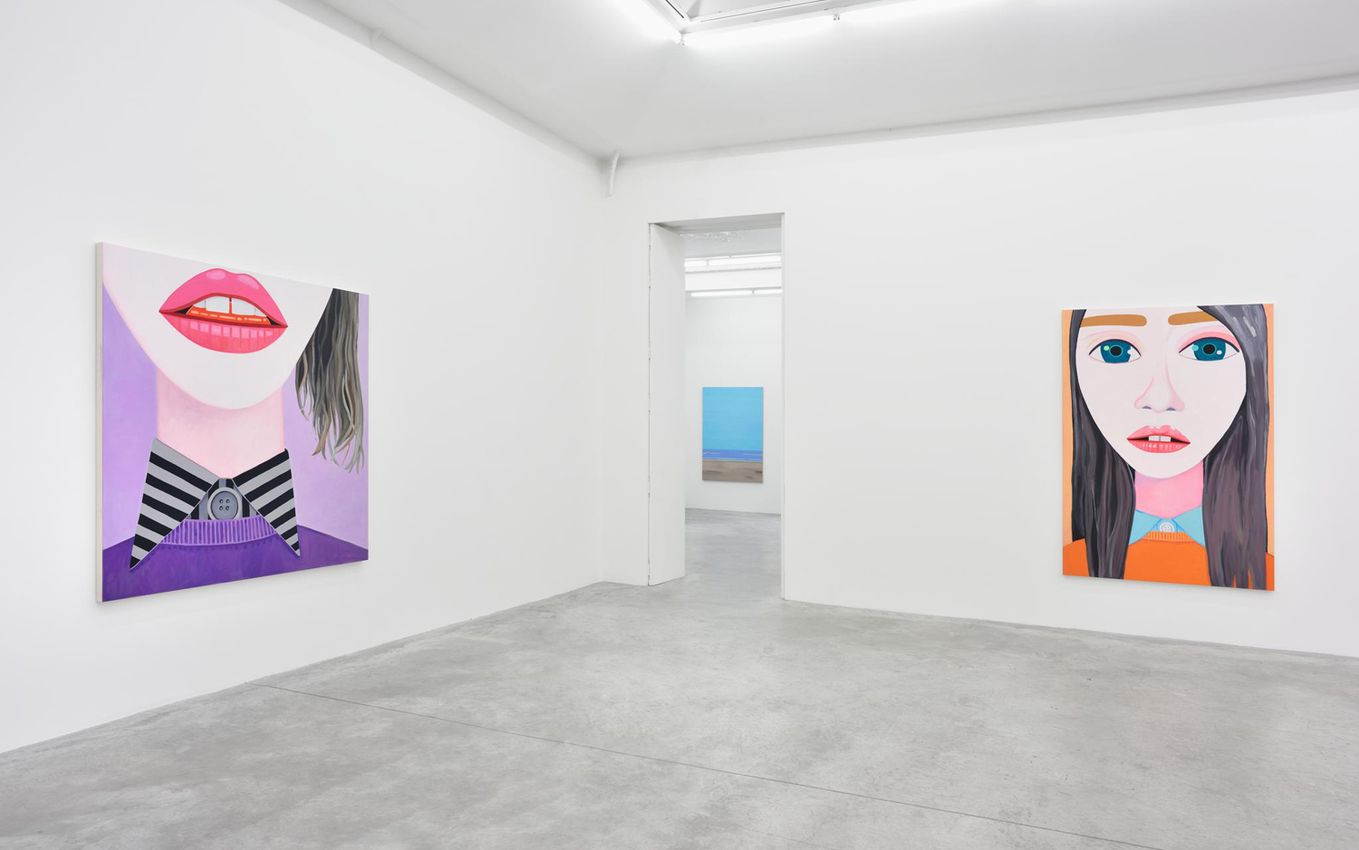
One thousands miles of waves of suns further and looking at the new paintings of Brian Calvin feels both strange and familiar at the same time. First about the strangeness, maybe, because we see the sun revolving around the earth but we know the opposite is true. We see first, but we see ‘twin infinitives’ walking through the exhibition space and gazing at his paintings. Eyes look at us, they follow our gaze going from painting to painting. We relate to what we see. The thinking and the words come later: we know these acrylic painted eyes can’t look at us.
I will try to explain this in another way: we see the multiplication of figures, eyes and lips on the canvases, but they always feel – even when seen together – like infinitive. This strangeness is reinforced because of what seems to be an undetermined number of twins. Are you still following? I will move to the familiarity right away. We are looking at the compositions of Brian Calvin and I can actually quite agree with the comment that painting is a conversation and therefore definitely not a monologue. A painting is never closed. You can always ‘plunge into’ a painting over and over again. Nothing stops you from carrying on thinking about a painting, continuing the course of the ‘thinking hand’. You can hold a private conversation with a painting. Again and again, the painter and the viewer are twins in an undetermined way.
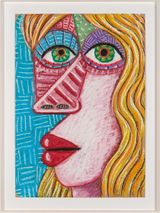
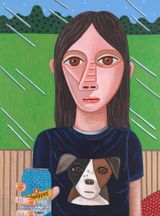
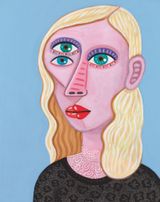
Brian Calvin’s painted world is familiar because it speaks to different generations at the same time. There’s a painterly affiliation with the so-called flatness of form in Alex Katz’s research, together with a Warholian legacy of image making. It’s also possible to relate to another mindset and have lo-fi music sounds guiding you through his painted representations. Thirty, forty, fifty years of music resonating in one painted detail for instance. Look at the fingers or the cigarettes, the ‘gloss’ on the lips: is it a still-life, or is it you driving on the highway and listening to the radio? Recently, I saw a youngster staying more than one hour in a Brian Calvin exhibition. Walking around, alone, looking in a concentrated way at each painting. Maybe he related to the fact that the paintings and himself too have become image-ridden, image-makers in the 21th century?
You are guided by images walking through an exhibition of Brian Calvin. You are trying to recapture something and at the same moment encounter a specific transformation. That’s because we can all relate to the concentration on the object that is transformed on the canvas. Maybe that’s part of the so-called thingness of images?
One example: look at the painted buttons on the new paintings, the uniqueness of each one of them. A button is fashion, but it’s also a circle, it’s another circle, and another circle, together with another circle and another circle. Twin infinitives? Yes, I agree. To paint.
Phillip Van den Bossche
Back in the 1990s, Brian Calvin began developing a figurative, non-narrative, pictorial style. Landscapes and portraits steeped in his Californian roots dominated this work. Close-up treatment of subjects, highly composed structures, as well as luminous colours laid flat endow these large-scale paintings with a strange temporality. In observing his technique of pictorial economy, one gradually comes to see a type of abstraction in his representation of certain details. They reveal, even greater still, the true finality of his work, reaffirming the primacy of a visual reflection on painting itself and its possibilities. ‘I prefer to experience abstraction through the creation and tending of images. Painting provides the medium.’


Almine Rech opened its doors on April 1st, 1997 in the 13th arrondissement in Paris. The gallery was founded on an axis of California Minimal, Perceptual art and Conceptual art, representing artists such as James Turrell, John McCracken and Joseph Kosuth.

A respected voice in contemporary art discourse.
Focusing on ambitious storytelling and insightful art-world commentary. Ocula Magazine publishes in-depth interviews, critical essays and timely analysis on the artists, exhibitions and ideas driving the global art world.
Learn more about Ocula Magazine
Showcasing the best of the art world.
Ocula partners with galleries from around the world to highlight their artists, artworks and exhibitions. Gallery membership is by application and invitation, with each member vetted by an independent panel.
Learn more about Ocula Membership

Specialises in the sale of major artworks.
Led by a team with deep ties to the world’s leading auction houses, galleries and collectors. Ocula’s advisory team offers bespoke services to high-net-worth clients from around the world who are looking to acquire the best of contemporary and modern art.
Learn more about our team and services