Joe Andoe Rides Again
By Deborah Solomon
It has now been almost 40 years since Joe Andoe headed east, arriving in New York from his native Tulsa, Oklahoma. He soon won attention for lean, roughly poetic paintings of horses and winding roads. Although he is sometimes thought of ‘that horse painter,’ a survey of some 20 paintings spanning several decades at Almine Rech offers a much-needed reminder of the breadth of his achievements and his startling relevance to the current scene. For starters, he’s an important forerunner of the photo-based realism that has become the default style among younger artists today. Moreover, his work can be read as a form of social critique, with its views of a robust America on the brink of disappearance.
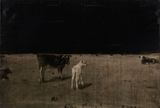
Andoe usually works in monochrome, especially ivory black or mars black, and many of his paintings have the tonality of vintage photographs. When he paints a picture of a horse-or for that matter, of quadrupeds including wolves, dogs and buffaloes-he isn’t working from life. Rather, his usual practice is to find photographs online and print them out and transfer them freehand onto canvas. His use of found photographs allows him to operate at an obvious distance from his subjects, and leaves his work unencumbered by a suggestion of nature worship or other forms of transcendence.
His painting technique is almost comically casual. Using his hands, or paper towels, he starts with a pigment-covered canvas and wipes paint off of his surface, bringing images out of darkness. Some of his scenes can remind you of Vija Celmins’s nighttime skies, except they’re much greasier. It is probably relevant that ‘oil,’ for Andoe, describes not only his preferred painting substance but the sought-after prize of countless prayers in his home state.
Andoe, who is now 63, grew up in Tulsa and received an M.F.A. from the University of Oklahoma. In 1982, the year after he graduated, he moved to New York, which continues to be his home. He is part of the generation that came of age after the dominance of Minimalism, which, as everyone knows, fetishised geometric forms and sleek surfaces and practically outlawed the sensual medium of oil-on-canvas. Andoe, officially, is a post-Minimalist whose work can at times resemble that of the New Image painters (such as Susan Rothenberg and Robert Moskowitz) who emerged in the ‘70s and returned figuration to painting.
Put another way, you might say that Andoe has fused post-modern figurationwith views rooted in the Old West. His paintings can evoke the days when cowboys and their loyal horses flashed across the big screen at the drive-in, and the world was still black and white. Andoe is not an ironic artist, and he isn’t satirising the old days. To the contrary, he can’t stop thinking about them. The strong, predominantly female faces of wolves and horses that gaze directly at him as he coaxes them to life on canvas are both here and not here. That is where the poignancy resides in his work, in his pursuit of an absence.
(Deborah Solomon, the art critic of WNYC Public Radio, is at work on a biography of Jasper Johns.)
Tulsa-born painter Joe Andoe is known for his austere depictions of everyday subjects, such as roadsides with cloud-filled skies, horses, dogs, and flowers. For his painting, he uses a reductive technique where he covers an entire canvas with thick black oil paint, then wipes off the paint while still wet to reveal an image beneath, creating an enigmatic and textural minimalism. ‘Since the late ‘70s I have fancied myself a landscape painter, and a painter of the things that hang around on the landscape’ wrote Joe Andoe in his memoir Jubilee City (2008). In his recent work, Andoe underscores the possibilities of imagery by developing a cinematic vision of American mythologies. Often compared to the photographic documentation of teenage life in Tulsa by Larry Clark, Andoe’s universe has emerged as one great depiction of the American spirit and its iconography.


Almine Rech opened its doors on April 1st, 1997 in the 13th arrondissement in Paris. The gallery was founded on an axis of California Minimal, Perceptual art and Conceptual art, representing artists such as James Turrell, John McCracken and Joseph Kosuth.

A respected voice in contemporary art discourse.
Focusing on ambitious storytelling and insightful art-world commentary. Ocula Magazine publishes in-depth interviews, critical essays and timely analysis on the artists, exhibitions and ideas driving the global art world.
Learn more about Ocula Magazine
Showcasing the best of the art world.
Ocula partners with galleries from around the world to highlight their artists, artworks and exhibitions. Gallery membership is by application and invitation, with each member vetted by an independent panel.
Learn more about Ocula Membership

Specialises in the sale of major artworks.
Led by a team with deep ties to the world’s leading auction houses, galleries and collectors. Ocula’s advisory team offers bespoke services to high-net-worth clients from around the world who are looking to acquire the best of contemporary and modern art.
Learn more about our team and services