



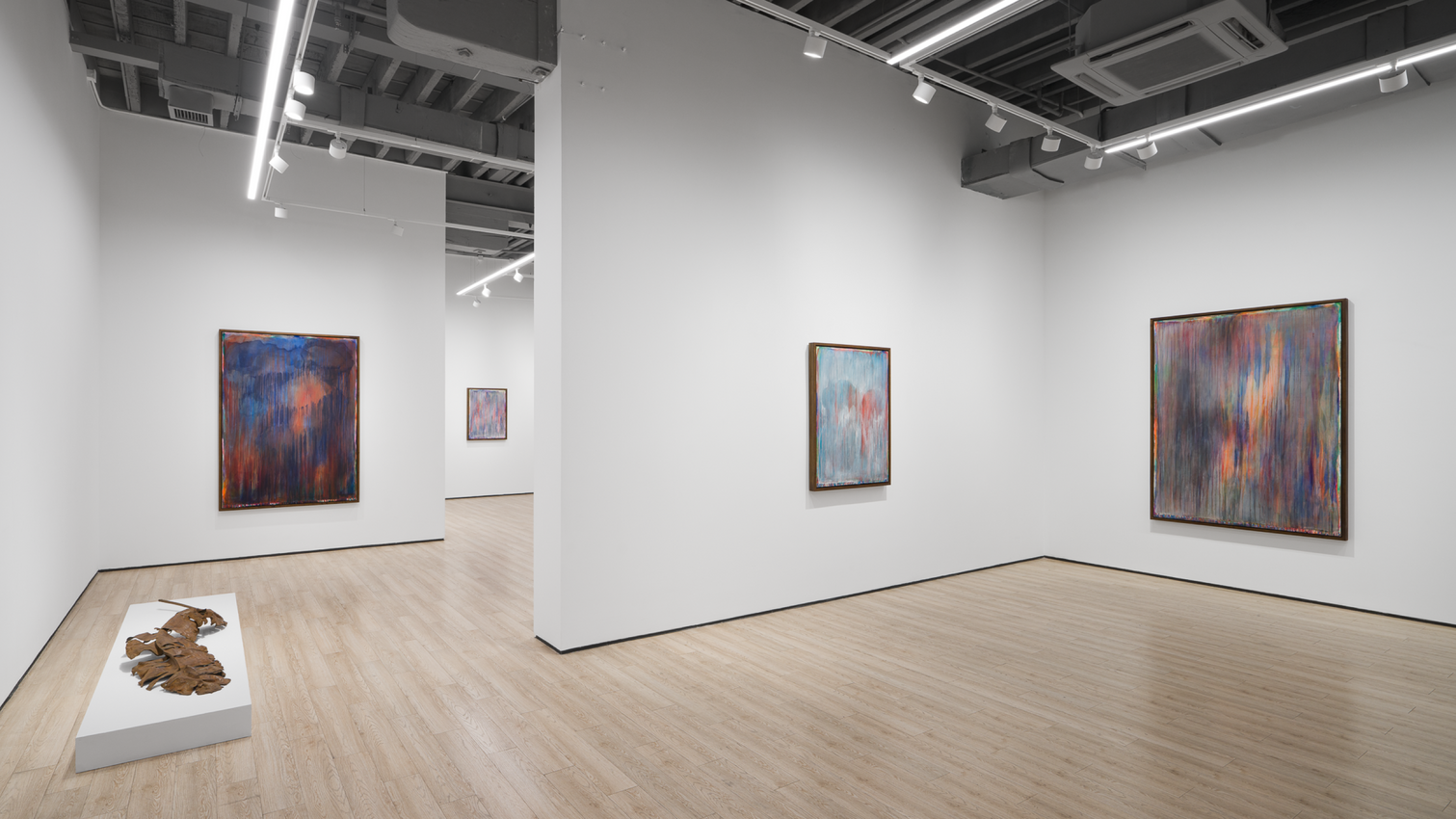
Almine Rech Paris is pleased to announce the first exhibition by Kenneth Noland with the gallery organised in collaboration with the Paige Rense Noland 2008 Marital Trust and The Kenneth Noland Foundation. Rarely shown in Paris, and in France, this selection of works constitutes an important survey exhibition, featuring paintings realised between 1960 and 2006.
Kenneth Noland ranks among the most recognised artists of the Colour Field and Post Painterly Abstraction. Well-known for his coloured concentric circles, chevrons and stripes, he is considered as ‘one of the great colourists of the 20th century’ by Karen Wilkin, the author of a monograph on Noland. ‘His art was from start to finish an art of colour, part of a long tradition that dates in the modern era to Impressionism, runs through Cézanne and Matisse, into the twentieth century, to Morris Louis, and Helen Frankenthaler.’1 writes the author. ‘To the end, Noland added to that tradition by exploring ways of colour painting virtually unimaginable, and often without precedent. As he worked into the twenty-first century, his art took on more and more colour and therefore more light. This was a new direction for Noland, making the trajectory of his art all the deeper and wider. His light will surely remind us of the golden hues of the American Luminist painters of the nineteenth century.’2
Noland spent years exploring the implications of the stripes inventing seemingly endless variations, from complex orchestrations of multiple stripes to empty centres with concentrated groupings at top and bottom. In the 70s, he adds a new movement in his work, giving more space for more colour experimentation. For works such as Interlock Color (1973), and others from the plaids series, vertical fields are dissected by slender grids and the places where bars overlap are emphasised by changes in colour and density. The plaids while predominantly vertical, also included several square diamonds. In some of his shaped canvases of this period, Noland at once emphasised and distorted the edges of his shapes by means of colour changes and groupings of colour bands. From the end of the 70s, and over the next few years, the shapes ranged from relatively regular near-rectangles, slightly irregular, to unconventional irregular hexagons and unamenable, culminating in the slender figures sometimes referred to as surfboards from 1981-1982 (such as Begin and End, 1981). With the chevrons of the 1980s, surfaces are newly opulent, there is a new emphasis on layering and transparency, a true mutability of colour. As in Comet (1983), Noland transforms the chevrons into what are essentially brand new works and interjects a veritable primer on new varieties of colour application. In the paintings of the last years, such as Into the Cool No.9 (2006) and Burst (2006) ‘he combined all he had discovered over the course of this latest series, a perfect pitch, a fusion of emphatic colour at right centre to barely discernible at left and centre bottom; an in and out weaving of pinks and blues; quasi geometric shapes with an amorphous bleeding of the hues with a touch of mastery that certifies Noland’s genius. Then, almost as an exit, a single line from the bottom of the circle to the lower edge takes us quietly out of the gentle pictorial turmoil of the painting.’3 With the strong but quiet paintings of the last years, Noland creates a meditative aura that invites the viewer into a private dialogue with the art, the artist, and world around us.
Kenneth Noland (b. 1924, Asheville, North Carolina; d. 2010, Port Clyde, Maine) studied at Black Mountain College from 1946 to 1948 with Josef Albers and Ilya Bolotowsky. He had his first solo exhibition at Galerie Raymond Creuze in Paris after moving there in 1948 to study for a year with sculptor Ossip Zadkine. He taught at the Institute of Contemporary Art, Washington, D.C. (1949-1951), at the Catholic University, Washington, D.C. (1951-1960), and at the Washington Workshop Center of the Arts (1952-1956). His work was part of the Venice Biennale (1964) and his first retrospective was held at the Guggenheim Museum (1977), which traveled to the Corcoran Gallery of Art, Washington, D.C. and the Toledo Museum of Art, Ohio (1978). Noland has been the subject of solo exhibitions at a range of international institutions, including the Museo de Arte Moderno, Mexico City (1983); Museo de Bellas Artes, Bilbao, Spain (1985); Museum of Fine Arts, Houston (2004); Tate, Liverpool (2006); and Butler Institute of American Art, Youngstown, Ohio (1986 and 2007).
1 Karen Wilkin, Kenneth Noland, 20 Century Artists, 1990.
2 Ibid.
3 William C. Agee, ‘Kenneth Noland: The last paintings,’ Kenneth Noland, Into the Cool, 2017.
Kenneth Noland (1924—2010) was an American Color Field painter whose circle, chevron, stripe, and shaped-canvas paintings became emblems of what critic Clement Greenberg termed Post-Painterly Abstraction and, more specifically, the Washington Color School. He is best known for large-scale abstract works in which stained bands and rings of colour on unprimed canvas are both subject and structure, rather than a vehicle for depicting the outside world.


Almine Rech opened its doors on April 1st, 1997 in the 13th arrondissement in Paris. The gallery was founded on an axis of California Minimal, Perceptual art and Conceptual art, representing artists such as James Turrell, John McCracken and Joseph Kosuth.

A respected voice in contemporary art discourse.
Focusing on ambitious storytelling and insightful art-world commentary. Ocula Magazine publishes in-depth interviews, critical essays and timely analysis on the artists, exhibitions and ideas driving the global art world.
Learn more about Ocula Magazine
Showcasing the best of the art world.
Ocula partners with galleries from around the world to highlight their artists, artworks and exhibitions. Gallery membership is by application and invitation, with each member vetted by an independent panel.
Learn more about Ocula Membership

Specialises in the sale of major artworks.
Led by a team with deep ties to the world’s leading auction houses, galleries and collectors. Ocula’s advisory team offers bespoke services to high-net-worth clients from around the world who are looking to acquire the best of contemporary and modern art.
Learn more about our team and services