Kerlin Gallery is delighted to announce The Weight of Nothingness, an exhibition of new sculpture and photography by Siobhán Hapaska that explores absence as a material and as a psychological condition.
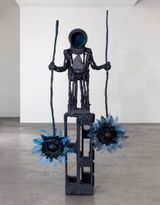
In The man with a stone in his stomach inverts sunflowers. a lone figure stands on a makeshift plinth. Their core is hollowed out and filled with a stone, the identity is obscured or they are without one. The darkened skeletal framework is a precarious one, simultaneously devotional and exhausted, its offering of inverted blue sunflowers are denied their upright sunny, optimistic disposition.
There is a heavy stone, a weight of nothingness at its core.
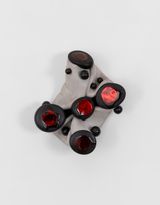
Surrounding the central figure is a new series of wall-mounted sculptures meticulously constructed from twisted concrete cloth with resin and Jesmonite. Concrete cloth — a material associated with reinforcement and containment — is manipulated by Hapaska into forms that appear bodily. Each work has its own glass like forms escaping from the folds or growing on its surface, some red, like enlarged blood platelets, others black, each a dark lens into another infinite universe.
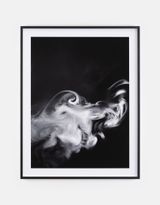
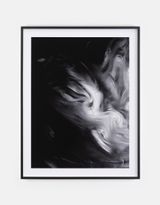
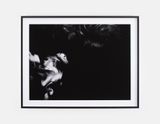
A parallel series of photographic prints captures the artist’s breath in a cold, darkened studio. Barely visible and transient, the images register breath as condensation and disappearance simultaneously — a minimal but insistent index of bodily presence.
The work in this exhibition continues to refine Hapaska’s longstanding engagement with material instability, disorientation and our contemporary psychic dislocation. In one particular work Article 1 UDHR, Hapaska represents the very best of human intentions, the foundational principles of dignity, liberty, and equality spelt out in shells that are eroding, on course to disappear. At the centre of each a void.
Hapaska’s solo exhibitions include Douglas Hyde Gallery, Dublin; Kunstmuseum St Gallen, Switzerland; John Hansard Gallery, University of Southampton; Magasin 3 Stockholm Konsthall; Museum Boijmans Van Beuingan, Rotterdam; the Barbican, Camden Arts Centre; ICA, London. Collections include Hirshhorn, Washington; MIT, Cambridge; Museum of Fine Arts, Boston; Museum of Contemporary Art, Chicago; Tate, London; Irish Museum of Modern Art, Dublin; The National Gallery of Ireland; Arts Council of Ireland; Arts Council of Northern Ireland; Ulster Museum, Belfast; Kunstmuseum St.Gallen; Magasin III, Stockholm Konsthall; Moderna Museet, Stockholm; Museum Boijmans Van Beuningen, Rotterdam; Museum of Contemporary Art, Shenzhen, China and LOEWE. She has participated in major international exhibitions including Documenta X, the British Art Show, Glasgow International, and the 49th and 56th Venice Biennales.
Courtesy Kerlin Gallery.


Siobhán Hapaska’s sculptures present a powerful investigation of conflict, faith and the human condition. Her work uses a dazzling array of materials, each loaded with history and multiple readings: olive trees, deerskins, coconuts, wheat, moss and sheepskin come into contact with sleek aerodynamic forms, aluminium, engines, artillery, concrete cloth and industrial machinery. Ushering these disparate materials into forms that feel anthropomorphic or animalistic, the resulting works spark humour and pathos, reflecting upon our place in a world filled with violent opposing forces and conflicting ideologies. Sometimes kinetic, moving or shaking, many of Hapaska’s works reference travel, rootlessness or displacement, with trees uprooted and plants cast among strange mutant landscapes of opalescent fibreglass. Though they carry a sense of disquiet, her works are always a testament to the perseverance of hope, desire and longing in the face of adverse global conditions and political or spiritual unrest, often undershot with a dark wit, a playfulness, and a devotion to physical objects as transmitters of empathy and emotion.
Kerlin Gallery was founded in Dublin in 1988. It has built an international reputation for its dedicated, meaningful representation of leading contemporary artists through its exhibition, publishing and art fair programmes. Its current site was designed by the minimalist architect John Pawson in 1994 and offers 3,600 square feet of exhibition space over two floors in the heart of Dublin City Centre.

A respected voice in contemporary art discourse.
Focusing on ambitious storytelling and insightful art-world commentary. Ocula Magazine publishes in-depth interviews, critical essays and timely analysis on the artists, exhibitions and ideas driving the global art world.
Learn more about Ocula Magazine
Showcasing the best of the art world.
Ocula partners with galleries from around the world to highlight their artists, artworks and exhibitions. Gallery membership is by application and invitation, with each member vetted by an independent panel.
Learn more about Ocula Membership

Specialises in the sale of major artworks.
Led by a team with deep ties to the world’s leading auction houses, galleries and collectors. Ocula’s advisory team offers bespoke services to high-net-worth clients from around the world who are looking to acquire the best of contemporary and modern art.
Learn more about our team and services