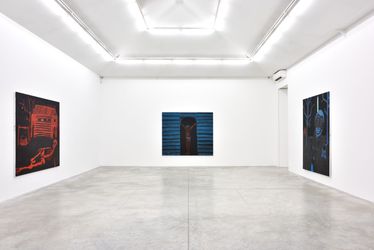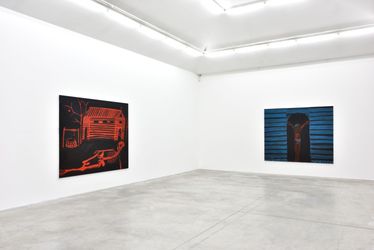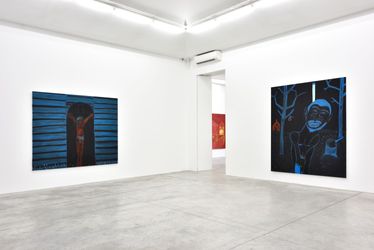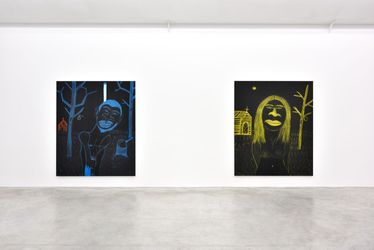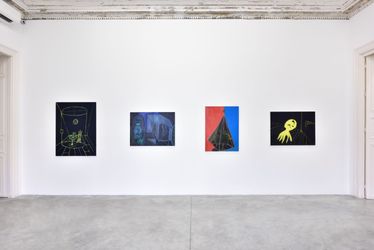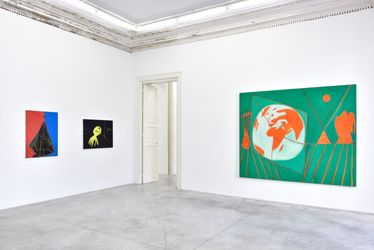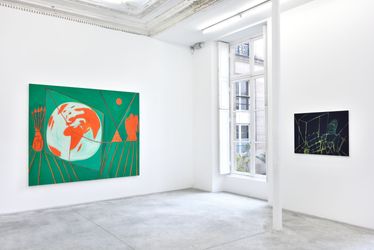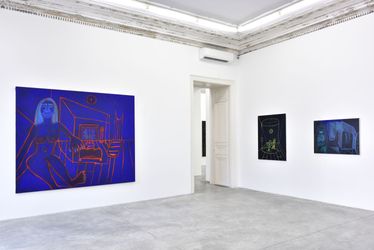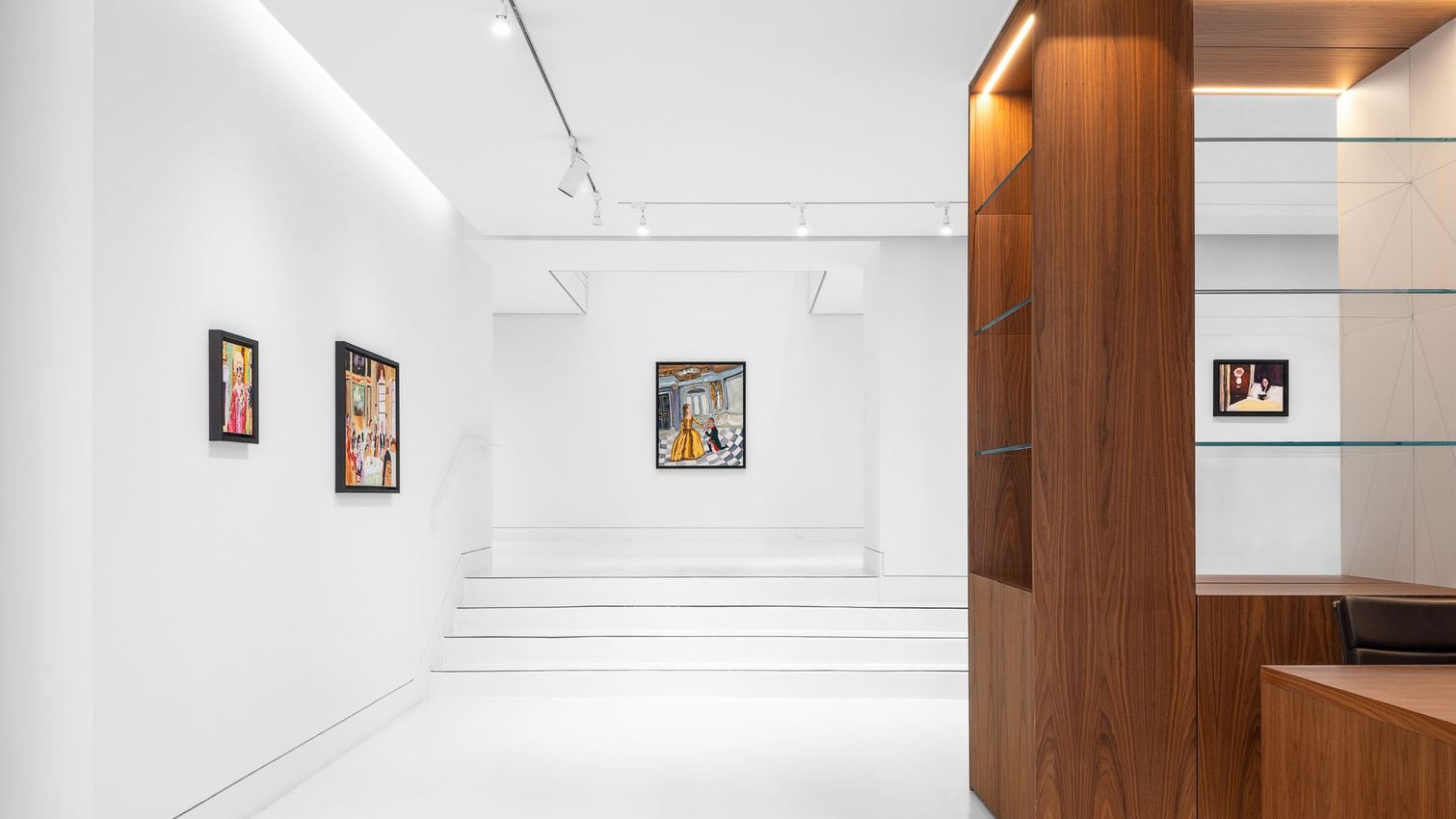
For Marcus Jahmal, painting begins with black. Ivory Black, Lamp Black, Intense Carbon Black. These layered shades of oil give his works an intense chromatic texture reminiscent of Ad Reinhart. Coaxing an image from a black-primed canvas is a deeply spiritual, apophatic process, a kind of accumulation through negation, a way of communing with the void. True to form, Jahmal calls painting his ‘religion.’ A self-proclaimed night-owl, he often works in the evening light of his Bushwick studio, drawing his imagery from his walks through the neighbourhood after sundown, and asks questions of his paintings that only they can answer. This makes for a monastic but secular practice. ‘I paint my way out of the darkness,’ he says.
Jahmal’s ‘New Religion’ is in fact a very old one. His work is steeped in ancientmythology, American folklore, and the history of the African diaspora. He’s an avid collector of rare, out-of-print books about colonial art and Moorish architecture. When I first visited his studio, a painting of the Santa María—the largest of the three galleons that Christopher Columbus sailed to the old ‘New World’—hung on the wall, its sails billowing in the wind. A number of other paintings featured the decorative metalwork common on Bushwick fences; Jahmal notes that, in addition to their own shackles, slaves were forced to produce the elaborate iron trellises famous throughout the French Caribbean, which are now replicated industrially in Brooklyn. The duality of ironwork is embodied by Xango, the god of metallurgy in Afro-Caribbean candomblé, who is equally beneficent and wrathful. By invoking the pain that hides behind beauty in these iron acanthus and fleur-de-lis, Jahmal foregrounds what we might call a politics of decoration. The patterns in his paintings are formal devices that, while negotiating between figure and ground, also bind the works to long histories of slavery and colonisation.
Jahmal was born and raised in Prospect Heights, Brooklyn, a neighbourhood with a large Haitian population. He recalls waking up to the scent of pork tchaka wafting through his open window. At the local barbershop, a poster of Toussaint L’Ouverture astride a rearing horse was a source of constant wonder. His neighbours would perform voodoo ceremonies in the basement of his apartment building, which he spied through an open window. His grandmother, who was from New Orleans, would invite him over for bowls of gumbo. That dish, which gave its name to Jahmal’s 2019 exhibition at Passerelle Centre d’art contemporain, encapsulates the creolised nature of his work, which is equally indebted to the 1980s neo-expressionism of Georg Baselitz and Francesco Clemente. The 2005 Jean-Michel Basquiat retrospective at the Brooklyn Museum, steps from his home, left an especially deep impression.
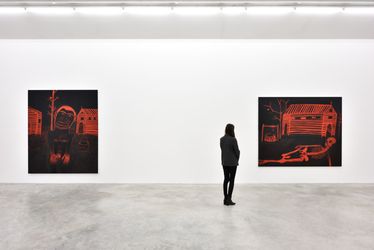
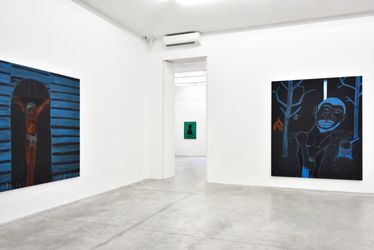
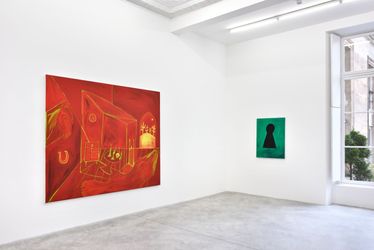
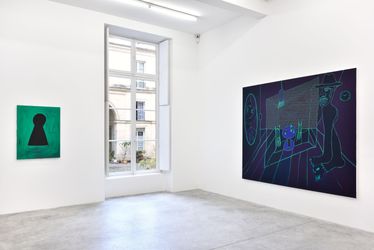
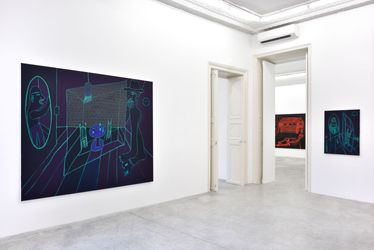
The interior scenes in ‘New Religion’ are a kind of séance. It’s unclear where these rooms begin and end; floorboards and mouldings cut across the paintings at odd angles, lending them an unstable sense of depth. Objects hover spectrally. Jahmal has rendered each space in two contrasting tones, as if seen through night goggles or a body scanner. Each features a rhombohedron at its centre, inspired by the volumes that Francis Bacon traced around the figures in his tortured paintings. Clock on the walls, meanwhile, mark the time that Jahmal finished painting them. Skulls recall the memento mori of Pablo Picasso. Other details point to older origins: in Neon Ritual, for example, a nude woman reclines on the floor while a horse stares at her through an open window, a scene reminiscent of Henry Fuseli’s Nightmare (1781). The encounter in Radiation is the stuff of real nightmares: a figure standing on a skull, glowing nuclear green, gazes into a mirror—where an entirely different person looks back at him.
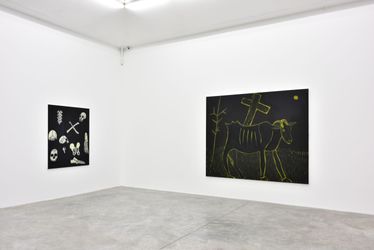
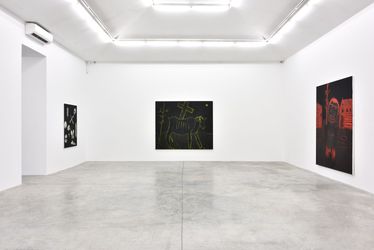
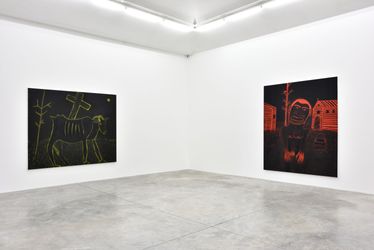
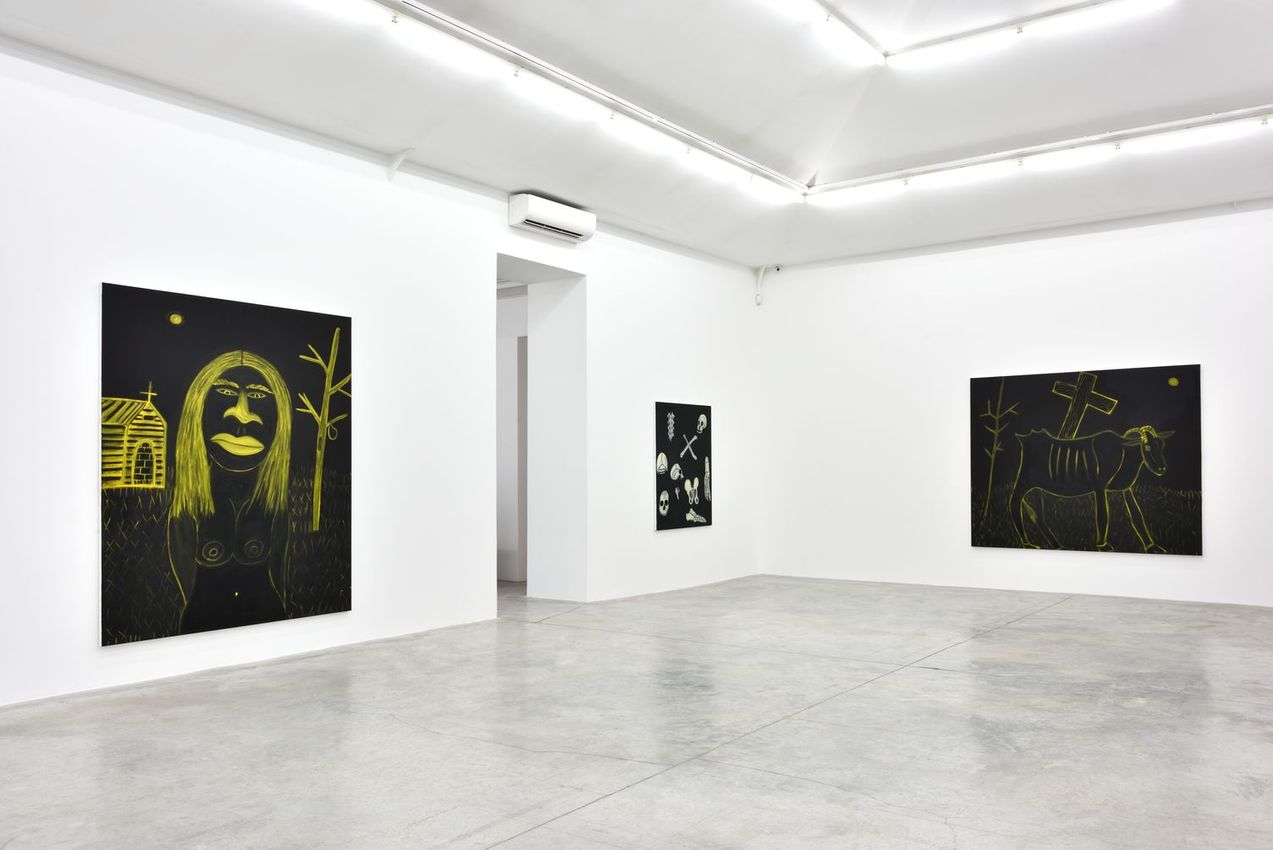
An accompanying suite of landscape paintings situate us in the rural American South. Jahmal has left the black primer on these canvases exposed, casting his outdoor scenes in darkest night. Clapboard barns and churches have been rendered with lateral stripes—another potent pattern. Blades of grass slice across the horizon, painted quickly with an oilstick. Jahmal completes his most frenetic gestures while listening to hip-hop, and so I imagine the sound of Kanye West’s Blood on the Leaves (2013) whistling through these reeds. Meanwhile, trees stretch their eerily barren branches towards the sky. A short noose dangles from one—a simple loop that turns these living landscapes into lynching fields. It hangs there almost matter-of-factly, strange fruit glowing in the moonlight.
Two landscapes are also portraits. A nude lumberjack stands uncomfortably in Moonshine, his axe sunk into a nearby stump. The moon casts a cool blue ray of light onto his head. Black Mass takes its name from the satanic ceremony, and it’s unclear if the calm woman in the foreground is a priestess or sacrificial lamb. Like the lumberjack, she’s been rendered in the same jaundiced tone as the landscape around her, her bare chest Black on Carbon Black. Textured layers of black paint lend depth to the work, summoning forth a spiritual realm beneath the surface of the world. Like the clocks in Jahmal’s interiors, the moon marks time here as it rises and falls, waxes and wanes. It tracks the painter’s progress through the night as he works, asking questions and waiting for answers. It is both a silent witness to the violence in his landscapes and a light which helps his figures find their way in the dark.
Text by Evan Moffitt, writer and critic. Courtesy Almine Rech.


Marcus Jahmal is an artist based in Brooklyn, New York. His paintings depict domestic scenes and landscapes built from memory and imagination. In his images, which are both theatrical and quietly intimate, Jahmal showcases exuberant brushwork and his particular strengths as a colourist. As the art critic Roberta Smith wrote in the New York Times, Jahmal’s ‘main love is colour, which he uses stunningly, but he exploits everything–space, surface, colour, image–to create various incongruities.’ The reds, oranges and other vibrant hues featured in his compositions create a symbolist language connected to the artist’s subconscious and dreams. Jahmal collects his ideas through a practice of automatic drawing, moving intuitively through images he pulls from life or art history. From these drawings, he assembles a cast of objects, mixing his everyday experience with the modern and the myth. Read together, these motifs form a surreal environment with recognisable figures that suggest the complexities and invisible relationships within prosaic life. Jahmal’s work has been exhibited in New York, Chicago, Miami, Tokyo, Japan, and throughout Europe.


Almine Rech opened its doors on April 1st, 1997 in the 13th arrondissement in Paris. The gallery was founded on an axis of California Minimal, Perceptual art and Conceptual art, representing artists such as James Turrell, John McCracken and Joseph Kosuth.

A respected voice in contemporary art discourse.
Focusing on ambitious storytelling and insightful art-world commentary. Ocula Magazine publishes in-depth interviews, critical essays and timely analysis on the artists, exhibitions and ideas driving the global art world.
Learn more about Ocula Magazine
Showcasing the best of the art world.
Ocula partners with galleries from around the world to highlight their artists, artworks and exhibitions. Gallery membership is by application and invitation, with each member vetted by an independent panel.
Learn more about Ocula Membership

Specialises in the sale of major artworks.
Led by a team with deep ties to the world’s leading auction houses, galleries and collectors. Ocula’s advisory team offers bespoke services to high-net-worth clients from around the world who are looking to acquire the best of contemporary and modern art.
Learn more about our team and services