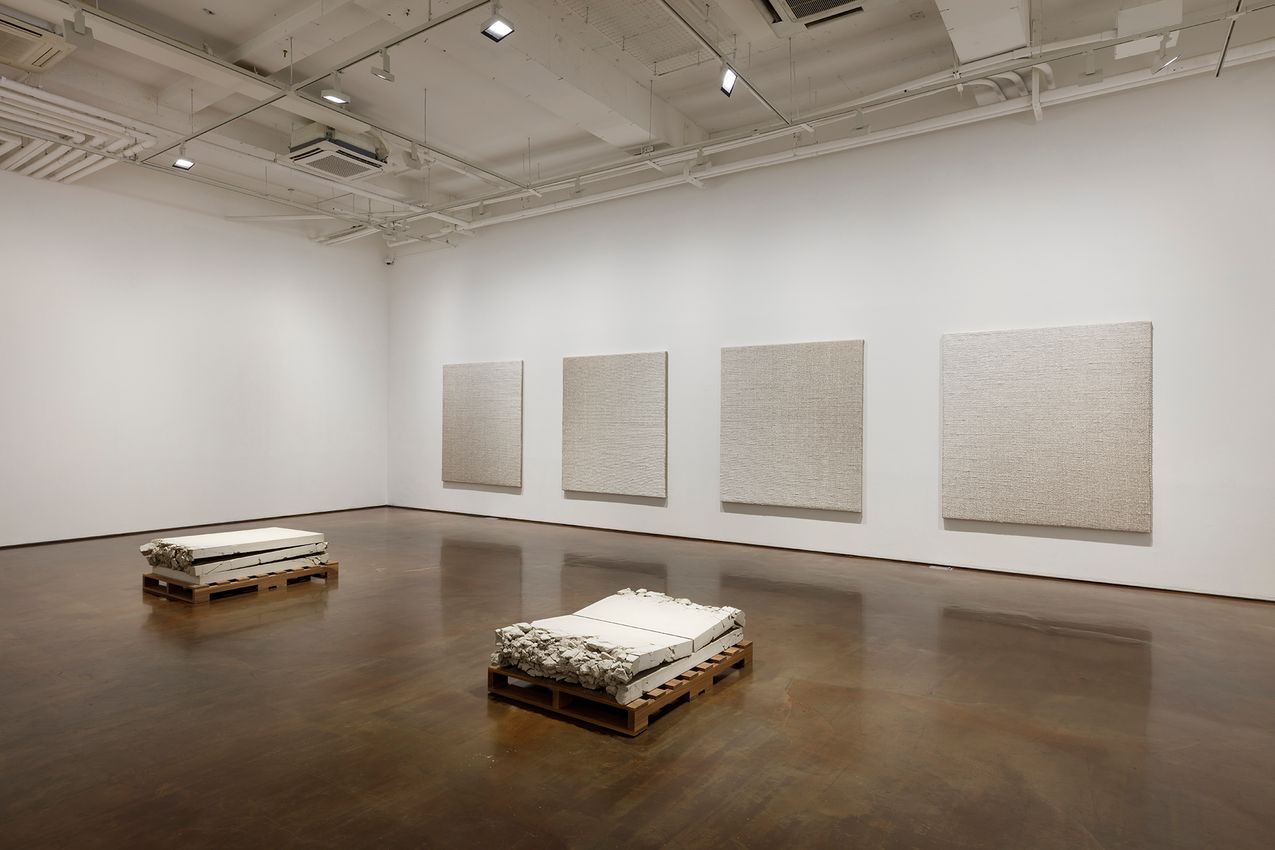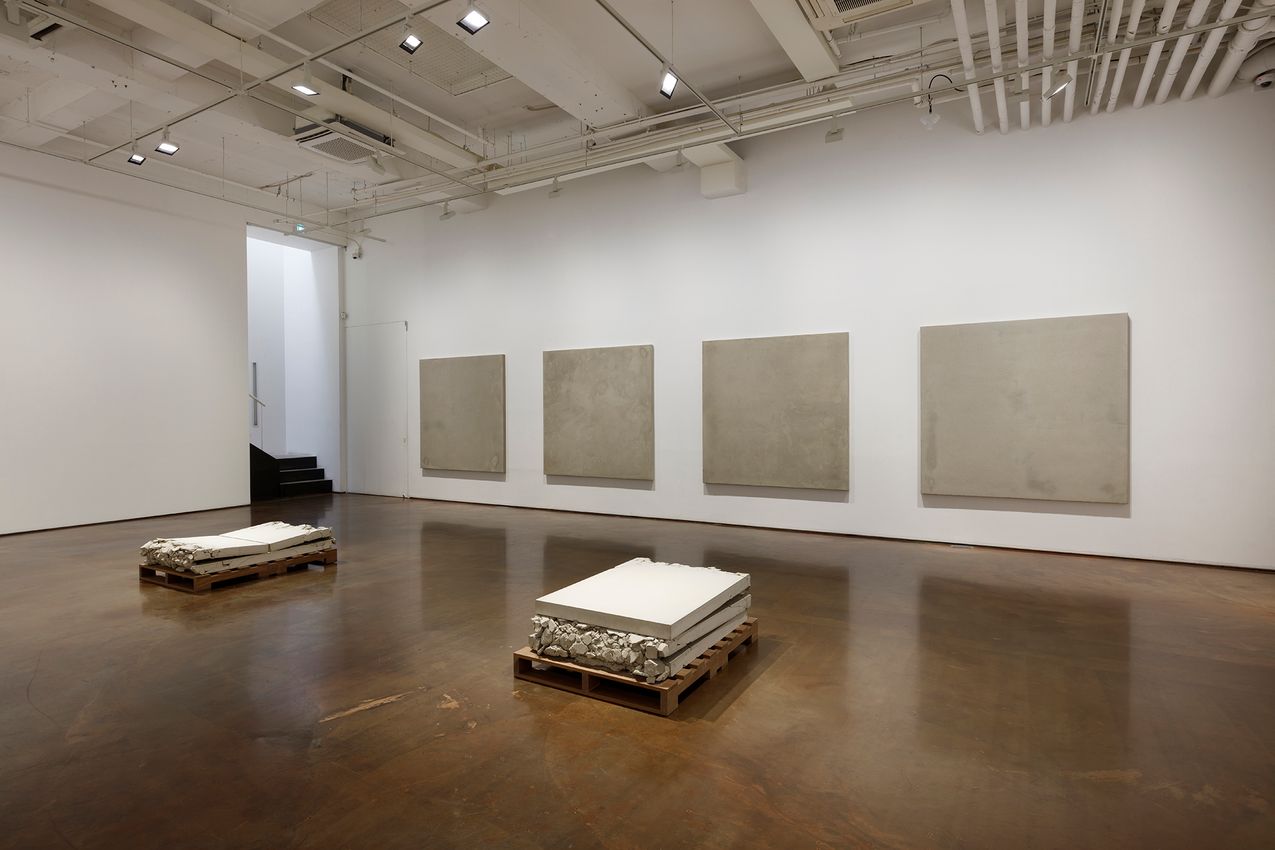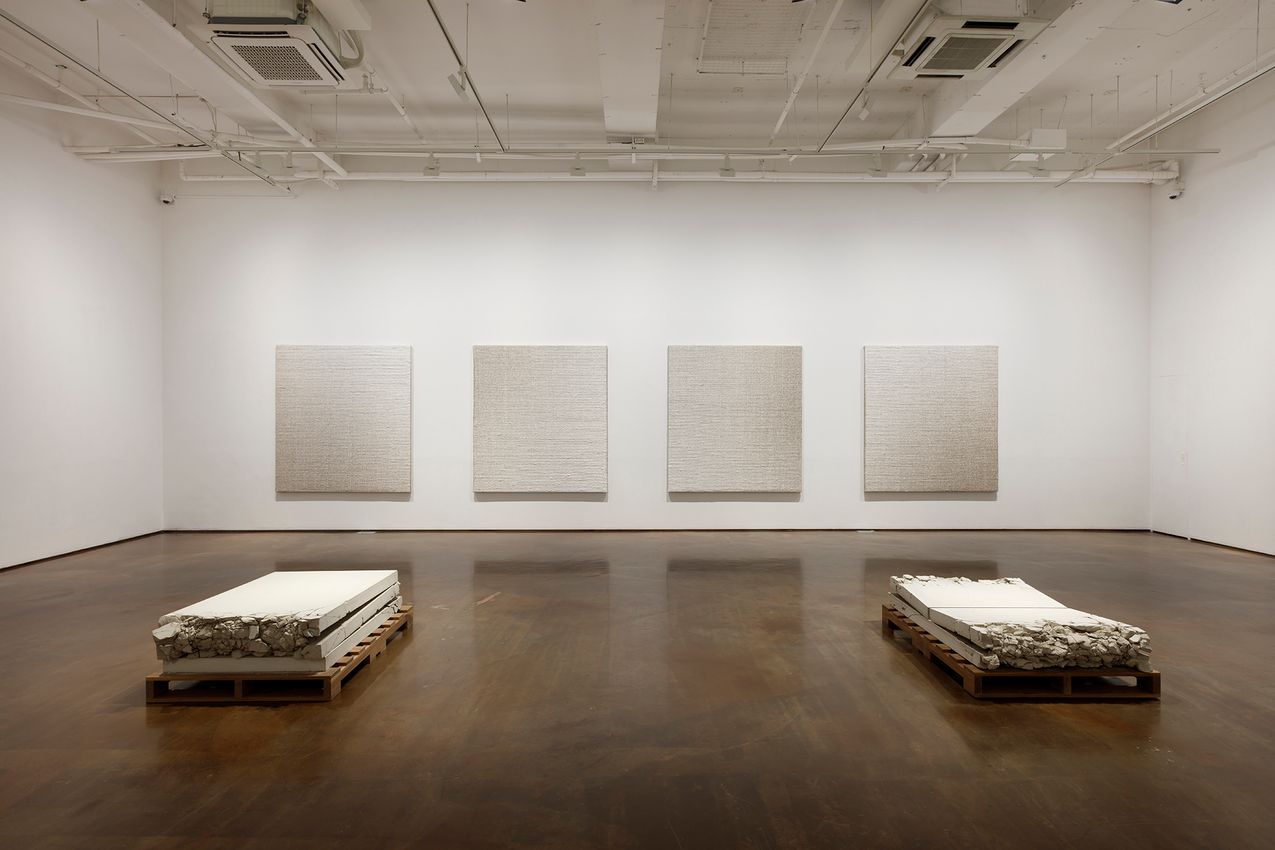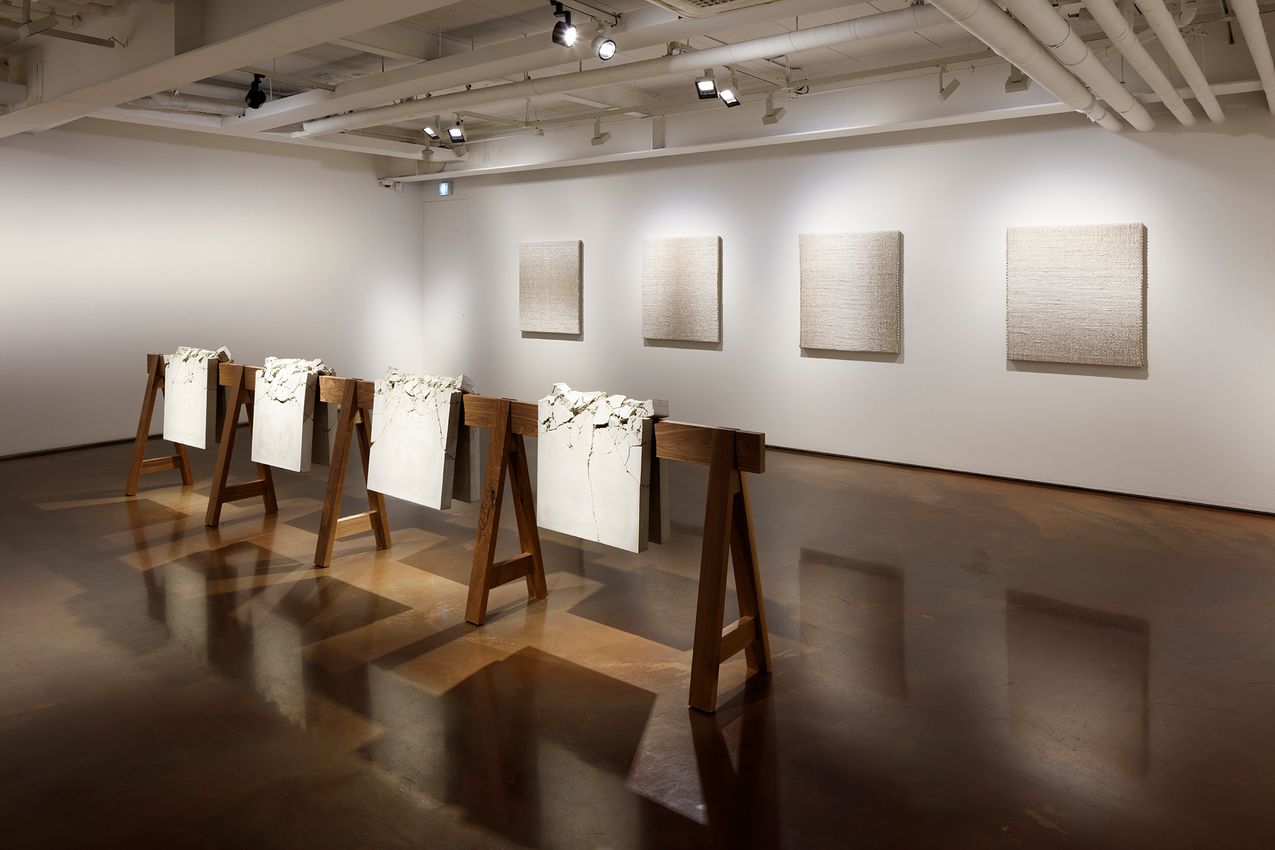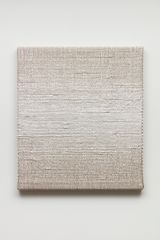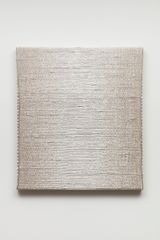




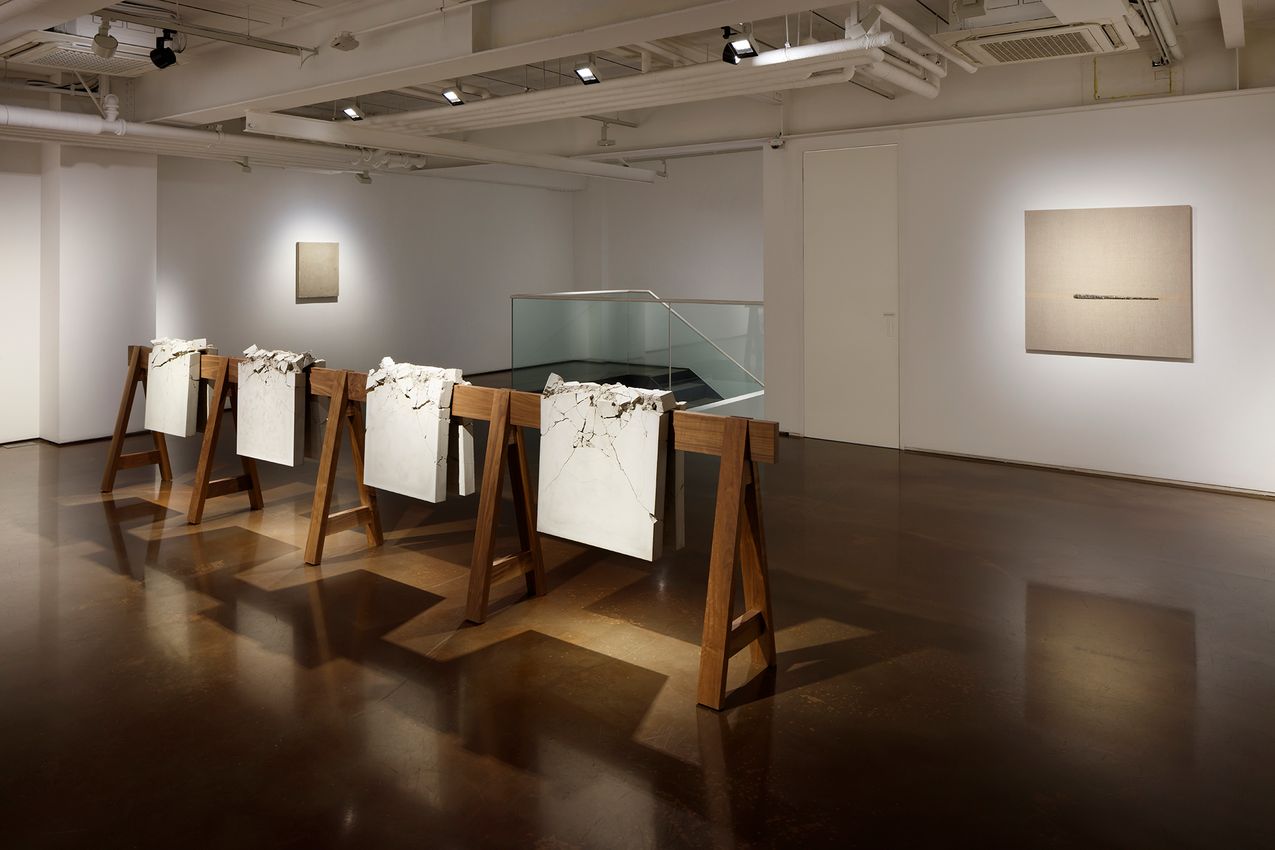
ARARIO GALLERY SEOUL I SAMCHEONG opens Analia Saban (b. 1980, Buenos Aires, Argentina)‘s solo exhibition Particle Theory for the closing exhibition of this year. Analia Saban, born in Argentina and based in Los Angeles, is an artist who has continued to expand the boundaries of traditional media interpretation through the exploration and experimentation of materiality and materials used in art. Through a variety of experiments based on traditional materials, such as making a plane by weaving dried paint between canvas, making a plane out of concrete on canvas, or folding concrete as if it were paper, she points out that medium classification in contemporary art is artificial, and reaching further, asks what the fundamental distinctions between mediums are. Her work is done by dismantling the physical nature of the material and the basic premise of the medium, in which the artist’s unconsciousness penetrates. When an artist deconstructs the working principle of things, they unconsciously project the way he/she views the world. In other words, the material properties and the work of the medium experimentation can also be expected to be reconstructed by her unique and unconscious interpretation of the world.
The exhibition’s title, Particle Theory, is related to the artist’s attitude toward creation. Saban, with the same attitude as a scientist trying to understand the principles of matter, tries to find the ‘particles’ that make up painting and, by extension, art. ‘The Woven Painting’ series looks like a painting at first glance, but differ from conventional painting. The artist solidifies acrylic paint like a thread and then uses it to make a plane by inserting it between the warps and wefts of the canvas. Through this process, the canvas becomes a surface on which paint can be laid, while at the same time it is the paint itself, creating confusion among materials. In the series of concrete works, such as Draped Concrete, Polished Concrete and Folded Concrete, her materialistic experiments on the material and medium question traditional media interpretation. Contrary to that strong impression, these concrete works, by exposing the nature of particles that originally begin with a powder, meet with water and air then become solid and eventually harden, lead us to the question that, if we expand the same logic to art, what would be the smallest unit of material that could be called a particle, and extend further to question what the basic conditions of art are—and who decides these conditions.
Painting is an important subject for the artist. Even now, when new media are discovered and in the spotlight, painting is still the most popular and beloved medium, and as such, it is often questioned whether its survival is still valid or not. The artist asks, ‘Why is painting so important to our culture, and where does its value come from?’ Through material experiments, Saban hopes to make viewers to look at the component and composition hidden in the artwork in a new way by exposing the information and physical structures of paintings, those of which are not detected from the surface alone. Unlike many paintings that deal with the plane-image problem, Saban and her work broaden the range of understanding, covering not only the plane, but also the technical support that makes the plane exist. Series such as Saban’s Woven... paintings and Polished Concrete look like paintings, but they are neither painting nor sculpture; rather, they stay in an ambiguous existence and serve as a threshold for questioning about each other’s point of divergence. However, when Saban applies concrete to canvas instead of paint, she is not rejecting the idea of painting but starting a conversation that is flexible and rich, not a contentious dispute. Through this exhibition, the artist wants to share her thoughts and find answers together with the audience in this special occasion.
Analia Saban studied Visual Arts at Loyola University and New Genres at University of California. She has exhibited in various institutions worldwide such as Modern Art Museum of Fort Worth (Texas, USA, 2019), Hammer Museum (LA, USA, 2019), NGV TRIENNIAL (National Gallery of Victoria, Melbourne, Australia 2017), LACMA (Los Angeles, USA, 2014), Palais de Tokyo (Paris, France, 2013). She was artist-in-residence at the Getty Museum in 2015-2016 and is the 2002 recipient of the Art Council Award (Los Angeles, USA). Saban’s works are represented in the collections of the Museum of Contemporary Art (Los Angeles), Los Angeles County Museum of Art, Centre Pompidou (Paris) and more.


ARARIO GALLERY SEOUL opened its doors in Sogyeok-dong in 2006. Since then, it has established its foothold as a leading contemporary art gallery in Korea and across Asia, continuing to be at the forefront of the international art scene through its efficient representation system and bold exhibitions. In March 2014, ARARIO GALLERY SEOUL relocated near the National Museum of Modern and Contemporary Art. In April 2018, ARARIO GALLERY SEOUL RYSE HOTEL, a second exhibition space in Seoul, opened in the Hongdae area. Running concurrently with its primary location until November 2019, the project space aimed to mirror the experimental spirit of the neighbourhood through its innovative programming. In 2022, ARARIO GALLERY SEOUL ended its Sogyeok-dong era. However, the various experimentation and ventures carried out in the gallery’s previous spaces continue to shape its future at its current location in Wonseo-dong, which reopened in February 2023. Through the preemptive discovery of young artists, steady support of represented artists, and the realisation of meaningful and original exhibitions, ARARIO GALLERY SEOUL aims to continually grow and contribute to the growth of the contemporary art scene in Korea.

A respected voice in contemporary art discourse.
Focusing on ambitious storytelling and insightful art-world commentary. Ocula Magazine publishes in-depth interviews, critical essays and timely analysis on the artists, exhibitions and ideas driving the global art world.
Learn more about Ocula Magazine
Showcasing the best of the art world.
Ocula partners with galleries from around the world to highlight their artists, artworks and exhibitions. Gallery membership is by application and invitation, with each member vetted by an independent panel.
Learn more about Ocula Membership

Specialises in the sale of major artworks.
Led by a team with deep ties to the world’s leading auction houses, galleries and collectors. Ocula’s advisory team offers bespoke services to high-net-worth clients from around the world who are looking to acquire the best of contemporary and modern art.
Learn more about our team and services