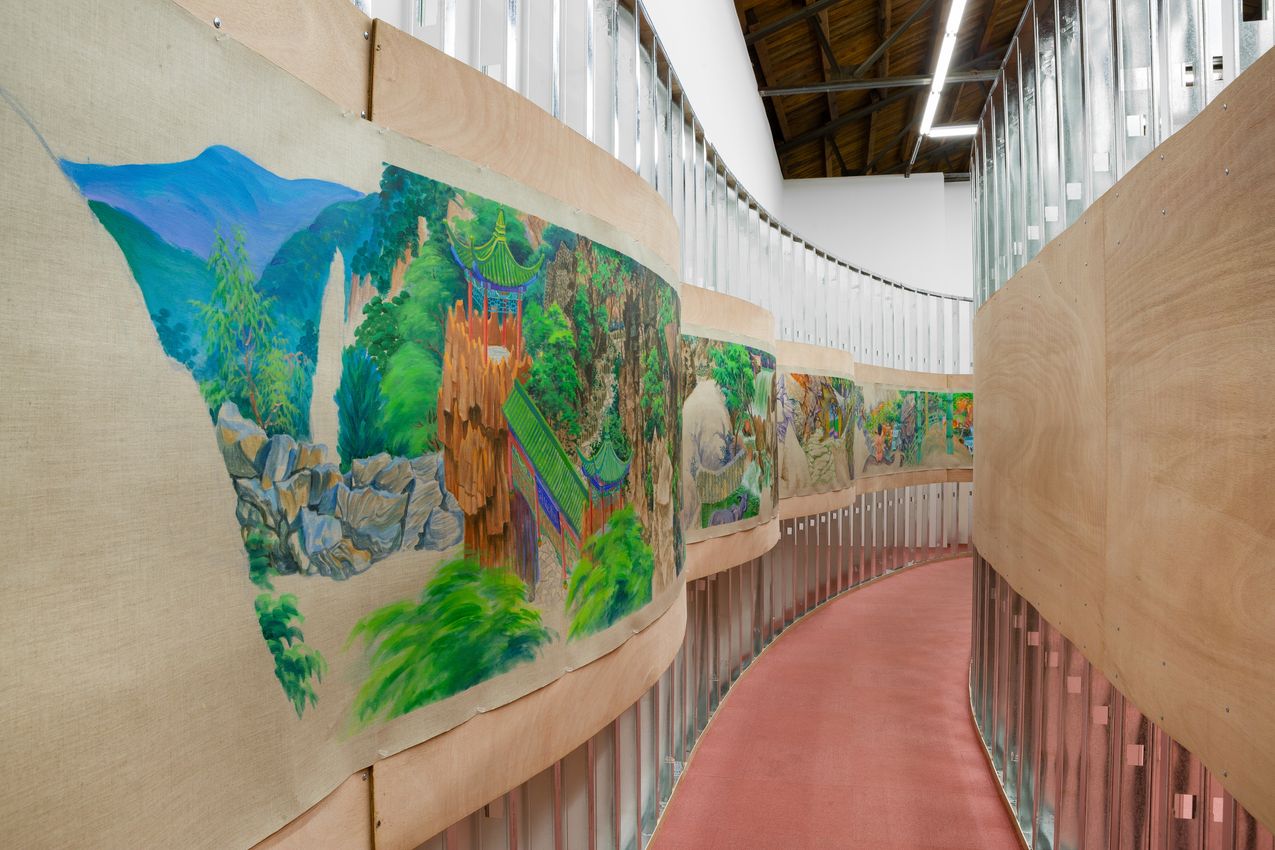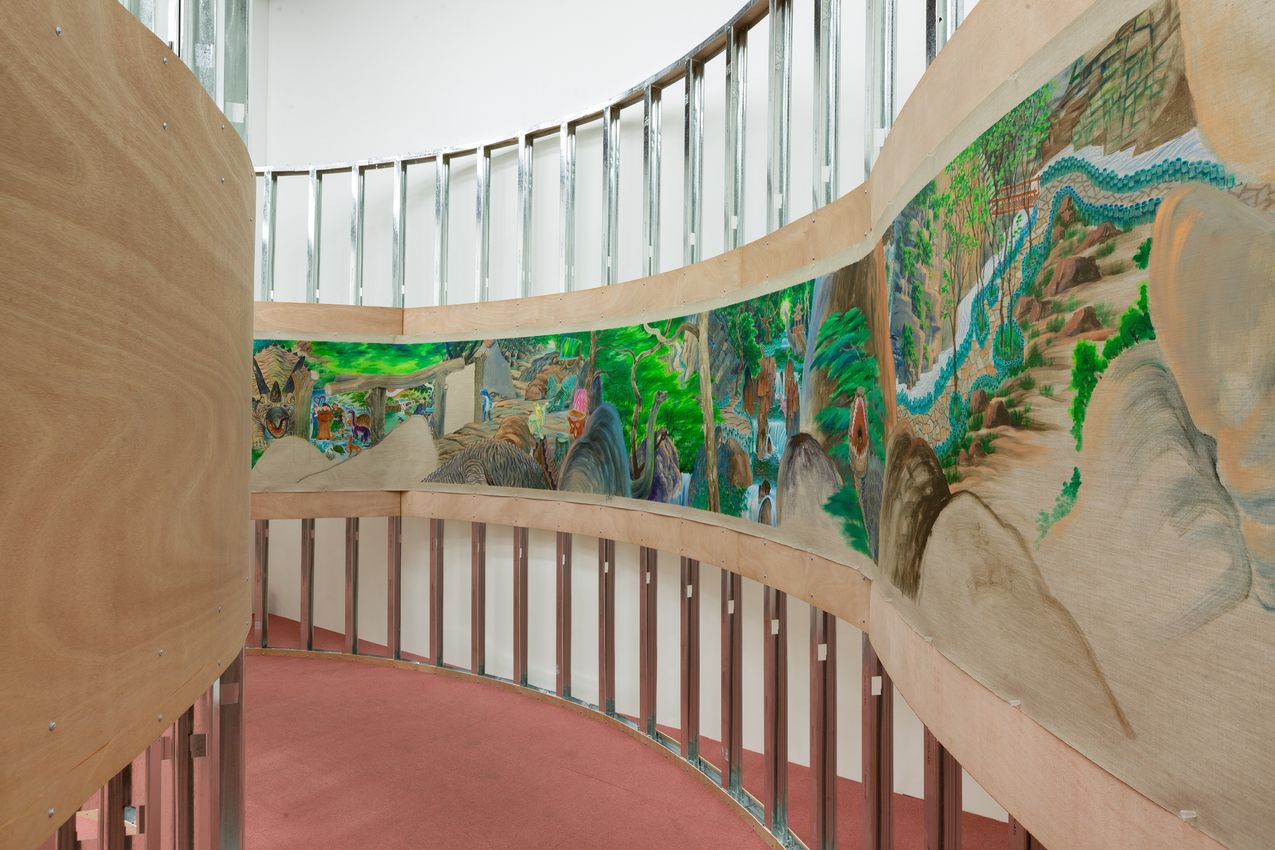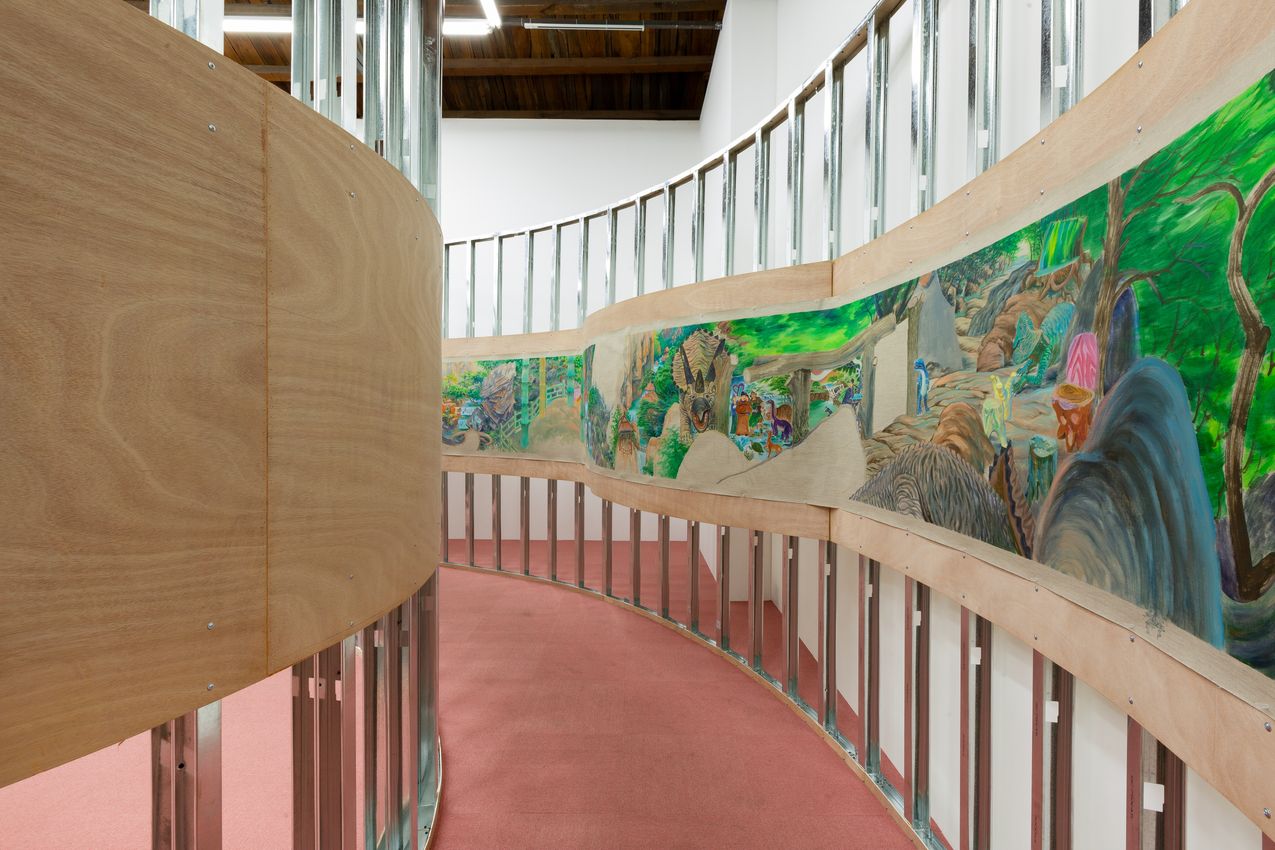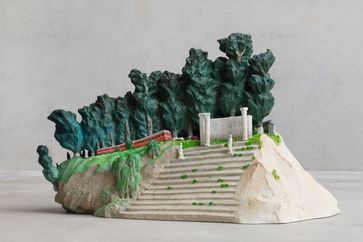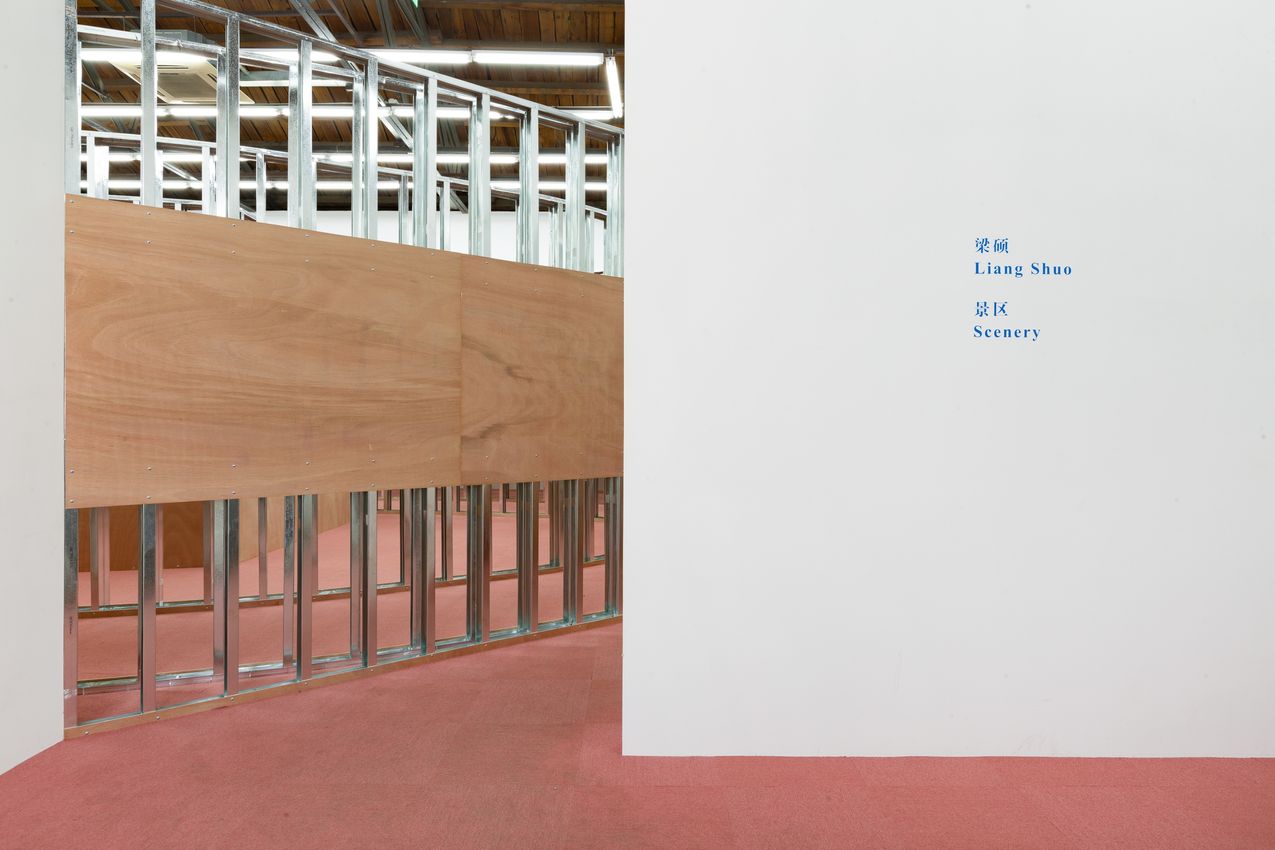
Beijing Commune is pleased to announce that Scenery, the second solo exhibition of artist Liang Shuo, will open on 21 March 2019. Scenery is the junction between the urban and the wild. Scenery as a concept conveys the contemporary attitude towards and understanding of landscapes, a locus for the ancients and the moderns, space and time, ideologies and aesthetics. Painting is the main medium presented in this exhibition, constructed as a figurative space for spectatorship, embodying the experiences, memories and reflections from Liang Shuo’s wandering about rivers and mountains in recent years. The exhibition will open until 4 May.
Liang Shuo frequently uses mundane objects and leftovers as materials, put together with the idea of ‘Zha,’ proposed by him in 2009. From the early ‘Migrate Worker Series’ to ‘Material Practice,’ ‘Smug and Beautiful,’ and ‘Fit,’ the reflections on space and ideological aesthetics are among his major interest. ‘Scenery’ is the key to Liang Shuo’s thinking in recent years. It is about achieving artificial creation to the maximum degreein various limited practical conditions, the same as the fusion between landscapes and Zha.
Liang Shuo regards the presentation of this exhibition as petit woyou (for ancient Chinese literati, woyou means looking at landscape paintings in place of traveling through physical territories) resulted from his recent years’ ‘traveling for pleasure.’ With reference to various formal structures used in traditional paintings such as handscrolls, albums, and hanging scrolls, the traditionally private scene of viewing is relocated into a public exhibition space. By constructing a confined path with economic, low-cost materials, the viewing experience is pushed into a new context. This arrangement follows Liang Shuo’s anti-genre, unpredictable logic and the idea of ‘freedom born out of restriction’ that he has always emphasised. Liang Shuo endows the geographical and cultural phenomena of the exhibition space with the connection between the inner and the outer, so that all the content of the paintings can be connected with their counterparts in reality–sceneries that actually exist. Liang Shuo appreciates how time and space are conveyed in ancient landscape paintings, and manages to achieve ‘anti-images’ by depicting his own embodied experience. ‘While your steps guide your sights,’ ‘people’ become part of the scenery in the exhibition space.
Compared to his previous exhibition Temple of Candour in which the spatial attraction was restored according to textual description, Liang Shuo in Scenery transforms his studies from the three-dimensional to the planar. Skeptical of the rigid mannerism ubiquitous in the classic themes of traditional paintings such as Wangchuan and Huangshan, Liang is more convinced of his own corporeal experiences. In the process of wandering and collecting materials, he consciously resists the retina-oriented training he had received. The space and sites in concern are blended with a constant unmasking and masking of the linguistic mechanism behind the ‘object’ and the ‘scenery’. Wandering in the cracks of reality created by Liang Shuo, the long paragraphs of text in the work serve as linguistic supplements to the images and contribute to the work’s spatial-visual transformation. His understanding of the nature of object is an experiential hybridity of reality, conscious feelings and visuality all generated by his particular methodology
Liang Shuo was born in 1976 and graduated from the Central Academy of Fine Arts, Beijing, in 2000, majoring in sculpture. From 2002 to 2007, he taught sculpture at the Academy of Arts and Design, Tsinghua University. Between 2005 and 2006, he was an artist-in-residence at the Koninklijke Academie van Beeldende Kunsten (the Royal Academy of Art), The Hague. In 2009, he began teaching sculpture at the Central Academy of Fine Arts. In a practice that brings together a range of materials and found objects, Liang defines an approach characterised by what he terms ‘scum’: roughness, a reliance on processes of construction and destruction, and an interest in everyday objects. His work has been presented at major museums around the world, including the National Art Museum of China, Beijing; the National Museum of Modern and Contemporary Art, Korea, Seoul; the Singapore Art Museum; the Power Station of Art, Shanghai; the Yerba Buena Center for the Arts, San Francisco; and the Rijksakademie, Amsterdam. His solo exhibition DISTANT tantamount MOUNTAIN was held at the Staatliche Kunsthalle Baden-Baden in 2017.
Founded in 2004, Beijing Commune is now located in 798 Art Factory, Beijing. Its initial programs were mainly group shows exploring various currents in contemporary art while now it primarily focuses on solo shows to carry on the in-depth research.

A respected voice in contemporary art discourse.
Focusing on ambitious storytelling and insightful art-world commentary. Ocula Magazine publishes in-depth interviews, critical essays and timely analysis on the artists, exhibitions and ideas driving the global art world.
Learn more about Ocula Magazine
Showcasing the best of the art world.
Ocula partners with galleries from around the world to highlight their artists, artworks and exhibitions. Gallery membership is by application and invitation, with each member vetted by an independent panel.
Learn more about Ocula Membership

Specialises in the sale of major artworks.
Led by a team with deep ties to the world’s leading auction houses, galleries and collectors. Ocula’s advisory team offers bespoke services to high-net-worth clients from around the world who are looking to acquire the best of contemporary and modern art.
Learn more about our team and services