




DING SHILUN
b. 1998, ChinaDing Shilun is a Chinese contemporary painter whose large-scale figurative artworks bring together myth, history and everyday absurdity in saturated, meticulously detailed scenes. Living and working between Guangzhou and London, he creates narrative paintings that mix Chinese literature, European art history, manga and global pop culture into a distinctive personal mythology.
Ding’s work has been shown with Bernheim Gallery in Zurich and London, in institutional exhibitions such as Janus at ICA Miami, and Song Art Museum in Beijing announced a major solo exhibition for 2026.
Early life and Education of Ding Shilun
Ding Shilun was born in 1998 in Guangzhou, a large city in southern China, and his experience of dense urban life and rapidly changing environments underpins the crowded, theatrical atmospheres of his paintings. He studied Painting at Guangzhou Academy of Fine Arts, completing his BA in 2020, and participated in an exchange at the Slade School of Fine Art in London, where he deepened his engagement with European painting traditions.
In 2022, Ding completed an MA in Painting at the Royal College of Art in London, a period that helped crystallise his language of elongated figures, layered perspectives and ink-like oil paint. He now maintains a studio practice between Guangzhou and London, working closely with Bernheim Gallery and exhibiting with contemporary art galleries and institutions across Europe, China, Australia and the United States.
Ding Shilun Artworks and Style
Ding Shilun artworks are multivalent narrative paintings grounded in magical realism, populated by beguiling figures who move through fantastical yet strangely recognisable worlds. Blending traditional Chinese painterly techniques with illustration, manga and cinematic staging, he constructs images that feel like stills from an unfolding ‘personal fable’ rather than straightforward allegories.
A defining idea in Ding’s practice is the construction of his own mythology, in which every character can be read as a projection or avatar of the artist. He draws on sources ranging from Chinese legends collected in In Search of the Supernatural to Nuo opera, Goya’s Los caprichos, fashion imagery and anime, allowing spirits, gods, historical figures and club-goers to occupy the same pictorial stage. The paintings are not literal illustrations of these stories; instead, they transform ‘indescribable emotions’ into figures and scenes that hint at fear, desire, confusion and humour at once.
Technically, Ding dilutes oil paint with solvent until it behaves like ink on paper, building many thin, translucent layers that create a tension between precision and haze. Surfaces can resemble watercolour, with coexisting perspectives and abrupt shifts in scale that blur any fixed distinction between real and surreal. This approach demands intense concentration—mistakes cannot be wiped away—so each canvas evolves gradually, like a puzzle assembled without a guiding picture.
Thematically, Ding’s work circles around identity, self-preservation and the feeling of living inside systems larger than oneself. In texts for Janus, he describes his protagonists as embodiments of his own inner life, negotiating different cultures and ideologies while trying to construct a reality they can live with. Many paintings feature doubled faces, masked figures or reversible scenes, echoing the Roman god Janus and suggesting that every moment contains multiple directions, beginnings and endings.
Ding’s imagery is often darkly humorous, combining camp, fashion and horror-movie tension. Works such as Hunter’s Whistle (2024) show a corseted figure with flowers and tomatoes in their headdress, a crossbow at the waist and a skull in a basket, a ‘peaceful but quite scary’ portrait that captures his taste for beauty laced with menace. In other paintings, thieves dressed like Cookie Monster or the Hamburglar, a Ghost Rider-like biker on a flaming motorbike, Cinderella’s carriage and anime-style heroes jostle with market crowds and dinner guests, turning everyday scenes into contemporary history paintings.
In Spectres in Rehearsal, his 2026 exhibition at Bernheim in Zurich, Ding positions himself as a master puppeteer directing an ensemble of extraordinary characters from beneath the stage. Across four large canvases, he uses theatrical and historical imagery to paint what has been described as a ‘Human Comedy’ for the 21st century, where violent, universal and deeply human forces of survival sit beneath spectacle and caricature. The show leads directly into his solo exhibition at Song Art Museum in Beijing, extending these ideas into a museum-scale reflection on how myth and history shape contemporary consciousness.
Awards and honours of Ding Shilun
- 2024, Simon Lee Foundation Institute of Contemporary Asian Art artist commission, Art Gallery of Western Australia, Perth, Australia.
- 2023, selection for Zabludowicz Collection Invites programme, London, United Kingdom.
- 2022, featured graduate of the Royal College of Art degree show, London, United Kingdom.
Exhibitions of Ding Shilun
Ding Shilun has developed a rapidly growing institutional and gallery presence, with solo exhibitions at Bernheim and ICA Miami and group shows in China, Europe, Australia and North America. His paintings have entered public collections including ICA Miami, Guangdong Museum of Art and major museums in Europe and the United States.
Select solo exhibitions
- 2026, Spectres in Rehearsal, Bernheim Gallery, Zurich, Switzerland.
- 2026, Solo exhibition, Song Art Museum, Beijing, China.
- 2024–2025, Janus, Institute of Contemporary Art, Miami, United States.miamiandbeaches+1
- 2024, Mirage, Bernheim Gallery, London, United Kingdom.
- 2023, Invites: Ding Shilun, Zabludowicz Collection, London, United Kingdom.
- 2022, Paradiso, Bernheim Gallery, Zurich, Switzerland.
Select group exhibitions
- 2024, Simon Lee Foundation Institute of Contemporary Asian Art exhibition, Art Gallery of Western Australia, Perth, Australia.
- 2024, presentations during Miami Art Week at ICA Miami, Miami, United States.
- 2024, exhibitions at Guangdong Museum of Art, Guangzhou, China.
- 2023, group exhibition, Kunsthal NORD, Aalborg, Denmark.
- 2022, Royal College of Art graduate exhibitions, London, United Kingdom.
Website, Instagram, and further reading
Artist’s Instagram: www.instagram.com/ding_shilun
For further reading on Ding Shilun’s practice and key works, see the Bernheim Gallery artist overview and Spectres in Rehearsal exhibition text, the Janus exhibition page at ICA Miami, the Simon Lee Foundation Institute of Contemporary Asian Art profile, the TWO x TWO catalogue essay and Alex Hawgood’s interview ‘Artist Ding Shilun Makes His Own Mythology’ in W Magazine. View exhibitions featuring Ding Shilun on Ocula when available.
About this profile
This profile of Ding Shilun was commissioned for Ocula by Anna Dickie drawing on verified sources including museum and contemporary art gallery publications, institutional exhibition materials and major art media coverage.
Ding Shilun FAQs
Who is Ding Shilun?
Ding Shilun is a Chinese contemporary painter from Guangzhou whose large-scale figurative paintings mix myth, history, manga and pop culture, and he lives and works between Guangzhou and London. He has exhibited with Bernheim Gallery in Zurich and London, ICA Miami, Zabludowicz Collection in London and institutions in China, Australia, Europe and the United States.
What type of art does Ding Shilun make?
Ding Shilun makes figurative narrative paintings grounded in magical realism, featuring crowded scenes where gods, spirits, historical figures and cartoon-like characters share the same space. Using heavily diluted oil paint, intricate detail and overlapping perspectives, he turns personal emotions and cultural references into complex visual fables.
What are Ding Shilun’s main themes and ideas?
Ding Shilun’s main themes include identity, self-preservation, cultural hybridity and the absurdity of contemporary life under social, political and economic pressure. His “personal fables” explore how individuals navigate conflicting beliefs and systems, often through masked, doubled or camp figures that embody both vulnerability and bravado.
What are the most important works and exhibitions by Ding Shilun?
Important works and exhibitions by Ding Shilun include key 2024 paintings from Janus at ICA Miami—such as The Magical Sword Does Not Come (2024) and Lost in Time (2024)—and the panoramic canvases in Spectres in Rehearsal at Bernheim Zurich, shown from 5 February to 11 April 2026. Earlier milestones include Paradiso at Bernheim Zurich in 2022, Mirage at Bernheim London in 2024, and his Invites: Ding Shilun presentation at Zabludowicz Collection in London from 28 September to 19 November 2023, which helped establish his international profile.
How does Ding Shilun use mythology and pop culture in his paintings?
Ding Shilun uses mythology and pop culture by placing Chinese legends, religious imagery and Nuo opera masks alongside Cinderella, Cookie Monster, anime heroes and fashion references in the same composition. This collision turns old stories and mass-media icons into tools for thinking about contemporary life, suggesting that myth and pop culture shape how people imagine themselves today.
Where can I see work by Ding Shilun?
You can see work by Ding Shilun at Bernheim Gallery in Zurich and London, ICA Miami in the United States, the Art Gallery of Western Australia in Perth and museums including Guangdong Museum of Art in Guangzhou. His paintings also appear in group exhibitions, public and private collections across Europe, Asia, Australia and North America, and in events such as TWO x TWO for AIDS and Art in Dallas.
What is distinctive about Ding Shilun’s painting style and technique?
Ding Shilun’s painting style is distinctive for its use of heavily diluted oil paint that mimics traditional Chinese ink, creating translucent layers that are both controlled and unpredictable. Combined with precise detailing, shifting perspectives and cinematic staging, this technique produces immersive, puzzle-like compositions that viewers read slowly over time.
What is Ding Shilun’s background and education?
Ding Shilun studied Painting at Guangzhou Academy of Fine Arts, completed an exchange at the Slade School of Fine Art in London and earned an MA in Painting from the Royal College of Art in 2022. His training across China and the United Kingdom underpins his hybrid visual language, in which Chinese folklore and urban life meet European painting, fashion imagery and anime.
Has Ding Shilun received awards or major recognition?
Ding Shilun has received major recognition through the Simon Lee Foundation Institute of Contemporary Asian Art commission at the Art Gallery of Western Australia and selection for the Zabludowicz Collection Invites programme in London. His inclusion in institutional shows at ICA Miami, Guangdong Museum of Art and other museums, as well as acquisitions by public collections, underscores his growing status in international contemporary painting.
Ocula | 2026


Representative Artworks

Ding Shilun, The Intimate (2024). Oil on linen. 230 x 190 cm. Courtesy Ding Shilun. Photo: Eva Erzog.
View story

Ding Shilun, The Intimate (2024) (detail). Oil on linen. 230 x 190 cm. Courtesy Ding Shilun. Photo: Eva Erzog.
View story
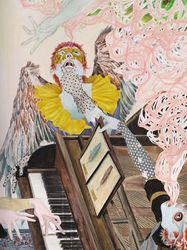
Ding Shilun, Annunciation (2024) (detail). Oil on linen. 230 x 190 cm. Courtesy Bernheim Gallery. Photo: Eva Erzog.
View story

Ding Shilun, Medals of Merit (2024). Oil on linen. 110 x 90 cm. Courtesy Bernheim Gallery. Photo: Eva Erzog.
View story
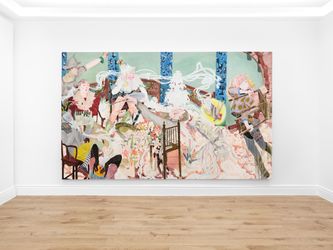
Ding Shilun, Medals of Merit (2024). Oil on linen. 110 x 90 cm. Courtesy Bernheim Gallery. Photo: Eva Erzog.
View story

Explore and Follow Artists Shaping Contemporary Art
A respected voice in contemporary art discourse.
Focusing on ambitious storytelling and insightful art-world commentary. Ocula Magazine publishes in-depth interviews, critical essays and timely analysis on the artists, exhibitions and ideas driving the global art world.
Learn more about Ocula Magazine
Showcasing the best of the art world.
Ocula partners with galleries from around the world to highlight their artists, artworks and exhibitions. Gallery membership is by application and invitation, with each member vetted by an independent panel.
Learn more about Ocula Membership
Specialises in the sale of major artworks.
Led by a team with deep ties to the world’s leading auction houses, galleries and collectors. Ocula’s advisory team offers bespoke services to high-net-worth clients from around the world who are looking to acquire the best of contemporary and modern art.
Learn more about our team and services