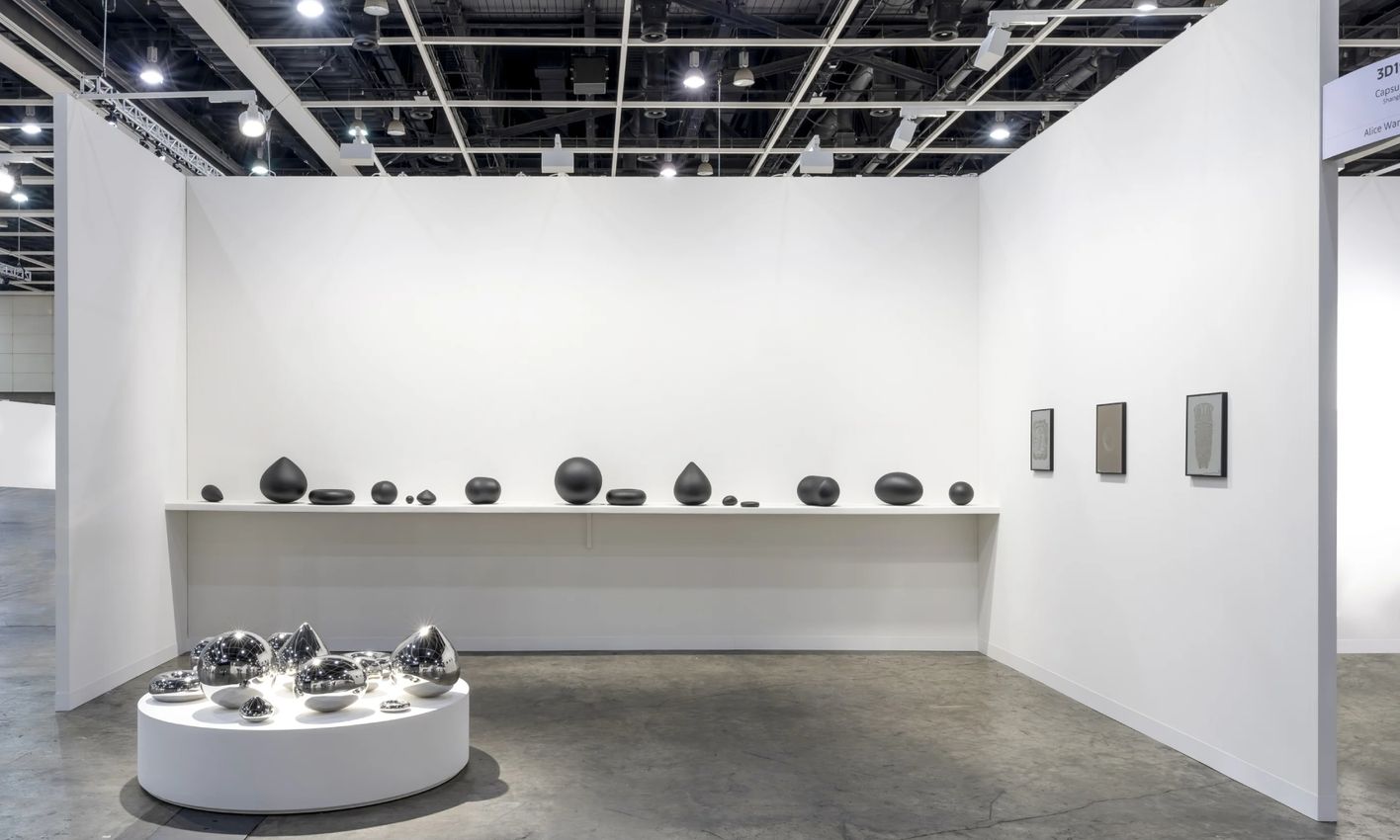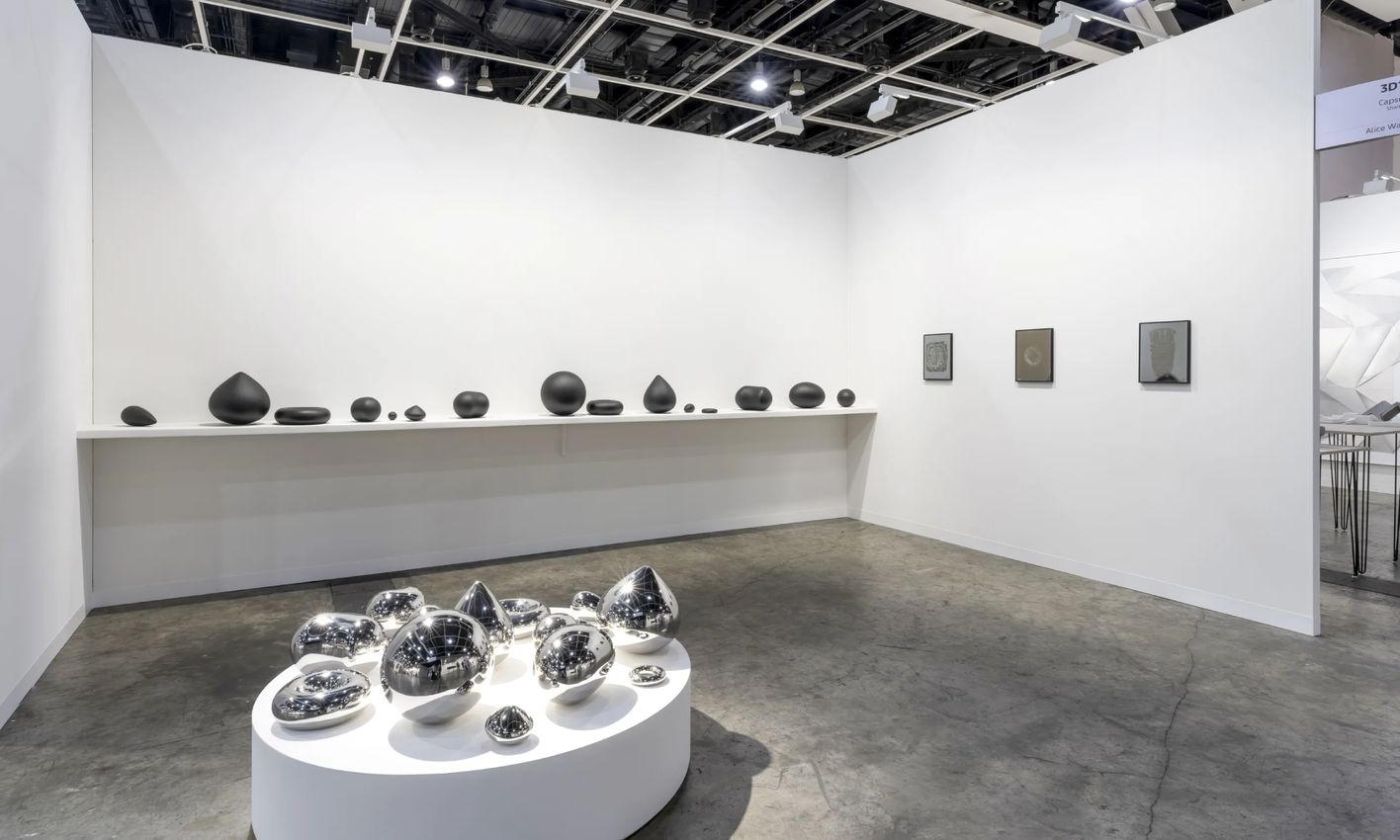
Capsule Shanghai is pleased to participate in the Discoveries sector of Art Basel Hong Kong 2023 with Alice Wang‘s (b. 1983, Xi’an, China) solo project Quantum Dream Machine, showcasing a new group of stainless-steel sculptures and a series of wet-plate collodion photographs exposed on two-way mirrors.
Popping in and out of being, electrons exist as probability clouds. They can also be entangled to exist in two different parts of the universe at the same time. What Einstein called ‘spooky action at a distance,’ these electrons cease to be distinct objects and function as one system that inhabits two states simultaneously. Beyond our common-sense perception of reality, the quantum dimension feels strange and mysterious.
Unlike digital computers that store information as electrical signals in binary bits, quantum computers use subatomic particles, such as electrons; in particular, entangled electrons are used to encode data in multiple states at once, giving the quantum computer its incredible potential. Based on the shapes of hydrogen electron probability clouds, the three dimensional forms use the language of sculpture to bring the quantum experience into the realm of our senses.
Sculptures can shift perception and open up alternate ways of thinking and imagining new worlds. Entangling two electron cloud forms, the paired sculptures are interconnected — one existing in opposite phenomenological effect to the other; the ultra-matte black stainless-steel pieces absorb light while their mirror finish counterparts reflect light. Activating one’s memory and imagination, the work implicates the spectator in its entanglement; seeing one form triggers the mind to conjure its inverted twin, in an instant, one is transported into the quantum dimension.
Three two-way mirror glass sheets are embedded with images of various quantum computing technologies using the wet-plate collodion photographic process. The translucent quality of the two-way mirrors gives the photographic works a sense of dimensionality while retaining their reflective property. Constructed as portal-like screens, the images on mirror reflect the ‘world of the human’ while providing a glimpse into the quantum realm like dream machines.
Quantum computers have the potential to model reality in a range of scenarios, including weather systems, viral behaviour, information networks. The future applications of quantum computing will be revolutionary, which may affect climate change, global health, communication, and other issues on the planetary scale. As Richard Feynman said, ’Nature isn’t classical, ... if you want to make a simulation of nature, you’d better make it quantum mechanical.’


Working with the mantra that the Earth is plummeting towards the Sun while just missing it, Wang combines scientific, technological, mythical, and spiritual perspectives to see how matter can be understood to embody existential qualities. Wang chooses materials that convey the sentient universe through sensual, tactile, and metaphoric means, and imagines how the nature of reality can be expressed in the language of sculpture and film.

A respected voice in contemporary art discourse.
Focusing on ambitious storytelling and insightful art-world commentary. Ocula Magazine publishes in-depth interviews, critical essays and timely analysis on the artists, exhibitions and ideas driving the global art world.
Learn more about Ocula Magazine
Showcasing the best of the art world.
Ocula partners with galleries from around the world to highlight their artists, artworks and exhibitions. Gallery membership is by application and invitation, with each member vetted by an independent panel.
Learn more about Ocula Membership

Specialises in the sale of major artworks.
Led by a team with deep ties to the world’s leading auction houses, galleries and collectors. Ocula’s advisory team offers bespoke services to high-net-worth clients from around the world who are looking to acquire the best of contemporary and modern art.
Learn more about our team and services