Press Release

Vanilla is, unexpectedly, a political word. First, the word persuades through its sound. The lips meet and part, as if releasing a small burst of air. The tip of the tongue lightly touches the palate and rolls away. It unfurls. As the tongue turns inside the mouth, vanilla spills outward. To say vanilla is to release a scent at once sweet and lingering, dissolving into the air like falling snow. I think of the ecstasy of those intimate moments when a world I did not know suddenly arrives, borne on the utterance of a single word. Of the present in which nothing has happened, and yet everything has already been lost. Of a tiny world collapsing, and of a fragile future approaching from an unknown time and place. Of this place where the future bends toward the past, and the present turns back upon it. The thought appears suddenly and disappears just as quickly. Of accepting the end of the world and to speak of that long journey, the tongue releases vanilla in a way that refuses to end. It slips quietly, momentarily, between the teeth. It traces a spiral along the edges of the mouth, rounded in its pronunciation. A beginning without harshness, a middle without an edge, an ending without a period. At a certain point, even when I stop, the tip of my tongue continues to turn. Vanilla comes undone inside the mouth. You dissolve into vanilla.

One milky dawn, while dreaming, something approaches my paralyzed body, takes my head in both hands, and bites into it as if eating a translucent fruit. In Chanson pour le Nouveau-Monde (Song for the New World, 2021), the narrator recalls a childhood spent on a Caribbean island many years after her father disappeared in Scotland. Miriam Charles layers the incomprehensibility of loss after the experience of losing someone onto a longing for her homeland of Haiti and the suppressed memories of a community. Like a song caught in endless repetition, the work is acutely attuned to the possibility of endings; it watches for them. The camera lingers over nearly motionless scenes—a cemetery, a waterfall, a shoreline, children’s toys scattered on the ground. The emotional density is immense. A persistent sensation hangs over the images: that something incomprehensible has already happened, or is about to happen. The song, sung in the artist’s native language of Kreyòl, seems to cast a spell upon the very condition of the world we inhabit—as though it has always existed, and will always exist, in such a state: one in which a tragedy has already occurred or is perpetually on the verge of occurring. In this way, the artist renders my despair and your disappearance, each individual loss, as fundamentally interconnected.

Seungyeon Yi’s Time Eroded Cliff (2026) resembles a sea cliff shaped through the ceaseless passage of waves and breaking light, through cycles of death and birth. It is a formation carved by salt-laden water, or a place of refuge for living creatures. Laden with multiple layers of metaphor, the cliff becomes an entryway into another temporal realm. The materials that seem to melt and loosen across the wall surface, together with the tangible and intangible layers accumulated within them, evoke an ongoing process of movement and transformation. How many currents of time and change must they pass through? The moment a hand touches the ivory-coloured surface, its contours begin to dissolve. Apparitions of dead life forms drift within the mass, stripped of physical presence, volume, and specificity. If there is one thing the artist believes without doubt, it is that no disappearance is ever entirely complete; nothing vanishes without leaving a trace. That conviction slowly takes shape within the work, dissolving, settling, and accumulating across the surface. Time Eroded Cliff regards time not only as a merciless force that erases life, but also as a mystery that enables life to emerge and grow. Time does not move in a straight line. Instead, it extends in multiple directions, overlapping and folding into itself as it flows.

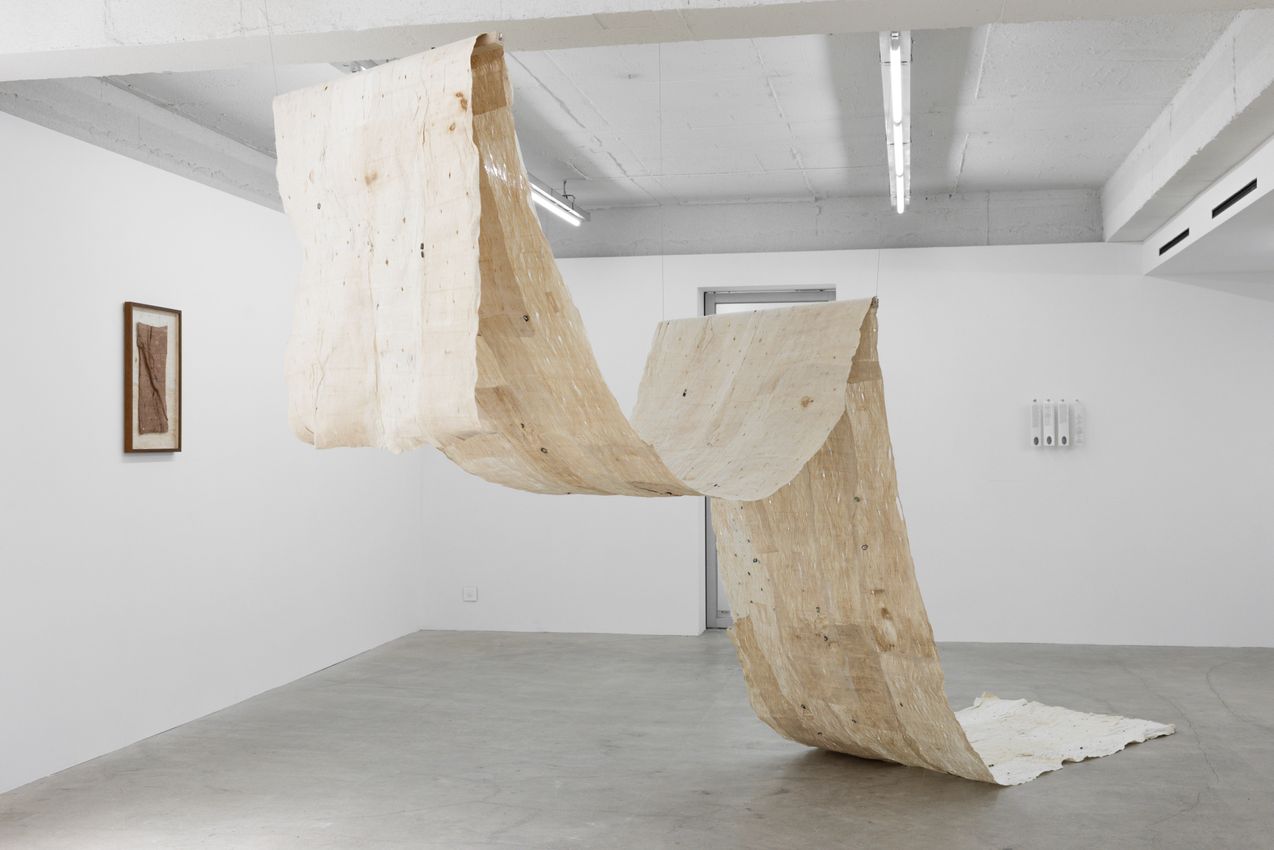
Encountering Mata1, the end of the world no longer appears as a singular event but as a fractal—an ending that recurs endlessly at different scales. As a Māori artist living in the aftermath of a “small apocalypse2,” Atarangi Anderson weaves forms of life that emerge after collapse through Te Ao Wairua3—the spiritual realm encompassing the profound and sacred relationships among spirits, ancestors, all living beings, and the cosmos. The diamond-shaped pātiki4 motifs embroidered onto aute5 cloth symbolise both the abundance of feminine care and the fractal logic of a reality that is never fixed but constantly moving and renewing itself. Made by beating, joining, and thinning sheets of tree bark, the cloth stretches and envelops. Light and cool, it moves through the spaces between things. As the long strips of bark slowly lean toward us, an unfamiliar world begins to diffuse through the air. A pale white tinged with yellow flows quietly into our vision, inviting us to encounter a truth larger than ourselves.

  1. In Māori: Eyes that make spiritual perception possible
  2. As a Māori Indigenous artist, she argues that, like many Indigenous communities, the Māori have already experienced an apocalypse—that is, the end of nation, land, and culture.
  3. In Māori: The spiritual world
  4. Derived from the diamond shap–e of the flounder, thi–s motif metaphorically represents women’s care and devotion to the community (iwi) in Māori Indigenous culture. It is a symbol that honors the role of women who, even while men sleep deeply through the night, remain alert to the moment when flounder appear—providing food in the darkness and sustaining life through their labor.
  5. In Māori: Polynesian traditional barkcloth
  6. For example, the artist shared the following account of her working process: “Since 2020, the aute grove (pā aute) that I have been nurturing and caring for has been the subject of ongoing dispute, as developers have sought to purchase the land for housing construction. After years of legal contention, the case eventually reached the Supreme Court, and this week the garden is being dismantled. They are installing pipelines through the very old trees that form the source of my work.For me, this incident feels like yet another example of how colonial orders—still operating today—continue to obstruct every attempt to reassemble and restore the world. It is truly heartbreaking.” Such experiences invite us to reconsider what it might mean to create abundance and liberation within a world that is already damaged and displaced.

Text. Seunga You

Read More

Installation Views

Artists Exhibiting

About the Gallery

CAPTION is a contemporary art gallery based in Yongsan-gu, Seoul. Founded in 2023, the space presents distinct visual vernaculars and practices from Korea and abroad. Working in close alignment with its artists, it aims to foreground visionary perspectives to cultivate long-term creative trajectories through curated exhibitions, publications, and collaborative projects.Positioned as a facilitator between creators and audiences, CAPTION gathers diverse viewpoints and recontextualizes them to explore new discourses in art. The gallery serves as a vital nexus connecting artists with collectors, nurturing visions as they evolve into sustainable careers. As an experimental space unconstrained by medium or discipline, CAPTION strives to offer multi-layered artistic experiences within the dynamic landscape of contemporary art.

View Gallery Profile
Address
2F, 5, 81-gil Wonhyo-ro
Yongsan-gu
Seoul
South Korea
Opening Hours
Wednesday–Sunday
1pm – 7pm

Closed on Mondays & Tuesdays
(1)
Seoul 2F, 5, 81-gil Wonhyo-ro, Yongsan-gu
CAPTION
2F, 5, 81-gil Wonhyo-ro, Yongsan-gu, Seoul, South Korea
+82 0507 1409 7995
http://www.captionseoul.com

Opening hours
Wednesday–Sunday
1pm – 7pm

Closed on Mondays & Tuesdays
The art world in focus