




JASPER JOHNS
b. 1930, United StatesOne of the most influential American artists of the 20th and 21st centuries, Jasper Johns revolutionised contemporary art with his iconic use of everyday imagery—such as flags, numbers, and maps—challenging the boundaries between abstraction and representation.
Early Years
Jasper Johns was born in Augusta, Georgia, and raised in South Carolina. From a young age, he showed a strong inclination toward art but received little formal training early on. He briefly studied at the University of South Carolina before moving to New York in 1949, where he attended the Parsons School of Design for one semester. Following military service during the Korean War, Johns returned to New York, where he began forging a pivotal artistic relationship with Robert Rauschenberg.
In the mid-1950s, Johns began developing a new visual language that broke away from Abstract Expressionism. By embracing familiar motifs—such as the American flag—and deploying them with conceptual and painterly complexity, he laid the groundwork for Pop art, Minimalism, and Conceptualism. Johns continues to live and work in Connecticut and Sharon, maintaining a central role in contemporary art discourse.
Artworks
Jasper Johns’ artwork combines intellectual rigour with formal experimentation, often using encaustic painting, collage, printmaking, and sculpture to explore perception, symbolism, and the process of making art.
Flag (1954–55)
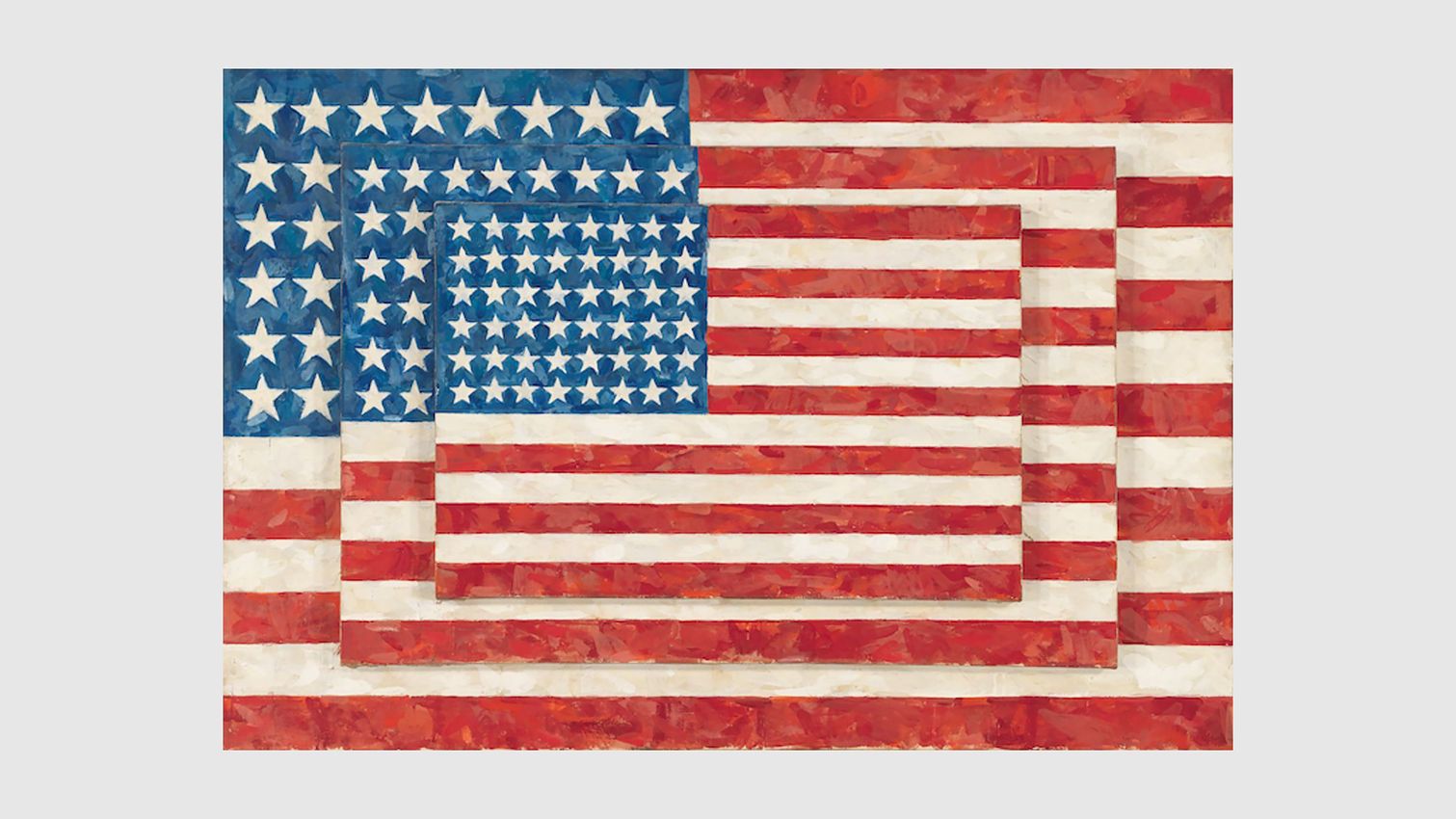
Arguably his most recognised work, Flag (1954–55) is a painting of the American flag made using encaustic, oil, and newspaper on fabric mounted on plywood. While it depicts a familiar image, Johns’ treatment renders the flag simultaneously symbolic and physical. The wax preserves layers of collaged newsprint beneath, inviting close inspection and blurring the line between surface and meaning. With Flag, Johns asked whether we are looking at a picture of a flag or the thing itself. This ambiguity disrupted prevailing ideas about abstraction and representation, and helped reposition American contemporary art toward a new visual and conceptual clarity.
Target with Four Faces (1955)
His Target paintings, produced between 1955 and 1958, shifted the focus from the gestural spontaneity of Abstract Expressionism to the structural clarity of symbolic forms. In Target with Four Faces (1955), a concentric target is painted in encaustic below a hinged wooden box containing cast-plaster fragments of human faces. This bold combination of sign and body, painting and sculpture, introduced a charged psychological dimension. The concealed faces evoke themes of identity, repression, and the partial nature of perception. Johns transforms a seemingly objective image into a complex meditation on viewing, suggesting that art is not just seen—it sees back.
Numbers and Alphabets
In the 1960s, Johns turned his attention to numbers and letters, developing serial works that played with legibility, repetition, and perception. Using stencils, encaustic, ink, and lithography, he treated these basic symbols as both form and language. Works such as 0 through 9 and Alphabet simultaneously conceal and reveal meaning, overlapping characters to form dense visual fields. By using universally recognised elements in deliberately ambiguous compositions, Johns disrupted communication itself. These works raised critical questions about how meaning is constructed, interpreted, or lost—offering a model of art that is both conceptual and materially grounded. Typography became a philosophical tool.
The Seasons and Later Works
In the 1980s and beyond, Johns’ work took a more introspective and elegiac turn. The Seasons (1985–86), a series of four large encaustic paintings, marks a significant shift toward autobiographical themes. Each canvas incorporates the artist’s shadowy silhouette alongside motifs like skulls, rulers, and catenary lines—symbols of time, mortality, and the body’s impermanence. This period also includes the Catenary series and Regrets (2013–14), works that layer memory, replication, and erasure. These later pieces reflect Johns’ ongoing engagement with the passage of time and the act of looking back. They are at once reflective and formally innovative, deepening his legacy.
Awards and Accolades
- Presidential Medal of Freedom (2011)
- Praemium Imperiale for Painting (1993)
- National Medal of Arts (1990)
- Elected to the American Academy of Arts and Letters (1988)
- Awarded the Grand Prize for Painting at the Venice Biennale (1988)
Exhibitions
Jasper Johns has been the subject of both solo and group exhibitions at important institutions. A selection of important exhibitions are provided below.
Solo Exhibitions
- Mind/Mirror, Whitney Museum of American Art, New York and the Philadelphia Museum of Art (2021)
- An Art of Changes: Jasper Johns Prints, 1960–2018, Carnegie Museum of Art, Pittsburgh. Travelled to Walker Art Center, Minneapolis; Grand Rapids Art Museum, MI; and Tampa Art Museum, Tampa (2019)
- ‘Something Resembling Truth’, Royal Academy of Arts, London. Travelled to The Broad, Los Angeles (2017).
- Regrets, The Museum of Modern Art, New York (catalogue). Travelled to The Courtauld Gallery, London (catalogue); and The Belvedere, Vienna (2014)
- Focus, The Museum of Modern Art, New York (2009)
- Gray, The Art Institute of Chicago. Travelled to The Metropolitan Museum of Art, New York (2007)
Group Exhibitions
- Just Above Midtown: Changing Spaces, The Museum of Modern Art, New York (2022)
- 1991 Biennial Exhibition, Whitney Museum of American Art, New York (1991)
- XLIII Venice Biennale, United States Pavilion (1998)
- 1985 Biennial, Whitney Museum of American Art, New York (1985)
- 36th Biennial Exhibition of Contemporary American Painting, Corcoran Gallery of Art, Washington, DC (1979)
- Venice Biennale (1968)
Critical Reception
Jasper John’s practice has been widely covered in leading publications such as Frieze, The Brooklyn Rail, and The New York Times
Jasper Johns FAQs
What is Jasper Johns best known for?
Jasper Johns is best known for his radical use of everyday imagery—such as flags, targets, numbers, and maps—to challenge artistic conventions. His 1954 painting Flag transformed a familiar national symbol into a conceptual and painterly object, blurring the boundaries between representation and abstraction. Johns’ work questioned how we perceive and assign meaning to images, and in doing so, helped lay the foundation for Pop art, Minimalism, and Conceptual art. His influence on contemporary art is both foundational and enduring.
Why was Flag considered revolutionary?
Flag (1954–55) was considered revolutionary because it defied the expressive tendencies of Abstract Expressionism by presenting a mundane, instantly recognisable subject in a meticulous, impersonal style. Painted in encaustic—a technique that suspends pigment in wax—Flag challenged notions of originality, authorship, and symbolism. Was it a painting of a flag or a flag itself? This ambiguity prompted viewers to question how images function in society and in art. Johns’ use of a common motif as serious art sparked a new conceptual turn in visual culture.
How did Jasper Johns influence contemporary art?
Jasper Johns’ influence on contemporary art is profound. By using found symbols and recontextualising familiar signs, he moved the focus of painting away from personal expression and toward conceptual enquiry. His work directly inspired artists like Robert Rauschenberg, Andy Warhol, Bruce Nauman, and even younger generations working in conceptual and post-conceptual frameworks. Johns also redefined the possibilities of materials, incorporating encaustic, collage, and sculpture in his paintings. His cerebral approach laid the groundwork for movements such as Pop, Minimalism, and Conceptual art, permanently expanding the language of contemporary art.
Ocula | 2025











Explore and Follow Artists Shaping Contemporary Art
A respected voice in contemporary art discourse.
Focusing on ambitious storytelling and insightful art-world commentary. Ocula Magazine publishes in-depth interviews, critical essays and timely analysis on the artists, exhibitions and ideas driving the global art world.
Learn more about Ocula Magazine
Showcasing the best of the art world.
Ocula partners with galleries from around the world to highlight their artists, artworks and exhibitions. Gallery membership is by application and invitation, with each member vetted by an independent panel.
Learn more about Ocula Membership
Specialises in the sale of major artworks.
Led by a team with deep ties to the world’s leading auction houses, galleries and collectors. Ocula’s advisory team offers bespoke services to high-net-worth clients from around the world who are looking to acquire the best of contemporary and modern art.
Learn more about our team and services