REVERENCE brings together forty works selected for the authority of their makers and the knowledge each one embodies. Spanning more than seven decades, from Albert Namatjira’s painted woomeras of the 1940s and 1950s to Wukun Wanambi’s etched metal, it places bark, hollow log, carved hardwood, linen and photography side by side, from Bathurst Island to the Pilbara and from Cape York to the Western Desert.
Five works stand at the centre of the exhibition, each of institutional significance.
Declan Apuatimi’s Purukuparli 1979 is a carved hardwood figure almost two metres tall, by one of the finest Tiwi carvers of his generation. Purukuparli is the Tiwi ancestor whose grief at his son’s death gave rise to the Pukumani ceremony. The sculpture was acquired on Bathurst Island in the year it was made and has spent nearly half a century in a private collection in France. Its return to Australia is an event in itself.
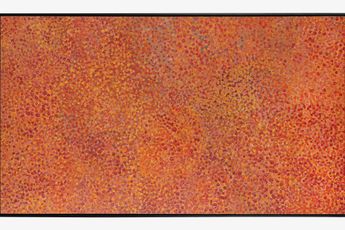
Emily Kam Kngwarray’s Untitled 1996 dates from the final year of the artist’s life. Deep magenta strokes gather at the centre of the canvas, layered over pinks, ochres and yellow. Kngwarray’s recent retrospective at the National Gallery of Australia and Tate Modern confirmed what many of us have long held: she ranks among the twentieth century’s greatest painters.
Arthur Koo’ekka Pambegan Jr’s Untitled – Flying Fox and Bone Fish Story 2010 spans four panels and six metres. Painted at Aurukun using earth pigments, it presents the Wik ceremonial designs Pambegan held as a senior custodian. Commissioned by the Girramay, Yidindji, and Kuku Yalanji contemporary artist Tony Albert, and later held in Los Angeles, it is one of the most ambitious works from his late practice.
Balang Nakurulk (John Mawurndjul AM)’s Barrangkarl – Waterlilies 2001 was painted at Milmilngkan, the artist’s Country in western Arnhem Land. Across nearly 1.7 metres of bark, his fine cross-hatched rarrk shimmers with the movement of water and light. It is a masterwork by an artist whose bark paintings transformed how the medium is understood in Australia and beyond.
Juntiwa 2017, by the Martumili Women Artists Collaborative, is a circular work 2.2 metres in diameter, painted by six senior Martu women: Nancy Chapman, May Chapman, Jakayu Biljabu, Nola Taylor, Mulyatingki Marney and Thelma Judson. Their waterholes and Country flow into a single field. It is a monument to shared custodianship.
Together, these works ask us to look with patience, listen before we speak, and recognise the knowledge and law that give them meaning. That is the reverence this exhibition takes as its title.
I thank the artists, their families and communities, and the art centres whose work makes this art possible; the collectors who have entrusted us with these works; and the D Lan Galleries team for bringing REVERENCE together. We look forward to personally welcoming you to our Melbourne galleries.
Text by D’Lan Davidson Founder & Director, D Lan Galleries. Courtesy D Lan Galleries
Founded in Melbourne in 2016 by D’Lan Davidon, D Lan Galleries is a leading international platform for the presentation and appreciation of Australian Indigenous art.
A respected voice in contemporary art discourse.
Focusing on ambitious storytelling and insightful art-world commentary. Ocula Magazine publishes in-depth interviews, critical essays and timely analysis on the artists, exhibitions and ideas driving the global art world.
Learn more about Ocula Magazine
Showcasing the best of the art world.
Ocula partners with galleries from around the world to highlight their artists, artworks and exhibitions. Gallery membership is by application and invitation, with each member vetted by an independent panel.
Learn more about Ocula Membership

Specialises in the sale of major artworks.
Led by a team with deep ties to the world’s leading auction houses, galleries and collectors. Ocula’s advisory team offers bespoke services to high-net-worth clients from around the world who are looking to acquire the best of contemporary and modern art.
Learn more about our team and services