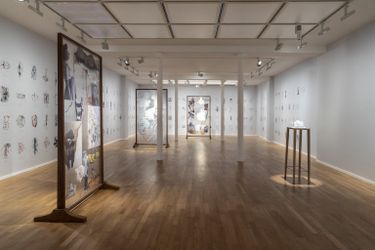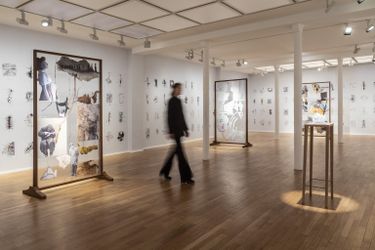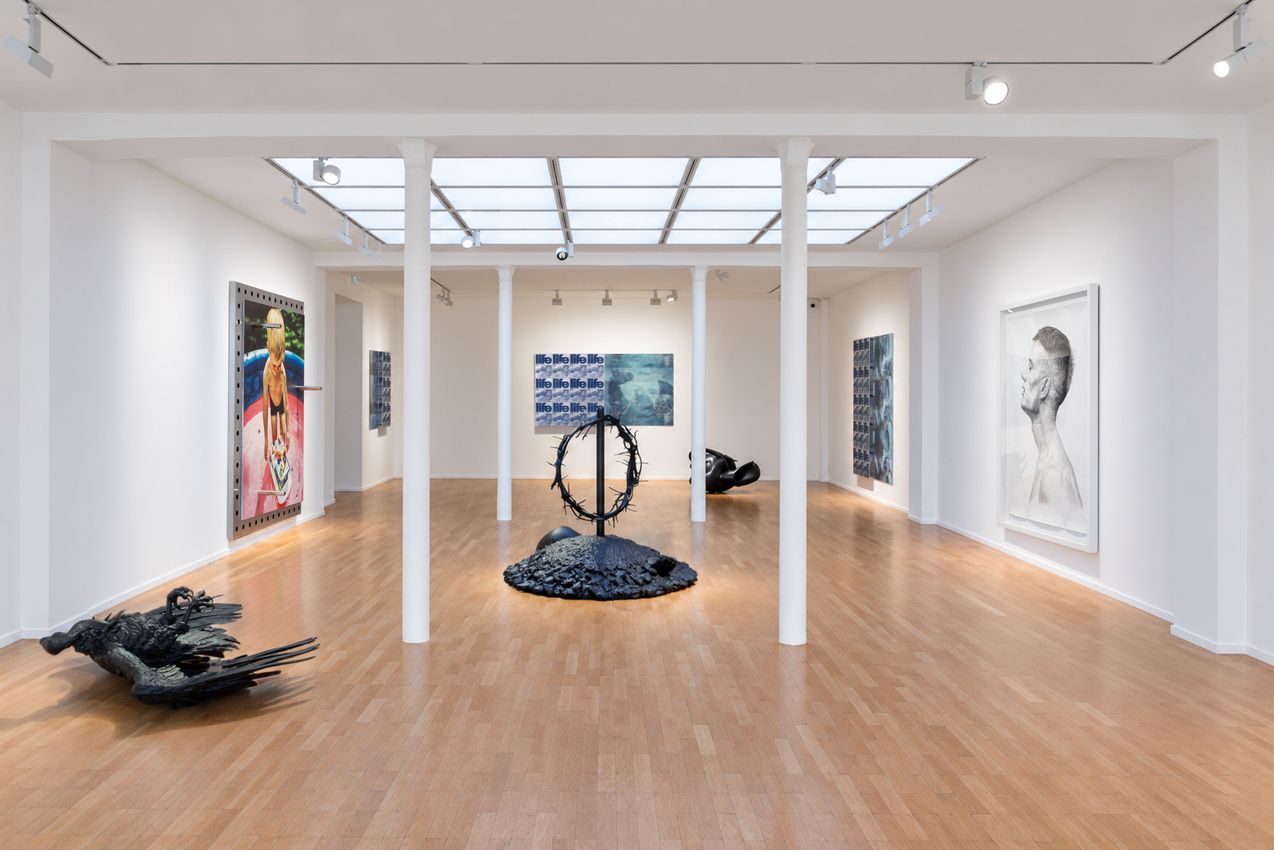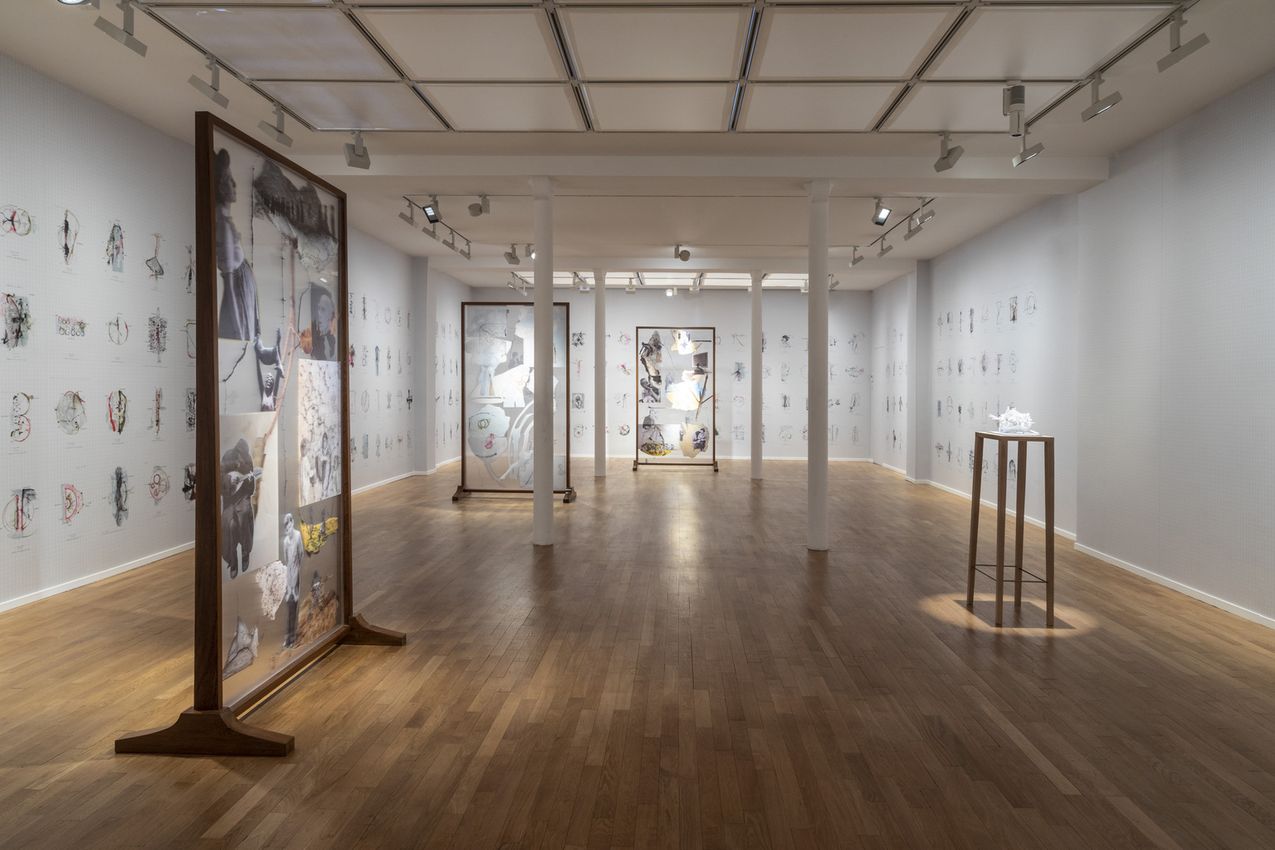
Jitish Kallat returns to Paris with Echo Verse, an ambitious exhibition conceived as a complex system of signs and conjectures linking artistic, historical and scientific references. Widely known for his conceptual and poetic language, Jitish Kallat has altered the tenor of the Beaubourg gallery with a new body of work exploring the passage of time and the notions of transience, evolution or entropy.
Jitish Kallat plays with scale and distance to offer an assembly of sensory and speculative propositions that weaves unexpected links between everyday reality and the cosmos. The exhibition opens with Elicitation # 1 (Terranum Nuncius), a photographic diptych of images drawn from the Golden Record archive dispatched by NASA on the Voyager space missions in 1977. These images–children playing with a miniature globe, a woman tasting an ice cream, a man eating a sandwich–were conceived as a summary of human life as addressed to an extraterrestrial intelligence. These inaugural images of consuming and surveying the planet can be read as an oblique invitation to reflect on the exhibition.
Extending his intimate notebook into an immersive mural-like format, Integer Study (drawing from life) is a repertoire of shapes and numbers that spans the entire gallery. Since the beginning of 2021, the artist has been exploring the planetary present through a daily count of the world population. One encounters 365 drawings, each displaying the algorithmically estimated births and deaths that have occurred up until a specific time each day. With intricate graphite and aquarelle pencil markings and gesso stains, Kallat’s painterly abstraction contrasts with precise data, forming a triangulation of life by mapping birth, death and time. Echoes of existential questions morph into ecological ones, from reflections on climate and extinction to evolution and decay.
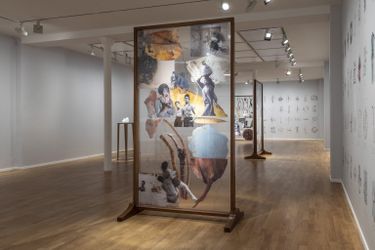
At the centre of the exhibition is a new suite of four double sided, multi-scopic photo works Epicycles (2020–2021) that have their genesis in the early months of the pandemic. Epicycles interweave familiar markers of change–a fallen stem, a crack in the wall, or an abstraction beneath a chair–with images drawn from the iconic touring exhibition Family of Man, organised at MoMA (New York) by photographer Edward Steichen in 1955. Hundreds of images were sourced for this exhibition from photographers working around the world, seeking a ‘declaration of global solidarity’ in the decade after World War II. Coalescing these intimate images from his studio with a glimpse of humanity from a distant time and place, Kallat yields a composite portrait of time and transience, ephemerality and expiry. These meticulously produced lenticular images create an illusion of depth and cause images to alternately appear and disappear as one moves in their presence.
Yet another elicitation punctuates as well as annotates the exhibition. Elicitation #2 (Cassiopeia A) is a three-dimensional visualisation of a dead star’s remains from a stellar explosion that occurred 11,000 light years away. While the star, the youngest known supernova remnant in our Milky Way Galaxy blew up 11,000 years ago, its light reached Earth in the late 1600s. The model is produced from NASA’s open-source files modelled from Sptizer Space Telescope’s data and can be described as a conceptual prompt within the exhibition rather than as a sculptural artwork. The Elicitations become reflective pauses to think of the complex interlacing of the immediate and the cosmic, the past and present, a recurrent motif in much of Jitish Kallat’s practice.
Echo Verse is the artist’s fifth exhibition with Templon.


Born in 1974 in Mumbai, Jitish Kallat is one of the most promising artists of his generation. Jitish Kallat’s work, imbued with autobiographical, political and artistic references, forms a narrative of the cycle of life in a rapidly changing India. Weaving together strands of sociology, biology and archaeology, the artist takes an ironic and poetic look at the altered relationship between nature and culture.


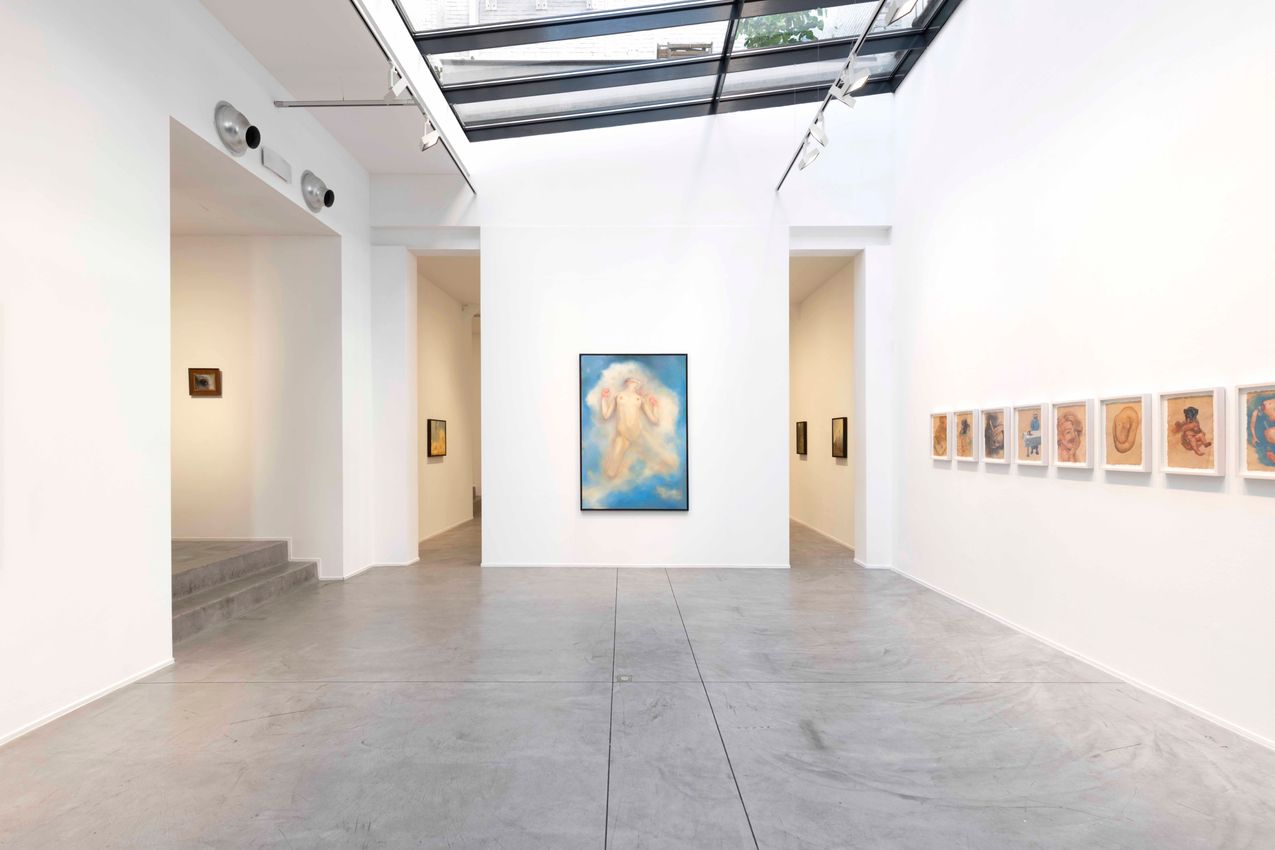
The gallery was founded in 1966 by Daniel Templon, who was then only 21. It first opened rue Bonaparte, in Saint-Germain-des-Prés in Paris, before moving in 1972 to its current location, rue Beaubourg, in the Marais, close to the Pompidou Centre, which opened in 1977. Daniel Templon first gained recognition by exhibiting conceptual and minimal artists such as Martin Barré, Christian Boltanski, Donald Judd, Joseph Kosuth, Richard Serra. In the seventies and eighties, Daniel Templon was one of the pioneers of the contemporary art and introduced many important American artists to the French public: Dan Flavin, Ellsworth Kelly, Willem de Kooning, Frank Stella, Andy Warhol. The gallery quickly became one of the references in contemporary art in France. In 1972, Daniel Templon and Catherine Millet co-founded the monthly art magazine ART PRESS.

A respected voice in contemporary art discourse.
Focusing on ambitious storytelling and insightful art-world commentary. Ocula Magazine publishes in-depth interviews, critical essays and timely analysis on the artists, exhibitions and ideas driving the global art world.
Learn more about Ocula Magazine
Showcasing the best of the art world.
Ocula partners with galleries from around the world to highlight their artists, artworks and exhibitions. Gallery membership is by application and invitation, with each member vetted by an independent panel.
Learn more about Ocula Membership

Specialises in the sale of major artworks.
Led by a team with deep ties to the world’s leading auction houses, galleries and collectors. Ocula’s advisory team offers bespoke services to high-net-worth clients from around the world who are looking to acquire the best of contemporary and modern art.
Learn more about our team and services