



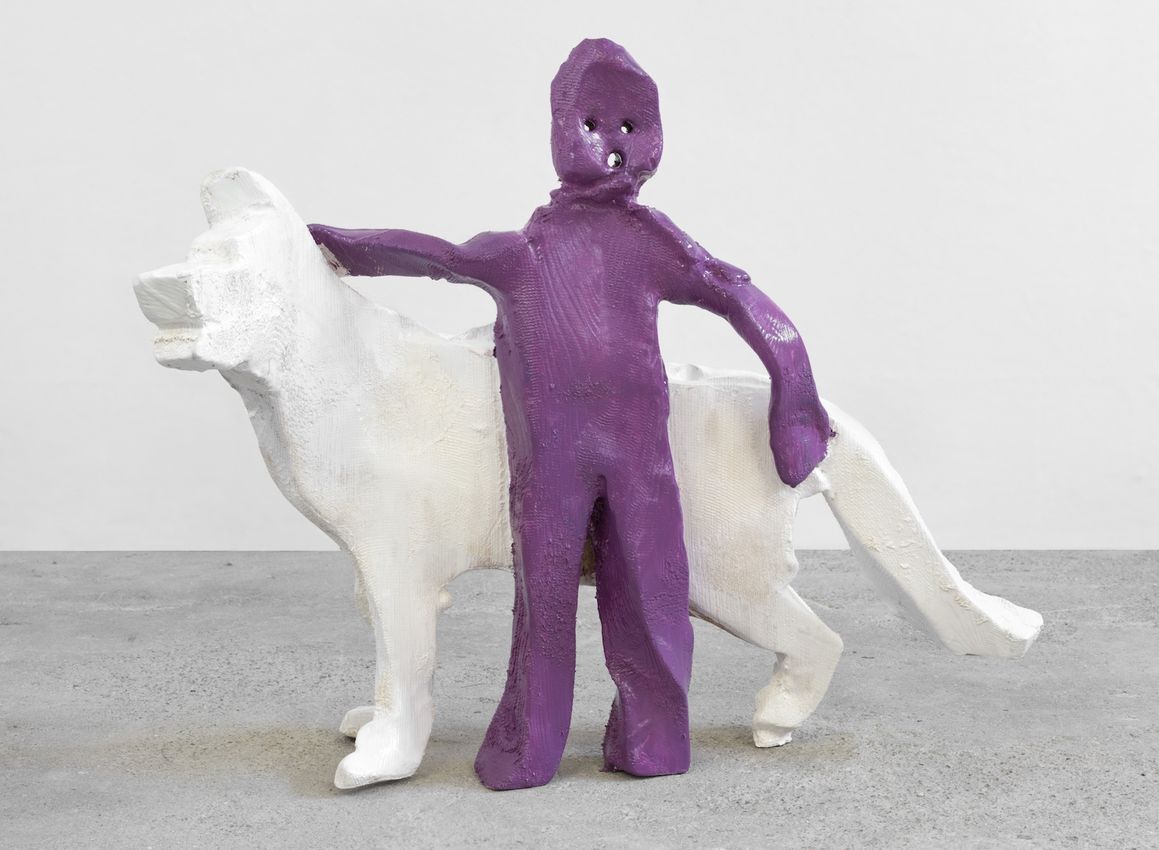
David Kordansky Gallery is pleased to present Barking Panting Sighs Heavenly, an exhibition of new sculptural works by Valentin Carron, on view from 27 May through 1 July 2022. An opening reception will take place on 27 May from 6 until 8 PM.
In Barking Panting Sighs Heavenly, Valentin Carron explores the romanticised loneliness often associated with the lives of artists. A group of sculptures in which humanoid figures are accompanied by dogs reflects his ongoing interest in motifs whose appeal is universal but whose roots are local or personal. He produced the forms using children’s modelling clay; after baking them in his home oven, they were scanned and then either robotically carved in wood or cast in aluminium at human scale.
As some of their titles indicate, these figures are distinguishable as either adults or children, but show no other legible markers of identity. This allows them to be read as the products of a bare kind of expression that privileges directness and simplicity. It also allows them to resonate with a wide range of classical, contemporary, and vernacular representations that appear throughout the histories of art and literature. At the same time, its rawness is somehow both sordid and metaphysical—a reminder that artistic renditions of solitude can be as cheerless and matter-of-fact as they are poetic and spiritual. Their ethos is equally indebted to Daniel Buren’s reduced visual language of stripes, the desolate subjects in Picasso’s Blue Period paintings, and the earthy characters encountered in stories by the Swiss writer Robert Walser.
As in his previous works, Carron’s interest in techniques of material substitution persist; in this case, the transubstantiation of children’s modelling clay into aluminium and wood. If earlier projects found him employing such techniques to tease out questions about the fraught dynamics between authenticity, artifice, and kitsch in contemporary life and historical memory, here he adopts a more overtly reverent stance toward the development of sculptural forms throughout the ages. Instead of serving conceptual and appropriation-based aims, these processes are now representative of an earnest curiosity about the possibilities of rendering ancient forms using new technologies. This allows him to draw a through-line connecting otherwise distant historical periods, especially since there is also a gentle Pop inflection to his choices of materials, which reflect those used in commercial and industrial practices more broadly.
At the same time, the sculptures’ classical sensibility is emphasised by their scale and arrangement in the gallery, revealing additional layers of Carron’s interest in exploring primary influences and sources of artistic form. These include ancient Etruscan art, well known for its remarkable tradition of figurative sculpture, and in particular, for its elaborate sarcophagi for married couples, which depict the people buried within them. Carron renders his interspecies pairs with similar attention to the close emotional bonds and reciprocal care involved in such long-term relationships. As the first animal ever domesticated by homo sapiens, dogs have come to represent ‘man’s best friend’—when Odysseus returned home from ten years of war and wandering in The Odyssey, he was recognised by only his faithful dog Argos.
Among other things, Barking Panting Sighs Heavenly is an investigation of what it means for things to feel familiar. Carron deftly points to the fact that the artistic longing to make something is often driven by a desire to make friends with impulses and emotions which originally present as strange, disturbing, or alien. The figures on view toggle back and forth between such extremes, with each aspect of their construction—including their material presence, their off-kilter and yet forthright sense of colour, and their portrayals of various permutations of human/animal relationships—keying recognisable associations even as it suggests that the things and situations people know best are never quite what they seem. If art has been a means of confronting this contradiction throughout the ages, it too remains an essentially mysterious endeavour. Carron’s concentration on simplicity and recognisability, and on the primacy of his own struggles to define the meaning of his chosen vocation, allows him to delight in this paradox, and to address its unsettling ramifications with humour and humanity.
Valentin Carron represented Switzerland at the 55th Venice Biennale, Italy (2013), and has been the subject of solo exhibitions at numerous institutions worldwide, including Museum im Bellpark, Kriens, Switzerland (2021); Le Consortium, Dijon, France (2020); Musée des Beaux-Arts de Rennes and Galerie Art & Essai Université Rennes, France (2018); Overbeck Gesellschaft, Lübeck, Germany (2015); Kunsthalle Bern, Switzerland (2014); Fondation Louis Moret, Martigny, Switzerland (2014); Palais de Tokyo, Paris (2010); Centro de Arte Contemporáneo La Conservera, Ceuti, Spain (2009); and Kunsthalle Zurich (2007). His work has been included in group shows at institutions including Musée d’art moderne et contemporain (MAMCO), Geneva (2021); Centre Pompidou-Metz, Metz, France (2020), and the High Line, New York (2016), and is in the permanent collections of institutions including Aargauer Kunsthaus, Aarau, Switzerland; Center for Curatorial Studies, Bard College, Annandale-on-Hudson, New York; and Migros Museum für Gegenwartskunst, Zurich. Carron lives and works in Martigny, Switzerland.
Swiss contemporary artist Valentin Carron is known for sculptural works that appropriate cultural symbols, forms, and well-known artworks, to question the legacy of tradition.


David Kordansky Gallery is one of the most dynamic venues for contemporary art, and is internationally regarded as a leading gallery of its generation.

A respected voice in contemporary art discourse.
Focusing on ambitious storytelling and insightful art-world commentary. Ocula Magazine publishes in-depth interviews, critical essays and timely analysis on the artists, exhibitions and ideas driving the global art world.
Learn more about Ocula Magazine
Showcasing the best of the art world.
Ocula partners with galleries from around the world to highlight their artists, artworks and exhibitions. Gallery membership is by application and invitation, with each member vetted by an independent panel.
Learn more about Ocula Membership

Specialises in the sale of major artworks.
Led by a team with deep ties to the world’s leading auction houses, galleries and collectors. Ocula’s advisory team offers bespoke services to high-net-worth clients from around the world who are looking to acquire the best of contemporary and modern art.
Learn more about our team and services