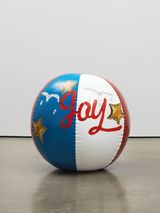
David Kordansky Gallery is pleased to present zrikha sheqi’att hashemesh (Sunrise Sunset), an exhibition of new paintings by Joel Mesler, on view in Los Angeles at 5130 W. Edgewood Pl. from November 11 through December 16, 2023. An opening reception will be held on Saturday, November 11 from 6 to 8 PM.
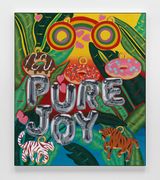
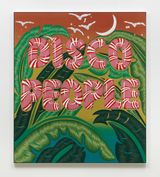
Mesler has become known in recent years for paintings that bring together autobiographical reflection, self-effacing humor, an open-hearted sense of precision and design, and a sly conceptualism with roots in a heterogenous group of modernist and postmodernist approaches to artmaking. zrikha sheqi’att hashemesh (Sunrise Sunset) finds him expanding his work in each of these categories and revealing the deeper strains of cultural awareness and collective purpose that have motivated him since the beginning of his multi-faceted career. The exhibition features two groups of paintings: nine small-format portraits of rabbis and thirteen large-scale canvases dedicated to the text-based imagery and rich visual patterning that have defined much of his project over the last decade.
While these groups can be seen as discrete series, each with its own formal and material parameters and associated themes and variations, in the context of the show as a whole, they form an intricately interwoven story of celebration and loss told on both personal and transpersonal scales. The paintings of rabbis, for instance, are modeled after examples of a genre that could be found in Jewish homes in the United States throughout much of the postwar period, where they often served as reminders of the European homelands—and ways of life—their owners’ families were forced to flee. Mesler has recast these reverent, sometimes pained, often melancholic, images according to his own style, shifting their palettes and transposing their self-seriousness into a brighter, but no less touching key.
The rabbi paintings reflect a degree of devotion that transcends mere depiction, however, because the artist has been methodically collecting original rabbi paintings as they appear in auctions and other sales, where they would otherwise go unsold. Because such paintings have gone out of fashion and many of their original owners have died, Mesler seeks to rescue not only the artworks themselves, but the Jewish traditions and histories of exile they symbolize. His own rabbi paintings are therefore products of a broader inquiry in which cultural identity is observed as a process of constant change and ever-evolving emotional response.
To this end, the composition and installation of zrikha sheqi’att hashemesh (Sunrise Sunset) is imbued with meaning that goes beyond aesthetic concerns. The nine rabbis on view are one fewer than would be necessary to form a complete minyan or Jewish prayer group, for which ten congregants (traditionally only men) must be present before public worship can begin. If the exhibition contains a tenth member, it is the one symbolized by the thirteen text paintings, whose number evokes the thirteen years of age at which observant Jews become adults through the ritual of bar or bat mitzvah.
In these thirteen works, Mesler explores the intersection of diurnal cycles and human life cycles, tracing the passage of a day through the appearance and eventual disappearance of the sun, and commemorating nuances of psychological development and family and cultural interaction in pithy phrases that function simultaneously as text and image. Sensitive, exuberant, and animated by contradiction, vulnerability, and hope, the paintings are communications about what it feels like to grow up, to not want to grow up, to live with expectations, to resist expectations, and to endure the awkwardness and transitions that accompany each phase of childhood. Set against—and structured by—the banana leaf pattern that has become a steady refrain in Mesler’s visual world, the narrative that unfolds from one work to the next is not only the tale of becoming an adult in the eyes of the Jewish community. Its passages are also recognizable to anyone who has made the transition from childhood to adulthood, or from innocence to experience, which are transposed here into the vocabulary of night and day. By the time the series arrives at (Untitled) Sunset (2023), with its austere, black background, a mood of resignation and mystery takes up residence alongside the fledgling hopes and familial encouragements that appear in other works.
Like much of Mesler’s work, the paintings are autobiographical to the extent that they are also universal. In this respect, zrikha sheqi’att hashemesh (Sunrise Sunset) synthesizes the entire arc of his artistic development to date, demonstrating how an abiding interest in portraiture and self-portraiture harbors a deep-seated curiosity about what individuals do with the histories, narratives, and traumas that contribute to the shaping of their lives. For this reason, his own trajectories, whether the kinds of personal stories documented in the exhibition or those that have marked his unique path as an artist, are perhaps best considered as some of the materials with which he works, no more or less important than the pigments and supports that constitute the physical manifestations of his work. This also helps illuminate the underlying pathos that runs like a swift river beneath the work’s surface manifestations, as well as the felt acknowledgements of lost time and longed-for love that give zrikha sheqi’att hashemesh (Sunrise Sunset) its compassionate force.
Joel Mesler (b. 1974, Los Angeles) has been the subject of solo exhibitions at the Long Museum West Bund, Shanghai (2023); FLAG Art Foundation, New York (2023); David Kordansky Gallery, Los Angeles (2021); Lévy Gorvy, Hong Kong (2021); Harper’s Books, East Hampton, New York (2020); and Simon Lee, London (2018). His work is in the permanent collections of the Cauldwell Foundation, London; HE Art Museum, Foshan, China; The Jewish Museum, New York; and K11 Art Foundation, Shanghai, among others. Mesler lives and works in Sag Harbor, New York.
Joel Mesler’s paintings shed light on universal themes by filtering them through autobiography, humor, self-deprecation, and surprising compositional juxtapositions. Childhood memories fuel meditations on design and popular iconography, not to mention the liquid, fluid, and mutable nature of the painting process. In recent years, Mesler has explored the power of acceptance, allowing emotions—as well as the cultural forms in which they become constellated—to exist at the center of his project. Mesler has also broadened his visual range, incorporating new motifs in the patterned backgrounds that provide the foundation for each composition and experimenting with increasingly elaborate ways of rendering typography. Their wry surrealism and emphasis on words and phrases place Mesler’s paintings in dialogue with the work of artists like Ed Ruscha and Christopher Wool, who engage with language and the relationship between text and image. But Mesler’s concerns are very much his own, and however lighthearted their surfaces read upon first glance, his paintings pose serious questions: How is a self constituted when it is not consistent from moment to moment? Where does pain end and healing begin?


David Kordansky Gallery is one of the most dynamic venues for contemporary art, and is internationally regarded as a leading gallery of its generation.

A respected voice in contemporary art discourse.
Focusing on ambitious storytelling and insightful art-world commentary. Ocula Magazine publishes in-depth interviews, critical essays and timely analysis on the artists, exhibitions and ideas driving the global art world.
Learn more about Ocula Magazine
Showcasing the best of the art world.
Ocula partners with galleries from around the world to highlight their artists, artworks and exhibitions. Gallery membership is by application and invitation, with each member vetted by an independent panel.
Learn more about Ocula Membership

Specialises in the sale of major artworks.
Led by a team with deep ties to the world’s leading auction houses, galleries and collectors. Ocula’s advisory team offers bespoke services to high-net-worth clients from around the world who are looking to acquire the best of contemporary and modern art.
Learn more about our team and services