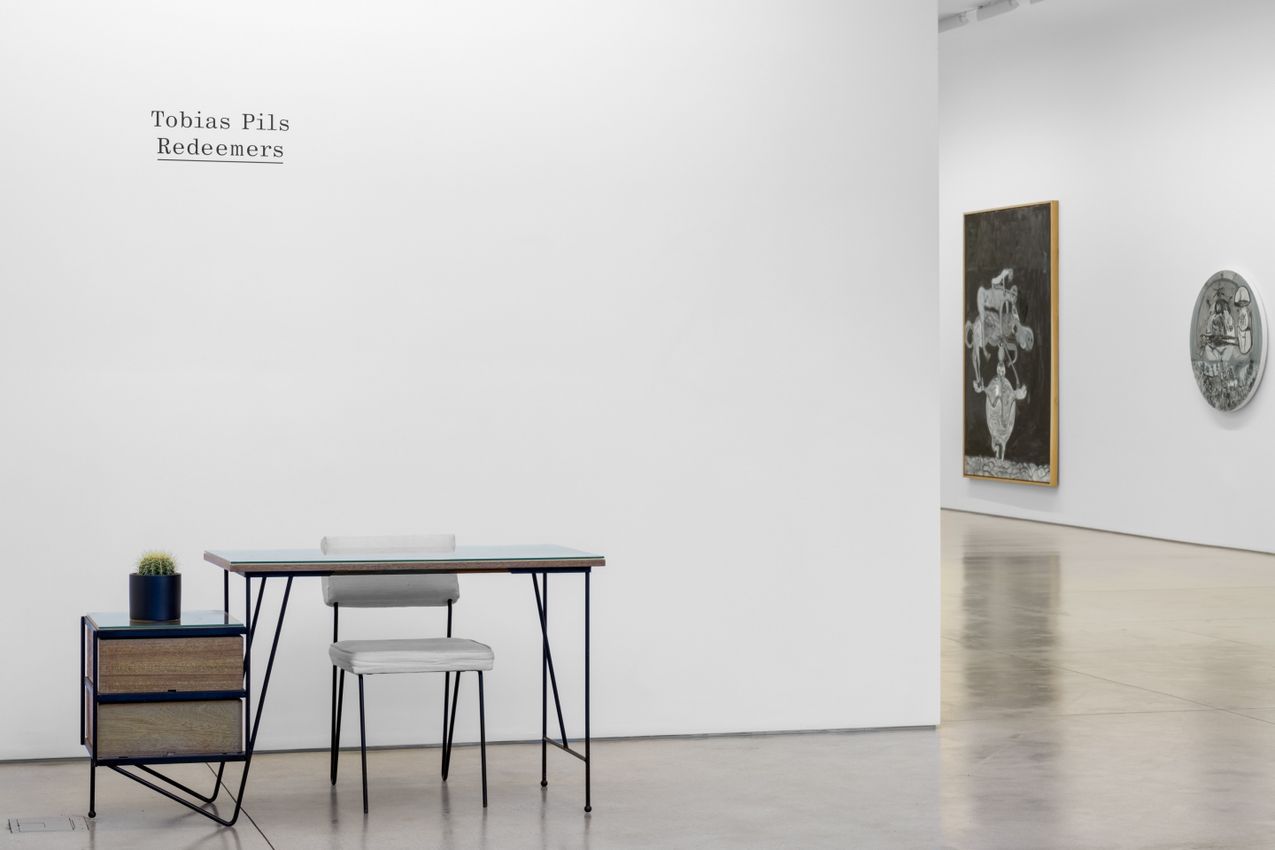
David Kordansky Gallery is pleased to present Redeemers, its first exhibition of paintings and works on paper by Tobias Pils. The exhibition opens on November 13, 2021, and will be on view through January 8, 2022. An opening reception will be held on Saturday, November 13 from 6–8 PM.
Over the last decade, Pils has become increasingly recognized for his rigorous, open-ended pursuits into the heart of painting. Working within a grisaille palette limited to shades of white, grey, and black, Pils utilises formal compositional strategies that play with scale, depth, and surface alike to create small moments of inquiry within larger pictorial spaces, allowing his intuitive relationship with the painterly medium to guide his compositions. A project with abstraction at its core, Pils’s work nonetheless moves fluidly into—and through—figuration, generating forms rich in collective symbolism.
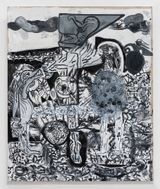
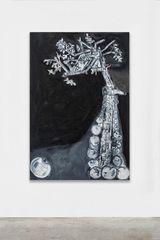
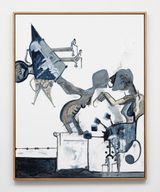
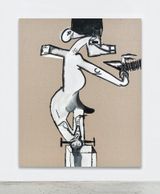
The new paintings in Redeemers depict a bulbous, feminine figure with biomorphic irregularities. A recent addition to Pils’s visual vocabulary, the eponymous Redeemer emerges from the canvases with arms stretched outward, as if tasked to hold together the world in which she is situated. Throughout the exhibition, she is seen participating in activities such as riding on horseback, giving birth to baby Redeemers, and rising like the sun above an allegorical landscape. Two smaller, circular canvases introduce shifts in scale and format, and take on the rounded shape of the Redeemer herself. They also feature groups of other mysterious figures that tunnel into, intertwine with, and collapse into one another. The overall impression is one of self-generative creation, with images of transcendence and decay suggesting natural—and supernatural—life cycles.
In each of the works on view, brushstrokes of deep greys and muted white pigment create ripples in the Redeemer’s flesh, forming images of folds, creases, and other skin-like textures. While the Redeemer’s body language is suggestive of the desire to embrace, the figure is alternately contained, guarded, and propped up by a cast of characters—including distorted horses and hybrid beings—that recur throughout Pils’s previous works. And though the paintings defy any single reading, the Redeemer evokes the kinds of spiritual transitions that animate many religions, albeit from an alternative conceptual standpoint in which improvisation and non-objective visual forms are as important as narrative or myth.
To this end, concentrated passages in which discernible brushstrokes, surface textures, and shifts in tone and hue prevail are reminders that Pils’s ideas and intuitions always exist in the physicality of the painterly medium. Areas defined by solid, blackened voids, for instance, become portals into the multiple worlds on display in each composition. In these cases, the Redeemer herself can be considered a metaphorical void, since she too functions as a container that holds the arsenal of signs (apples, eggs, etc.) populating the artist’s images. As he moves from one canvas to the next, Pils paints against predictability. He allows linework to guide him through his compositions, each of which constitutes an opportunity for world-building.
Installed in an adjacent gallery are a group of recent works on paper. These include both ink and pencil drawings that underscore the more overtly spontaneous facets of the artist’s methodology. Smaller in scale than the paintings, the works on paper also showcase the importance of linework throughout his oeuvre. They are animated by energetic inkblots and occasional splatters, and weave in and out of the pure abstraction and recognisable motifs also found in the canvases. Frenetic and open, intuitive and energetic, the works on paper find Pils breaking down the forms that exist at the core of his project and creating spaces in which he can build them anew.
In 2020, a permanent, large-scale installation of paintings by Tobias Pils (b. 1971, Linz, Austria) was inaugurated at Kunstmuseum Bonn, Germany, and a major permanent fresco was installed at the Renzo Piano-designed campus of École normale supérieure Paris-Saclay, Gif-sur-Yvette, France. He has been the subject of solo and two-person exhibitions at the Josef Albers Museum, Bottrop, Germany (2017); Le Consortium, Dijon, France (with Michael Williams, 2017); Chinati Foundation, Marfa, Texas (2016); and Secession, Vienna (2013), among other institutions. Recent group shows include Picasso et la bande dessinée, Musée Picasso, Paris (2020); Jay DeFeo – The Ripple Effect, Aspen Art Museum, Colorado (2018); Le Consortium Collection, Le Consortium, Dijon, France (2018); and Spiegelnde Fenster, 21er Haus, Vienna (2017). Pils’s work is in the permanent collections of Albertina, Vienna; Kunstmuseum Bonn, Germany; and Le Consortium, Dijon, France, among other institutions. Pils lives and works in Vienna.
Working within a palette of blacks and whites and the range of grays that can be made from them, Tobias Pils (b. 1971, Linz, Austria; lives and works in Vienna) creates mixed-media paintings full of abstract and representational elements. These elements are often arranged so that they flow from one to the next seemingly of their own accord, obeying the dictates of a painterly logic that generates meaning through the accumulation of many small moments. As such, Pils’s works are endlessly captivating as arrangements of textures, flows, and material invention—in a sense, as symphonic, non-objective compositions, even when their mythological content and primal imagery tempt narrative readings. This syncretic approach reflects a mind that revels in contradictions, even as it seeks to suture together contrasting passages with a subtle and virtuosic array of mark-making strategies that are alternately bold, incisive, impressionistic, and completely open to the innate properties of paint medium and support. Pils works at a variety of scales and in different contexts, responding to the urgency of his own intuition and the external constraints of architectural and institutional settings with equal fluency. In each of these forums, he locates the places where the vast and the intimate meet, both in the physical world and the human psyche alike.


David Kordansky Gallery is one of the most dynamic venues for contemporary art, and is internationally regarded as a leading gallery of its generation.

A respected voice in contemporary art discourse.
Focusing on ambitious storytelling and insightful art-world commentary. Ocula Magazine publishes in-depth interviews, critical essays and timely analysis on the artists, exhibitions and ideas driving the global art world.
Learn more about Ocula Magazine
Showcasing the best of the art world.
Ocula partners with galleries from around the world to highlight their artists, artworks and exhibitions. Gallery membership is by application and invitation, with each member vetted by an independent panel.
Learn more about Ocula Membership

Specialises in the sale of major artworks.
Led by a team with deep ties to the world’s leading auction houses, galleries and collectors. Ocula’s advisory team offers bespoke services to high-net-worth clients from around the world who are looking to acquire the best of contemporary and modern art.
Learn more about our team and services