

David Kordansky Gallery is pleased to present Projections, an exhibition of new paintings by Jenna Gribbon and the gallery’s first presentation of Gribbon’s work in New York. Projections is on view at 520 W. 20th St. from November 6 through December 19, 2026. An opening reception will be held on Friday, November 6, from 6 – 8 PM.
Gribbon’s paintings probe the complex interrelationships between looking and performing, between the tangled psychoscape of a romantic relationship and its everyday expression. The larger paintings in Projections constitute an evolution of a series in which the artist creates layered, often borderline-surreal scenes by using a projector to stack photographic images onto each other and onto figures that are physically present in the studio. In these newest works, she turns to the familiar figure of her wife, posed in profile or face-on, lit in glowing projected colour. Images of Gribbon, taken by her wife, are then projected onto her wife’s body and the wall behind, creating a complex, telescoping landscape of light and flesh, where figures merge and shadows loom. With these carefully architected images, Gribbon builds a narrative scaffolding that touches on deeply held truths encompassing one’s own relationships and the myths and stories that undergird our shared sense of humanity.
In the largest paintings on view, layered images of the couple take on mythical personas, their melded figures standing in for the hybrid monsters that populate ancient stories. The nude profiles of Gribbon and her wife repeat into the distance in Artemis of Ephesus (2026), evoking the titular many-breasted goddess; elsewhere their layered forms suggest the feared figure of the harpy or the two faces of Janus. These two-body manifestations of mythical narratives confront the prevalent idea of merging identities within lesbian relationships, directly approaching Gribbon’s own discomfort with the trope by literalizing the stereotype. Images of the two women converge and resolve throughout the series, as if negotiating their identities both separately and together. Recalling Francis Picabia’s transparency paintings, largely completed between 1927 and 1932, Gribbon’s superimposed images destabilize the viewer’s expectations through a playful approach to both perspective and subject. Where Picabia suspended disjointed images between layers of varnish or across various media, Gribbon’s painted figures appear on the canvas as they do in the studio, their resolute selfhood coexisting with a dreamlike sense of co-existence. The slippage between two people, and between their images, forms the heart of Gribbon’s practice, and her sustained collaboration with her wife invites an intimacy and familiarity that, over many bodies of work, serves as a portrait of their collaborative union.
The frisson of connection often manifests in the work as a function of the gaze. The tripartite relationship between artist, subject, and viewer, one driven by the act of looking, drives the visual and narrative tension of the paintings. Much of Gribbon’s work places the viewer alongside the artist as the principal enactor of the gaze, either as observer of or participant in a scene. The projection paintings alter this relationship in subtle yet novel ways. By placing the artist fully within the frame via the projected image, these works adjust the shape of this triangular connection, diminishing the artist’s role as looker and instead empowering the viewer as the sole observer. This shift also rearranges the works’ erotic charge. Where previous works have often been overtly sensual, here Gribbon creates a kind of erotic dreamspace out of the layered projections, one whose psychological remove lends the works a cool, cinematic aura.
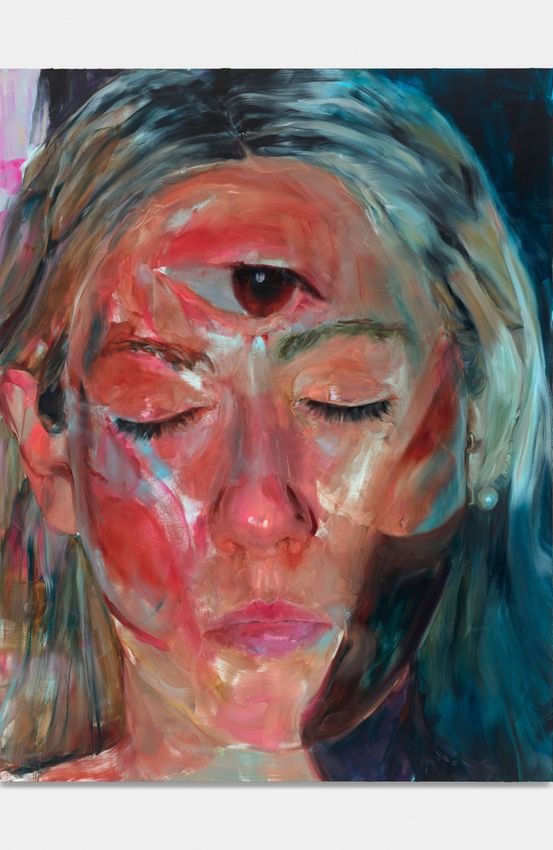
The intensity of light in the projector paintings builds upon a longstanding interest in the manipulation of both natural and theatrical lighting. Gribbon plays with the color and illumination of the projector to create a kind of fantasy space within these canvases, one that is often spatially disorienting and psychically charged. The medium-sized paintings playfully riff on the theme of sight—insight, hindsight, etcetera—by foregrounding the expanded sense of vision afforded their subjects, placing the eyes of projected figures on a forehead or posterior cheek. Through this playful rearrangement and layering of the organs of sight, Gribbon visualizes the extension of vision that comes from the added perspective of the other person. In Prescience (2026), Gribbon’s face is projected onto her wife’s torso, creating an oversized third eye that opens to a technicolor vision. Gribbon’s interest in expanded perspective extends to the way light can change the interpretation of a scene. Certain lights come loaded with preconceived meanings: think of the warm nostalgia of golden hour or the soft romance of candlelight. The cinematic quality of projected light, however, creates an analytic space divorced from real-world embodied associations, providing a more neutral environment in which to experiment. Gribbon uses this tabula rasa illumination to build layered, allusive vignettes that speak to the bond within this artistic and romantic partnership.
The projection paintings are accompanied by a series of small works that bring the exhibition out of the realm of spotlit fantasy and back into reality. These documentary-style paintings capture discrete moments or interactions from Gribbon’s domestic life: her wife gesturing mid-sentence, a kitchen table strewn with everyday objects. Here we see the real-world counterparts of the powerful id manifested by the mythical merged figures of the projector paintings. Like the larger works, these are lit by a strange and intense light, which, though natural, results in strong contrasting areas of light and dark akin to the effects of the projector. It is as if we the viewers have stepped back through the looking glass, and the monsters that haunted our dreams are once again just people we know.
Gribbon is currently the subject of a major solo exhibition at the Rose Art Museum at Brandeis University in Waltham, MA, a comprehensive survey of 25 years of painting. She was also the subject of a solo exhibition at Collezione Maramotti, Reggio Emilia, Italy (2022–2023). Recent group exhibitions include She Said, She Said: Contemporary Women Artists, Akron Art Museum, OH (2025); From Dawn Til Dusk: The Shadow in Contemporary Art, Kunstmuseum Bonn, Germany (2025); Day for Night: New American Realism, Palazzo Barberini, organized by the Aïshti Foundation, Rome (2024); Making Their Mark, Shah Garg Foundation, New York (2023); Living Histories: Queer Views and Old Masters, The Frick Collection, New York (2022); and Paint, also known as Blood: Women, Affect and Desire in Contemporary Painting, Warsaw Museum of Modern Art, Poland (2019). Her work is in the permanent collections of institutions including Kunstmuseum The Hague, Netherlands; Brooklyn Museum; Dallas Museum of Art; Museum of Fine Arts, Boston; San Francisco Museum of Modern Art; Honolulu Museum of Art; New Orleans Museum of Art; Musée d’Art Moderne et Contemporain, Geneva; Kurpfälzisches Museum, Heidelberg, Germany; Rubell Museum, Miami; and FLAG Art Foundation, New York. Gribbon lives and works in New York.
Jenna Gribbon’s (b. 1978, Knoxville, Tennessee) oil paintings constitute an important new entry in the long lineage of figurative art, extending its narrative possibilities to explore the act of looking. Her vivid portraits, frequently nudes or partial nudes, depict those closest to her, and sometimes the artist herself, in candid poses, during uncanny moments. Replete with saturated colors—and spot lit in awkward, uncomfortable, or humorous positions—the protagonists are often seen looking directly at the artist, blurring the line between observer and the observed. By including her own image in her paintings, whether it’s her legs brushed up against her partner’s or her dramatic shadow lurking in the foreground, Gribbon becomes both actor and director in an unfolding storyline that is equal parts comedic, tender, fantastical, and dark. She uses scale to decipher between true-to-life and constructed scenes. In her larger paintings, Gribbon employs strategically placed props—mirrors, blindfolds, clamp lights, coloured gels, green screens—to explore different types of mediation that affect image consumption and investigate the power dynamics between subject, artist, and viewer. Her recent work most prominently features her partner, Mackenzie Scott, whose recurrence both personalises and simultaneously establishes her as a kind of avatar; shifting the focus of the painting away from the figure and toward the way the figure is framed. Gribbon’s paintings often begin as a photo taken on her phone, forging a fluid relationship between photography and painting, the real and the surreal, and between the ephemerality of phone photography and the enduring quality of oil paint. By painting otherwise fleeting scenes, the artist adds texture, depth, and a sense of permanency to these temporal images, highlighting themes of pleasure, joy, and expanding the lexicon of queer iconography.


David Kordansky Gallery is one of the most dynamic venues for contemporary art, and is internationally regarded as a leading gallery of its generation.
A respected voice in contemporary art discourse.
Focusing on ambitious storytelling and insightful art-world commentary. Ocula Magazine publishes in-depth interviews, critical essays and timely analysis on the artists, exhibitions and ideas driving the global art world.
Learn more about Ocula Magazine
Showcasing the best of the art world.
Ocula partners with galleries from around the world to highlight their artists, artworks and exhibitions. Gallery membership is by application and invitation, with each member vetted by an independent panel.
Learn more about Ocula Membership

Specialises in the sale of major artworks.
Led by a team with deep ties to the world’s leading auction houses, galleries and collectors. Ocula’s advisory team offers bespoke services to high-net-worth clients from around the world who are looking to acquire the best of contemporary and modern art.
Learn more about our team and services