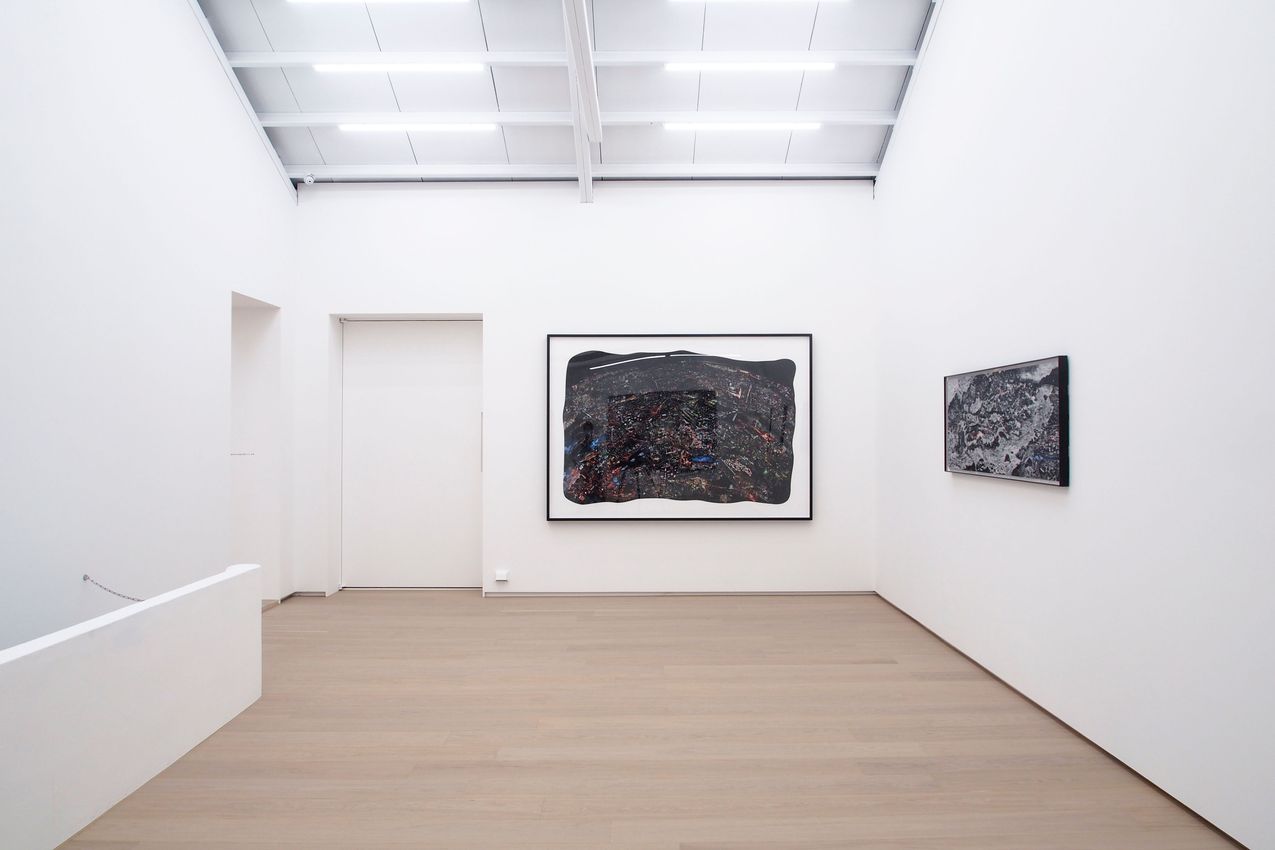
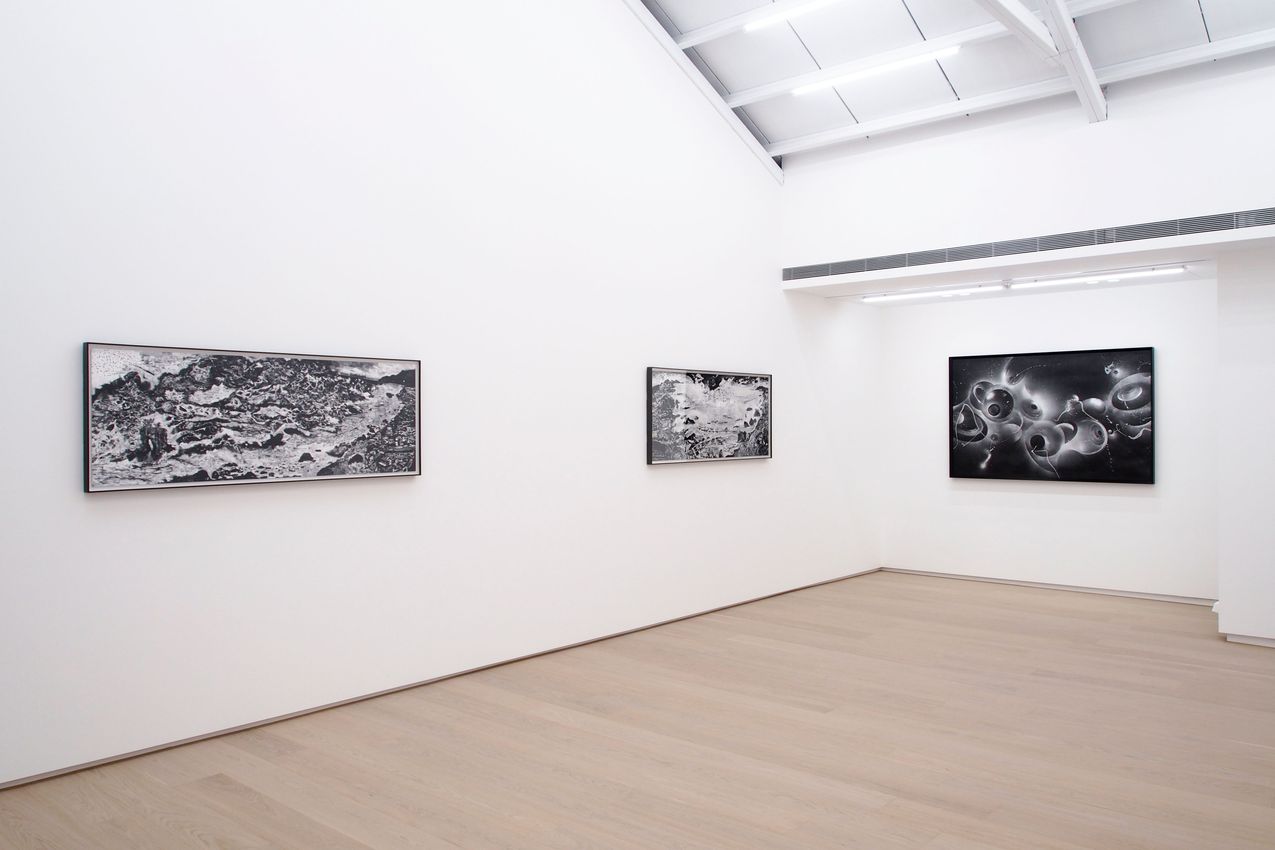
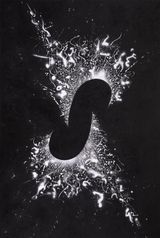
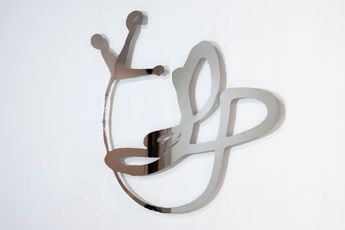
Each Modern is pleased to announce “New Horizon”, an exhibition of works by two prominent Japanese contemporary artists, Sohei Nishino and Hiraku Suzuki. With their creative methods of massive photo collaging and subconscious drawing, the artists present not only their challenges to the material but also their exploration between and beyond the horizon of geography and astronomy.
During the “Great Geographical Discovery” of the 15th to 17th centuries, humans began to actively expand into the ‘New World’, which also led to numerous creations of the world map. However, these maps were inevitably imbued with imperialism and colonialism from Europe, perceiving these new landforms and seas with these attitudes and lofty notions. When the world’s geographic overview gradually took shape, photography emerged in the 18th century to provide these explorers another way to enter the mainland, going deep into the communities of native peoples, taking pictures of local residents and publishing photos in newspapers and magazines disseminated in their homelands. This is the beginning of the universal understanding of our “world”, even though this “world” is incorrect, like the Mercator projection map used in the 15th century. In the modern era of tourism, all landscapes have become very small pieces of private memories, stored in computers or mobile phones.
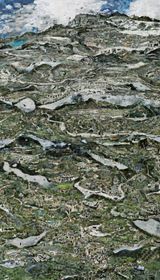
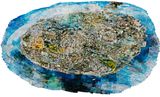
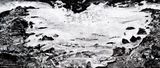
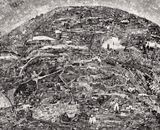
Sohei Nishino’s work can be seen as a mixture of both contexts. He often uses a large number of photos to collage and form magnificent natural landscapes and urban panoramic views, such as the eponymously titled “Mountain Line, Everest”, which uses three to four hundred rolls of negatives, and the reconstructions of the urban geographies of Tokyo, London, Jerusalem, and Amsterdam in his “Diorama Map” series. For the artist, the image fragments collected during the journey are not complete. Through repeated shots and collages, he integrates his own memories of the city so that the images are no longer just pure records. The perspectives and shapes presented in “Diorama Map” can be traced back to ancient Japanese hand-painted maps; the colors and narrative method of “Mountain Line, Everest” are reminiscent of mountain climbing pictures in Ukiyo-e; all break the visual photographic perspectives and aesthetics while also echoing the scattered perspective of oriental Shanshui paintings and their corresponding cosmology.
As we attempt to comprehend scenes on Earth, there is an unreadable language already extant around us. It might come from an ancient time; it might come from the dark universe. In the beginning of 2021, the oldest surviving cave drawings were discovered on Sulawesi Island, Indonesia: animals and hands drawn about 44,000 years ago. At the other end of this image we find the Voyager Golden Records launched in 1977 and the unexplained space signal detected in 2020. Between the ancient totems and the unknown signal, we restlessly juxtapose them, eager to find new information from them.
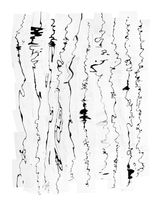
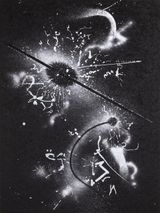
Suzuki’s drawing is the tube connecting both ends. The signs in his work are like lingual characters, embodying the messages from an ancient civilization and outer space. His early series “bacteria sign first arranges and buries dead leaves in the dyed earth. Later, Suzuki excavates only the midribs which compose several tiny Nazca Lines. His well-known drawing series “Constellation” presents the artist’s silver strokes on the canvas with earth. These signs are now shown in an archeological appearance, indicating their timeproof existence. The radio waves that fulfill the dark universe in the new series “Photon Flux” also express a status of perception. The horizon in Suzuki’s work is more about a mixture of the surface and the deeper universe.
Through photography and drawing, Nishino and Suzuki expand their vision from the micro to an expanse that approaches infinity, this exhibition approaches the horizon to the Kármán line. Although we can now observe the most distant known galaxy, GN-z11, we are just beginning to gaze down at our oceans, continents, history, and our own species; and looking up at the stars, at infinity and the further uncharted universe.
WE BELIEVE THAT ART GENERATES VALUE AND CONTINUES TO SHAPE THE FUTURE.

A respected voice in contemporary art discourse.
Focusing on ambitious storytelling and insightful art-world commentary. Ocula Magazine publishes in-depth interviews, critical essays and timely analysis on the artists, exhibitions and ideas driving the global art world.
Learn more about Ocula Magazine
Showcasing the best of the art world.
Ocula partners with galleries from around the world to highlight their artists, artworks and exhibitions. Gallery membership is by application and invitation, with each member vetted by an independent panel.
Learn more about Ocula Membership

Specialises in the sale of major artworks.
Led by a team with deep ties to the world’s leading auction houses, galleries and collectors. Ocula’s advisory team offers bespoke services to high-net-worth clients from around the world who are looking to acquire the best of contemporary and modern art.
Learn more about our team and services