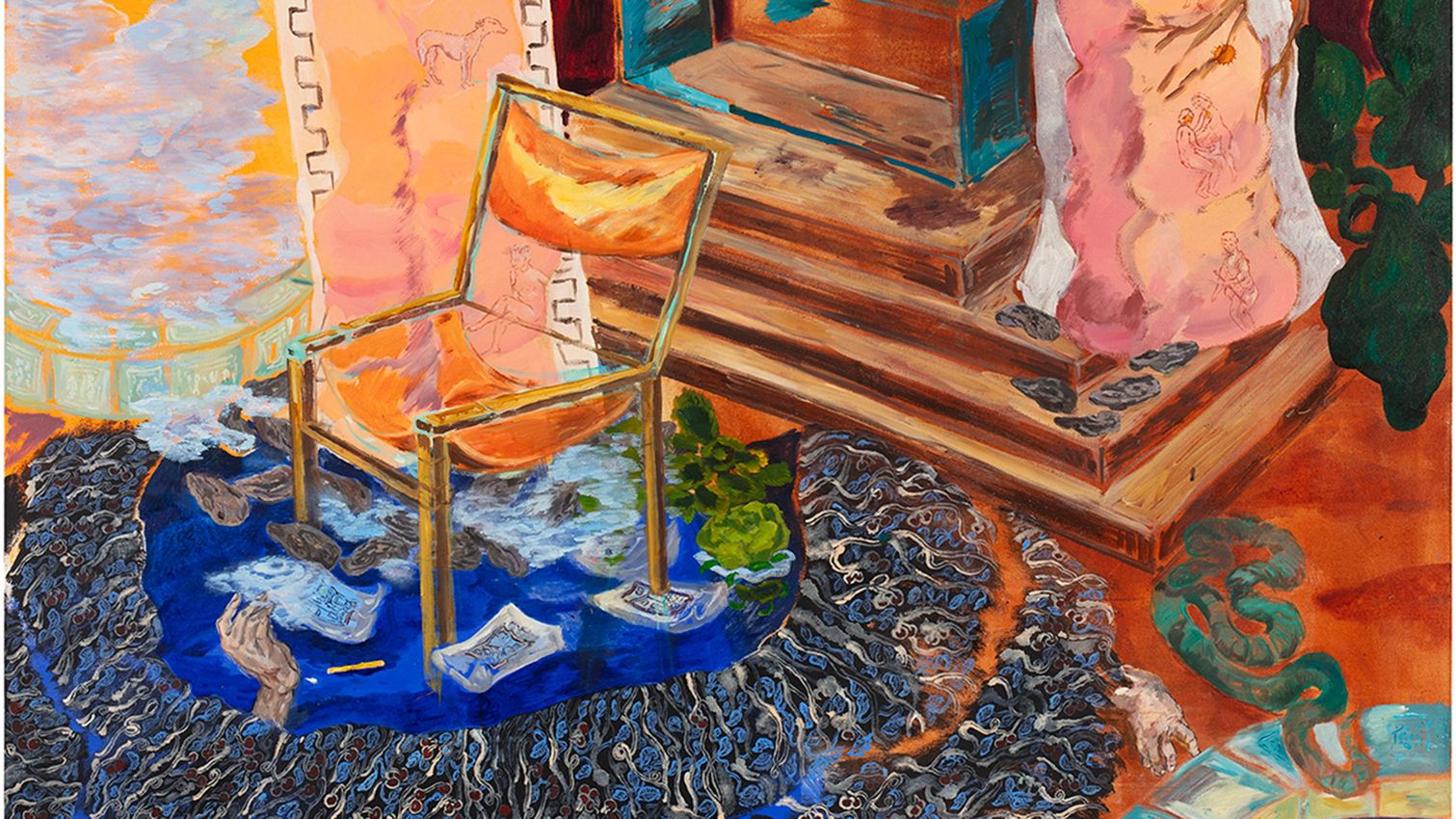
Elizabeth Xi Bauer is pleased to announce Here is the House, an exhibition of new works by Karoliina Hellberg, marking the artist’s first solo presentation at the gallery’s Exmouth Market space. Through a new series of large paintings, works on paper, objects, and a wallpaper composed of lithographs, Hellberg continues to explore how human intentions become embedded within the spaces we inhabit. These spaces, in turn, leave their imprint on the ways we think and perceive. The artist moves fluidly between interior and exterior settings, tracing the relationship between physical surroundings and states of mind. In this new body of work, Hellberg examines how attention is directed and how objects acquire significance through the act of looking.
Hellberg’s work invites the viewer into realms formed by familiar motifs and the residual presence of human touch. Whilst interested in the physical structure of a space, the artist explores metaphorical and psychological currents which underpin the worlds she creates. Houses and gardens are animated through traces of human presence, such as flowers left on a table or water spilling from an overturned glass. Absence becomes a generative force within the work, prompting viewers to consider how spaces continue to evolve beyond the intentions of those who first shaped them. For Hellberg, moments of stillness become a site of possibility within the painting, where change continues to unfold beyond direct human intervention.
The exhibition title, Here is the House, is borrowed from a Depeche Mode song and also pays homage to the late artist Marc Camille Chaimowicz, whose practice has been an important source of inspiration for Hellberg. Chaimowicz’s exploration of domestic space, atmosphere, and the intersection of aesthetic and lived experience resonates throughout the exhibition. This influence is echoed in a series of sculptural elements installed throughout the gallery, including tables and mirrors that appear both as physical objects and as recurring motifs within the paintings themselves. By moving these familiar forms between image and object, Hellberg positions the house as both a physical setting and a conceptual framework through which questions of attention, perception, and human presence unfold.
Hellberg turns to modes of focus as both a mental and embodied condition. Her paintings consider how particular environments may support, direct, or interrupt states of attention, examining how the material world becomes inseparable from the workings of the mind. The artist asks what occurs when we enter a state of focus, how we arrive there, and how that condition shapes our actions. Rather than establishing hierarchies among these elements, everyday objects, plants, and cultivated materials appear as markers of choice and attention. Through architecture, design, and the arrangement of objects, Hellberg explores how surroundings quietly shape the course of our thoughts.
Hellberg’s signature lush palette explores the power of colour to evoke emotions, considering how sensations and states of mind are communicated through hues. Hellberg also employs shifting scales and viewpoints within her paintings: some are an entire room, whilst others are close-up details of, for example, a specific fruit or herb. Through a sensory interplay of colour, the eye moves between the intimate detail and the wider scene; associations form, dissolve and reform, revealing how meaning is shaped by where we direct our attention and what we bring to the act of looking. Hellberg considers how space conditions perception, directing the mind towards certain details while allowing others to recede. Objects and architectural details give rise to stories that the paintings never fully resolve. Seemingly familiar spaces are assembled through fragments, associations, and visual cues that encourage narrative projection while resisting certainty. Hellberg is interested in the speed with which meaning is assigned to images, and how closer inspection can unsettle first impressions.
Drawing on personal experience, imagined worlds, and the recurring symbolic language of objects, Hellberg operates in a collage-like way. Her approach to painting holds a dual meaning: how we process information and memories, and how we subconsciously assemble these fragmented experiences. Individual works function as chapters within a larger trajectory, each connected to the next through acts of observation and making. For Hellberg, there is a comfort in the notion that each moment in the studio leads naturally to the next, forming part of a continuous process. Like the objects in the painting, the studio becomes a space in which one observation often unexpectedly leads to the next composition.
Here is the House explores shifting states of focus and the dissolution of fixed boundaries between interior and exterior worlds, memory and perception, presence and absence. Hellberg’s compositions remain open, encouraging viewers to linger within shifting perspectives and layered imagery rather than settle on a single interpretation. Instead, meaning unfolds gradually through association and reflection, creating a space for sustained attention.
For the object-based works, Karoliina Hellberg has collaborated with Ville Aakula, while the lithographs have been created in collaboration with Ubu Noir.
Karoliina Hellberg’s work immerses the viewer in a world of repeated imagery, signs, and symbols, a labyrinth of spaces and places, combining layers, forms, and elements. The artist blends dream-like visions and narratives that merge the every day with the ethereal. This is explored with pictorial tropes such as indoor scenes, plants, flowers, clouds, animals, and textiles, which are remembered, imagined, or inspired by researched source material.
Founded in 2015, Elizabeth Xi Bauer began as an innovative online platform accompanied by pop-up exhibitions. In 2021, as the UK was exiting lockdown restrictions, the gallery took on the challenge to open a permanent space in South-East London. Since then, in addition to an exhibition programme, Elizabeth Xi Bauer has collaborated on projects with international institutions, curators, and artists across various cities, including São Paulo, Amsterdam, Brussels, and Lisbon.

A respected voice in contemporary art discourse.
Focusing on ambitious storytelling and insightful art-world commentary. Ocula Magazine publishes in-depth interviews, critical essays and timely analysis on the artists, exhibitions and ideas driving the global art world.
Learn more about Ocula Magazine
Showcasing the best of the art world.
Ocula partners with galleries from around the world to highlight their artists, artworks and exhibitions. Gallery membership is by application and invitation, with each member vetted by an independent panel.
Learn more about Ocula Membership

Specialises in the sale of major artworks.
Led by a team with deep ties to the world’s leading auction houses, galleries and collectors. Ocula’s advisory team offers bespoke services to high-net-worth clients from around the world who are looking to acquire the best of contemporary and modern art.
Learn more about our team and services