
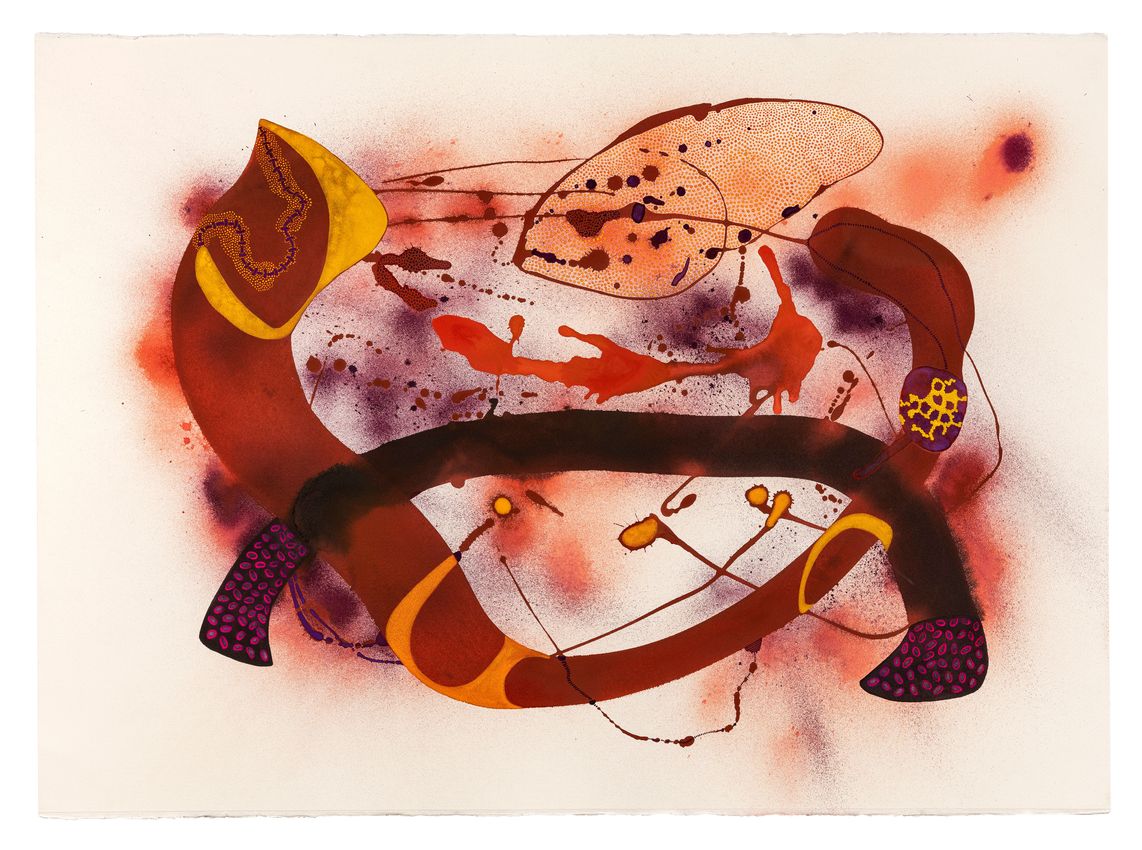
A single ember can hold entire worlds. Shapeshifting across terrains of earth and fire, this fragment compresses and preserves multiple passages of time and space. Under intense heat, this once solid form collapses and dissipates like vapour, our encounter with it entirely fleeting. Such is the dynamic that informs the volatile interplay between line, texture and colour in Manisha Parekh’s new exhibition Ember.
As a painting student in the 1980s, Parekh experienced the tutelage of Nasreen Mohamedi at The Maharaja Sayajirao University of Baroda and thereafter held close the importance of honouring the expressive qualities of any material. Ember’s mutable forms, which traverse works on paper and sculpture, are shaped by fluctuating encounters with temperature, pressure, and time. Parekh’s sensorial worldmaking is a result of deep deliberation – a practice of slow making to which Parekh has long remained committed. As art historian Rakhee Balaram notes, ‘the artist pays careful and painstaking attention to phrasing and lyricism in the arrangement of her works, but avoids preciousness through rigorous editing and an understanding of sequence and form’.
Viscous brushstrokes leap and coalesce as they invigorate the paper’s surface in the series Fields of Hibiscus (2026). These radiant watercolours are animated by buoyant motions that swell and fall – gestures that nod to the raga as one of Parekh’s central creative influences. In Fields of Hibiscus 1 (2026), webs of intertwining crimson and maroon ink strokes, occasionally caressed by swathes of magenta, are pierced by a jolt of saffron yellow. Hovering over the large pulsating knot is a single dotted thread reminiscent of the microscopic insect traces that have influenced installation works such as Shadow Garden (2013). Accumulating and dispersing, these undulating specks embody a rhythmic score emanating directly from the land.
Elements of the corporeal are evoked in Fields of Hibiscus 3 (2026) as ribbons of blood red materialise as throbbing arteries, punctuated by fine white fibres. As pools of ink appear, Parekh transforms them into temporary architectures held in place by fragile lattices. Despite the weighty presence of the central interlocking forms, Parekh maintains a compositional equilibrium as effervescent sprays of paint drift across its surface and provide moments of brief release. Here, she adds a vibrational layer to her paper works as the incidental paint flecks create a textural rupture we can almost feel and hear. The oscillation between fast and slow mark-making that is central to the Fields of Hibiscus series echoes how writer Amit Chaudhuri describes a raga as a structure that ‘is not a self-enclosed composition; it’s an unfolding’.
Parekh’s enlivened surfaces are explored more haptically in the triptych The Red (2024). Lengths of raw red silk are carefully teased through drilled holes in handmade paper before they are tied into knots to settle into place. By varying both tightness and distance between them, the protrusions sit like germinating seeds rippling outwards to evolve and accumulate into new landmasses that immediately sink back into the earth. Parekh delights in structural play – as the knots proliferate, she spaces them out generously. Here, gaps behave like rests in a dense musical composition. As the shapes dissolve and resurface, The Red recalls Parekh’s interest in ‘extremes of experience, the body and its inside, the world within and the world without’.
Rising from the ground is the sculptural installation Ember Breathes Alone (2026), which comprises twelve rhizomatic metallic forms. This group of perforated copper sheets rests precariously on delicate stands that cast shadows across the floor, transforming the work into a sculptural extension of Parekh’s drawing practice. She continues to meld sculptural and drawing-based modalities by embracing the embodied process that is present in the contorted and heavily patinated finish of the copper’s surface – a raw expression of the collaboration between the artist and other artisans to produce the work. Artist and poet Etel Adnan once noted that water’s iridescence is language. In the same vein, the incandescence of copper communicates a record of each maker’s touch. Fragmented like broken pieces of the earth’s crust, audiences are encouraged to perambulate the sculptures, paying close attention to what emerges between them.
When describing the experience of making this new body of work, Parekh explained that the creative process enabled her to take flight. Each composition revels in a liberating choreography that encourages our own senses of sight and imagination to share in the same movement. In Ember, Parekh continues to develop a formal language that is igneous; it continuously cools and reheats as it renders the boundaries between her chosen materials porous. Embers contain a life force that can never be fully lost. Resting dormant while casting a gentle glow, they gather strength to re-ignite once more.
Text by Amrita Dhallu, 2026. Courtesy Jhaveri Contemporary


Manisha Parekh (b.1964, Uttarsanda. Lives and works in New Delhi) is notable for her abstract style. Both biomorphic and gestural, she has developed a distinct aesthetic that subtly references the work of Nasreen Mohamedi, her teacher at Baroda. Often making pieces in series and using a linear plane or grid as her organising principle, Parekh dices with Minimalism and localizes it. Her materials – paper, cord, rope – draw on the craft traditions of India. Parekh explores their properties and works predominantly by hand to conjure organic, vegetal forms indebted to the natural world.

Jhaveri Contemporary was formed in 2010 by sisters Amrita and Priya with an eye towards representing artists, across generations and nationalities, whose work is informed by South Asian connections and traditions. The gallery’s dedication to original scholarship, engendered through its carefully crafted shows, is one of the many ways it distinguishes itself. Entwined with this philosophy is another guiding principle: showcasing the heterogeneous practices of long-celebrated luminaries as well as emerging talents, often in generously interrogative conversations. With a focus on mining lesser-known art histories, Jhaveri Contemporary facilitates dialogue between artists, curators and historians to add to the wider field of art. Estates served by the gallery include Mrinalini Mukherjee and Anwar Jalal Shemza.

A respected voice in contemporary art discourse.
Focusing on ambitious storytelling and insightful art-world commentary. Ocula Magazine publishes in-depth interviews, critical essays and timely analysis on the artists, exhibitions and ideas driving the global art world.
Learn more about Ocula Magazine
Showcasing the best of the art world.
Ocula partners with galleries from around the world to highlight their artists, artworks and exhibitions. Gallery membership is by application and invitation, with each member vetted by an independent panel.
Learn more about Ocula Membership

Specialises in the sale of major artworks.
Led by a team with deep ties to the world’s leading auction houses, galleries and collectors. Ocula’s advisory team offers bespoke services to high-net-worth clients from around the world who are looking to acquire the best of contemporary and modern art.
Learn more about our team and services
