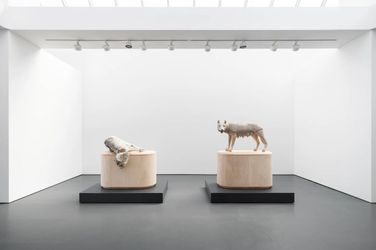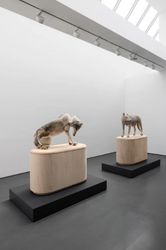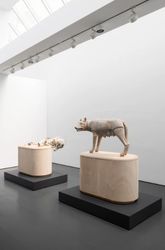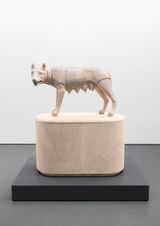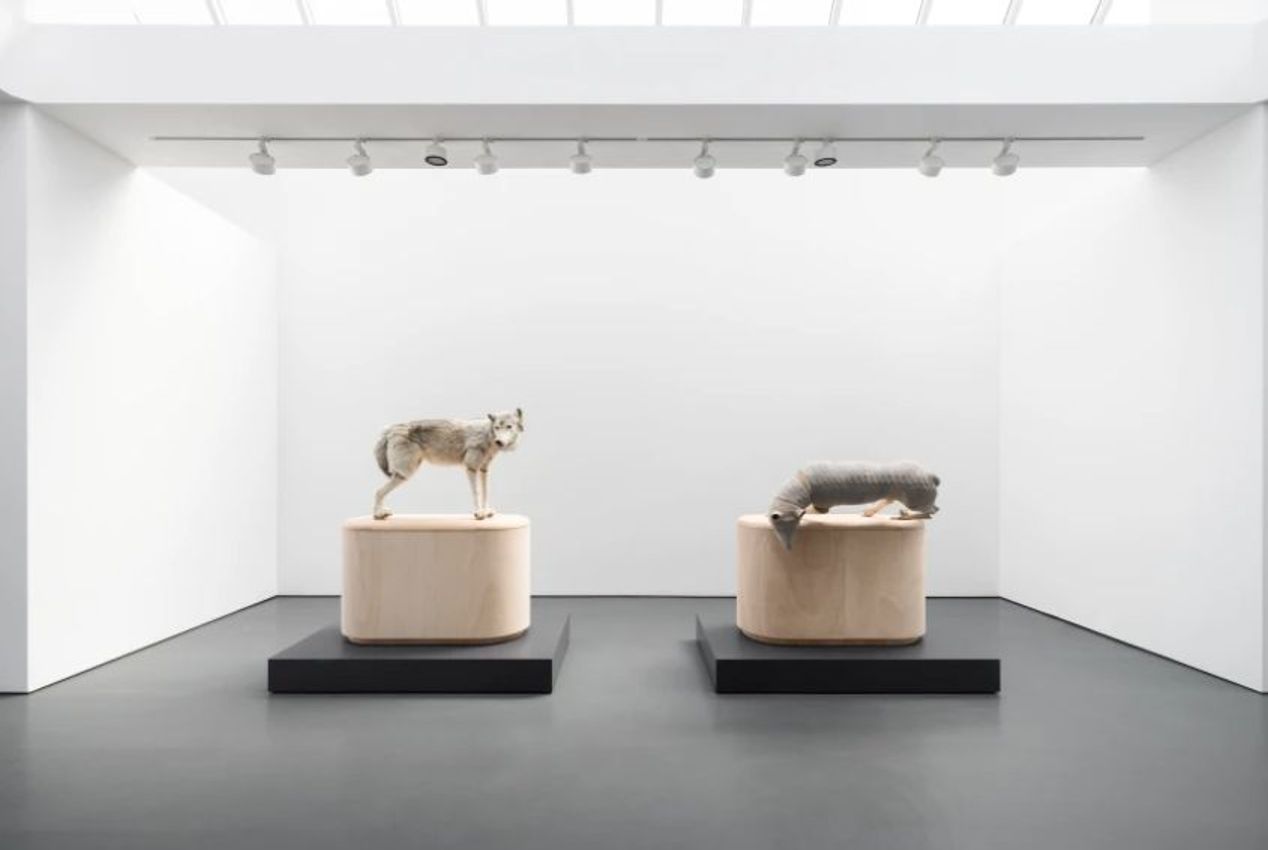
Esther Schipper is pleased to announce Zwei Wölfinnen, a presentation by Julius von Bismarck, whoserepresentation was announced earlier this year. On view are two sculptures of she-wolves: one appears as ataxidermied animal, the other is formally based on the iconic classical bronze of a she-wolf in the CapitolineMuseums in Rome.
Fierce creatures looming large in the humanity’s imagination, wolves are endowed with distinct attributes indifferent cultures: seen as brutal and unrelenting, doltish or menacing, greedy and destructive, or implicatedwith witchcraft and magical transformation (werewolf) in some, others associate the animal with independenceand freedom (lone wolf), courage and strength, cunning and intelligence. A recurring motif has the wolf turnprotector and caregiver of a human infants: most famously, Zoroaster, Romulus and Remus, Rudyard Kipling’sfictional character Mowgli—all were supposedly suckled by a she-wolf, raised by a pack of wolves.
Rendered nearly extinct in the late 18th and early 19th century, the fate of the wolf can be understood in alarger context of the domination of the natural world, specifically, as part of the Western European notion ofthe world as something to be domesticated, toiled upon, exploited. Increasingly demonized since the MiddleAges, Christianity emerges as major force in the demise of wolves, partially justified by the bible’s use of theanimal as a symbol of danger to the flock and, in the warning of false prophets who are ‘wolves in sheep’sclothing,’ to the soul.
Conceived as a pair, Bismarck’s two sculptures represent different aspects of lupine-human entanglement.Zwei Wölfinnen (Im Wolfspelz) at first looks the fierce creature, with its muscular body and roughcoat, even as its posture slightly echoes that of its Roman companion. This echo hints at the essence oftaxidermy: made from an animal skin drawn over a shape approximating a pose we may think of as typical,the taxidermied ‘animal’ is a fantasy. Carved from wood, Zwei Wölfinnen (Wilde Mutter), is modelled ona version of the Capitoline bronze of a she-wolf. A politicized hybrid of the human fascination with the wolf,the Etruscan bronze—distributed in multiple variations across Italian sculptural representations—became asymbol for the capital Rome when in the 15th century, bronzes of two infants were added—the mythologicalfounding fathers, Romulus and Remus. Bismarck’s sculpture leaves out the suckling infants, but the iconicityof the source lets observers almost unconsciously add them.
Then the illusion breaks—as with all taxidermied animals on closer inspection—when we see the largescale figures collapse and reconfigure, revealing the elaborate construction that enables their continuousmovement. A further development of Bismarck’s series of monumental collapsing sculptures presented inthe artist’s solo exhibition at the Berlinische Galerie in 2023, the new works emulate the mechanism of handheld push-puppet toys with miniature animals. Yet, the collapse of the animal’s body into sections—and withit the dissolution of the initial illusion of the animal sculptures’ intactness—brings with it a heady mix of power,curiosity and, as with many contemporary encounters with animals, pity and perhaps shame.
The format of Julius von Bismarck’s sculptures—their echoing the toy’s construction, anti-naturalistic awkwardmotions, and even the characteristic round base as plinth—has an anti-heroic effect: the imposing figures’continuous collapse is a choreographed study in powerlessness, turning the predator Zwei Wölfinnen(Im Wolfspelz) and the iconic cultural symbol Zwei Wölfinnen (Wilde Mutter) into jumbled dolls. Buttransformed in scale, the playfulness of its mechanistic source comes with a change in scale of the inferredviolence. The laughter at the sculptures’ unceremonious collapse becomes a symptom of our ambivalence attaking pleasure from this destruction and, in this realization, the wider consequences of humanity’s relation tothe world are revealed.
Zwei Wölfinnen then speaks to the core of Bismarck’s practice: the question of how the notion of Naturehas been constructed, in particular, how the conceptual separation of man from his surroundings, throughnaming, classifying, and creating systems, has gone hand in hand with the control and domination of theenvironment, with increasingly disastrous consequences, not only for the planet, but also, as a consequenceof broader notions of human sovereignty, for the lives of other beings, human and non-human.Concurrent with his presentation at Esther Schipper, Julius von Bismarck will have a solo exhibition atalexander levy.
Press release courtesy Esther Schipper


Julius von Bismarck is a German conceptual artist best known for technologically driven installations and interventions that examine how perception, power, and images shape our understanding of nature and reality. Working across installation, sculpture, video, and performance, he often uses scientific instruments and engineering to manipulate environmental phenomena, from storms and landscapes to urban infrastructure. His projects and series, including Image Fulgurator (2007), Some Pigeons Are More Equal Than Others (2010, with Julian Charrière), and Egocentric System (2015), have been presented at institutions such as Berlinische Galerie, Palais de Tokyo in Paris, and The Power Plant in Toronto. In 2026, ACCA in Melbourne will host a major solo exhibition dedicated to the artist.


Esther Schipper founded the gallery in 1989 in Cologne. In 1997 the gallery relocated to Berlin. Through more than three decades of continuous exhibition practice, the gallery has established itself as a major force not only in Germany but in an international context, with offices in Paris and Seoul and representatives in France, Spain, the United States, Latin America, South Korea, Taiwan and China. The gallery holds up to ten gallery exhibitions as well as multiple off-site projects each year and participates in leading art fairs across the globe.

A respected voice in contemporary art discourse.
Focusing on ambitious storytelling and insightful art-world commentary. Ocula Magazine publishes in-depth interviews, critical essays and timely analysis on the artists, exhibitions and ideas driving the global art world.
Learn more about Ocula Magazine
Showcasing the best of the art world.
Ocula partners with galleries from around the world to highlight their artists, artworks and exhibitions. Gallery membership is by application and invitation, with each member vetted by an independent panel.
Learn more about Ocula Membership

Specialises in the sale of major artworks.
Led by a team with deep ties to the world’s leading auction houses, galleries and collectors. Ocula’s advisory team offers bespoke services to high-net-worth clients from around the world who are looking to acquire the best of contemporary and modern art.
Learn more about our team and services