Press Release

Experimenter presentsa group exhibition featuring works by Ayesha Sultana, Aziz Hazara, Bani Abidi, Bhasha Chakrabati, Chanakya School, Christopher Kulendran Thomas, Prabhakar Pachpute, Radhika Khimji, Sohrab Hura, Soumya Sankar Bose, T. Vinoja, and Vikrant Bhise.

Bhasha Chakrabarti (b.1991; lives and works inHonolulu, HI) engagesartmaking as mending,both literally andmetaphorically. Herinterdisciplinary practicespans quilting, painting,film, and installation,exploring textiles’ politicsand poetics—how fabricsare made, transported,bartered, loved,gendered, classed, andlived in and with. At ArtBasel in Basel, Chakrabarti will be showing Cuddling (in three folds). Based on theexact dimensions of Correggio’s Jupiter and Io from 1532—a Renaissance paintingembodying themes of cloaking, transformation, and erotic rapture—these three oilpaintings tenderly depict the progression of an embrace between the nude body anda blanket. By using the religiously and temporally loaded format of a triptych, thequotidian act of sleeping under the covers—an act we imagine as devoid ofviolence—is suddenly made visible, in the words of writer Phanuel Antwi, “as a tensetransfer point of power.” As the body is gradually embraced/swaddled/eclipsed, thesubject-object relations within the composition are destabilised, prompting theviewer to reconsider their assumptions about the material and metaphorical weight,agency, and significance of the quilt.

In recent years, Bani Abidi (b.1971; lives and works betweenBerlin, Germany and Karachi,Pakistan) has been drawn to therole of disobedience, wit, anddisruption in an increasinglyacquiescent, cowardly, andsilent world. After SeekingComfort In A German Chair(2024) and Attempts AtMeasuring Refusal (2025); herlatest work is a set of watercolourstudies titled Ayyar the trickster, Berlin.

At a time of heightened state repression against pro-Palestinian voices in Germany,Abidi and her thirteen-year-old son—who live in Berlin—often discuss questions ofresistance. She observes him: a young boy on the cusp of adulthood, at a stage oflife that manifests a cocktail of daredevilry, innocence, and a clear sense of justice.Inspired by him and by questions about her own role as an artist in these times, sheis drawn to histories of ‘Tricksters’ in world literature, myths, and folklore as regulatorsof power in societies. Tricksters are complex anti-heroes who are mischievous,slippery, witty, and cunning—often gender benders and shape-shifters—who arealways on the side of truth, but usually the ones who ‘trick’ justice into becoming. Sheis enchanted by their wit and independence.In her watercolour studies, Ayyar the trickster, Berlin, Abidi draws from variousperformative gestures choreographed by her son, while also choosing some from theradical Eastern European art history of the 70s.

Ayesha Sultana’s (b. 1984; lives andworks between Jashore, Bangladeshand Atlanta, USA) graphite drawingssignify a delicate yet intriguingdissonance between appearance andreality, revelation and ambiguity—through configurations and arrangementsof geometric shapes and spatialstructures, in a frame-by-frameprogression of image and time. On closerviewing, the smooth surface of the paperis dark but reflective, nestled within it liesan intricate mesh of frictions and ruptureswhich animate the tactile surfaceresembling the texture of metalunderscoring the mineral attributes ofgraphite and referring to an element ofthree-dimensionality produced by the dialogue between the versatile malleability ofpaper and the austere physicality of graphite.

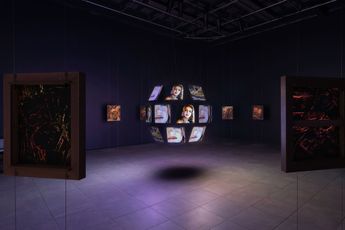
For much of the past decade,Christopher Kulendran Thomas hasbeen using advanced technologiesacross multiple disciplines to questionthe myths of Western individualism.His paintings metabolise the colonialart history that came to dominate in SriLanka after his family, who are Tamil,left escalating ethnic violence there.Kulendran Thomas often exhibitsthese paintings with video installationsthat fuse propaganda andcounterpropaganda into a speculativevortex of alternate histories.

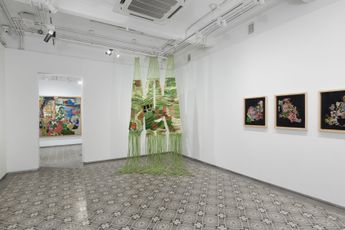
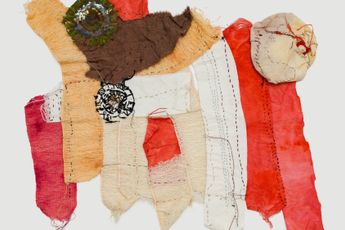
Through deep engagement with diverseindigenous textile techniques, materialinvestigation, and inherited knowledgesystems, Chanakya School’s practice,led by Karishma Swali, forms a conduitbetween contemporary thought andancient processes. The works serve inequal parts an exploration of theirinterconnected textile histories, as itserves a repository of understanding theresidues of the human hand imprinted inthread over time. Few human inventionscarry our imprint across time asintimately as cloth—through culturesand centuries, textile has absorbed thepersonal alongside the collective,becoming a palimpsest of humanexperience where stories are deposited,layered, and preserved. For ChanakyaSchool, these stories are not abstract—they carry the customs of a place, the ritualsof daily life, and the social codes that shape communal identity. To trace a line ofthread therefore, for the collective, is to follow an unbroken lineage of knowledge,even a physiological map or a chronological archive of our history that binds peopleto land, to one another, and to their communities.

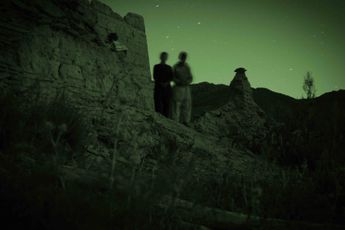
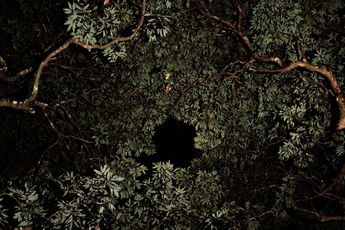
Aziz Hazara is an interdisciplinary artist workingacross various mediums, including photography,video, sound, and multimedia installations. His workexplores themes of surveillance, material culture,and supply chains within the context of powerrelations, geopolitics, and the panopticon. InMoonsightings, Hazara derives the vivid green fromretinal scans and biometric data that he excavatesfrom night-vision goggles. Frequently left behind inconflict zones by foreign military forces, thesegoggles and their data are often sold in the marketsin the United States, Afghanistan, and thesurrounding region at large. Hazara looks at supplychains and the production of surveillance technologies and their afterlives in regions that have recently been occupied by theUnited States.

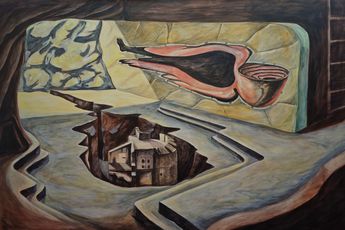
Prabhakar Pachpute’s (b. 1986; lives andworks in Pune, India) The Length of aDream/स्वप्नांची दीघर्ता is a recent body of work,where he simultaneously explores ideas ofalteration and renewal—elements that standin contrast to one another while also comingtogether to anchor critical introspection.Reflecting on Gregor Samsa’s transformationin Franz Kafka’s Metamorphosis, Pachputeconsiders whether Gregor truly changed, orwhether something had merely beenrevealed. The works meditate on thecondition of reducing oneself to a function,a commodity, or an object, and inhabiting aworld where passion becomes transactionaland care conditional. At the same time, theworks search for a path towardsregeneration—one that embraces resilience,revival, and the process of carving out anidentity that one once deeply believed in. The body of work reflects on the trajectoryof the dream that calls for such transformation, while holding on to the possibility ofhope that still lies within.

For more than a decade, Pachpute has critically examined the impact of mining onboth the environment and human lives. What began as a study of altered natural andindustrial landscapes has deepened into an exploration of the inner worlds of thosemost affected. This series of artworks engages with social and psychologicaldimensions of hardship and systematic abuse.

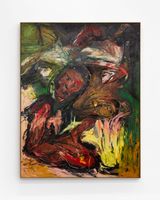
Sohrab Hura (lives and works in New Delhi,India) will present a selection of oil paintingsfrom his body of work The Forest. The titleencompasses the act of waiting within itself,evoking the forest as a space of myriadpossibilities—it can harbour secrets, offerrefuge, or provide a sense of solace andcomfort. For Hura, the forest becomes both aphysical and psychological manifestation.These works emerge from a place ofremembrance, anticipation, and imagination. Inthe recent months, Hura has beenaccompanying his father to medicalappointments that made him acutely aware ofhow time can feel interminable in the hospitalwaiting rooms. When he began working with oil paint, he felt a similar sense ofwaiting—the slow process of allowing one layer to dry before applying the next.

Vikrant Bhise’s (b.1984; lives andworks in Mumbai, India) practicereflects on the lives of various migrantand marginalised communities whohave been discarded by society andcontinue to fight for identity andacceptance. At Art Basel in Basel, Bhiseis showing three new bodies of work—They Made Us Wear It, UnsettledGrounds, and Denied Lands. Theseworks are a continuation of an earlierseries that engaged with communitiessuch as snake charmers and monkeycharmers, among others, who performon streets while moving from village tovillage with no permanent homeland.These migrant communities constructtemporary tents from whatever materialthey have accumulated, and the tent becomes both an abode and something theycan call their ‘own’. Tents, in particular, carry a politics of their own—they can becometheatres for performers who wander from place to place, speaking to the realities of such communities, while also serving as shelters for worn-out beings in moments ofprotest. The works reflect Bhise’s mindscape, where land, tents, cloth, people, andobjects churn together in turmoil, much like the lives of these communities that remainin a constant state of upheaval. The Buddha, as the ultimate form of peace andliberation, remains central to the artist’s visual vocabulary, alongside references toBuddhist iconography and architecture. The form of the Chattra spire, positioned atthe top of a Stupa, emerges as a symbol of peace and protection, offering a sense ofhope to these communities. The portrayal of Babasaheb Ambedkar serves as areminder of his enduring call to “Educate. Agitate. Organise,” foregrounding it as anessential tool in the fight against injustice and oppression.

Employing a range of processes that are central toher works, including photographic transfers frompersonal archives, collage, painting, stitching anddrawing, Radhika Khimji (b. 1979; lives and worksbetween Muscat, Oman and London, UnitedKingdom) pushes the edges of her practice.Khimji’s ongoing interests in expanding thepossibilities of thinking through shapes, geometry,and the body in relation to landscapes are often thepoint of departure in the works. Abstractedlandscape forms and images from construction sitesseem ensconced within innumerable repeated dotsand oblong shapes, an act that makes the surfaceof her works tactile and acutely textured.

Through an engagement with planetary transits andbodily sensations, Khimji’s work Scissors cut your inner grace, your perfect lace topuncture draws from the relationship between Neptune—associated with water anddissolving boundaries—and Saturn—the planet of structure and containment. Thetitle attempts to make concrete what has become abstract, images once grounded inmaterial experience, now transformed through a layered process of making. Thecurrent alignment of the planets evokes moments when established systems begin toerode; the last major conjunction coincided with the fall of the Berlin Wall. Inspiredby photographs of the port of Salalah in Oman, the works focus on fences, cables,and barriers separating land from sea. Across the work, these rigid structures beginto fray and fall apart, echoing wider instability and transformation. The work becomesa reading of self, landscape, and belonging—holding tensions between chaos andharmony, darkness and light.

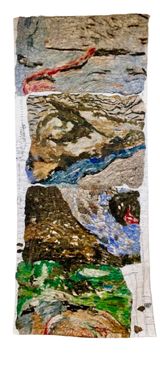
T. Vinoja’s (b. 1991; lives and works inKilinochchi, Sri Lanka) practice is influencedby contemporary art and Tamil literature,particularly the lived experiences of the SriLankan War (1983-2009). Her work exploresthe war-torn landscapes, social conflict, andcollective memory. Rooted in textile-basedpractices, her weaving embodies the conceptof skin—both as a physical boundary and ametaphor for land, identity, and loss.

The act of weaving itself is a process ofconnecting lines, much like the threads ofhistory and personal experience. These linessymbolise both the fragility and resilience ofhuman existence. Fabric, like skin,accompanies us through life and death,serving as a second layer that records ourpresence and absence. Through her practice,Vinoja seeks to evoke this enduringrelationship between body, land, andmemory, reflecting on the marks left by warand the stories woven into our collective past.

This work titled Converging Landscapesconsiders landscape as a constructed fieldthrough which borders are produced, and withthem, systems of nationalism and control.While geopolitically fragmented, these terrains remain materially and ecologicallycontinuous—an interconnected planetary system. From this perspective, separationis not inherent but imposed. The work traces the friction between Earth’s fundamentalcontinuity and the human histories of division—war, displacement, and territorialconflict—inscribed across its surface. It reflects on how notions of separation areproduced within a world that is, in itself, inseparable.

Soumya Sankar Bose (b. 1990; livesand works in Kolkata, India)reconstructs archival material and oralhistories through photography, film,alternative archives, and artist books.His hybrid practice, grounded in longterm research and close engagementwith local communities, underscoressubaltern experiences of themarginalised yet resilient in postPartition Bengal. “A chance encounterwith a diary found on a train compelsSoumya Sankar Bose to embark on ajourney that plunges him towards theintimate lives of strangers. Each onebound to the next not just throughBrinni–the unknown author of the diary–but by their brush with life’s inevitableend...We Need to Talk in Whispers brings to view that which is pervasive, and yet,remains marred by a resistance to narrating aloud. In a time where scores ofindividuals are plagued by mental distress, it pushes us to contend with thediscomfort of fatality’s grip on the mind. It asks us to attenuate to these lowerregisters, which carry the weight of our psyches and interior landscapes. When welearn to listen to, and learn from, the whispers, we may hold space for those thatwrestle, often alone, with untimely ends.”– Excerpt from text by Tanvi Mishra.

Read More

Selected Works

Loading...

Artists Exhibiting

Also Exhibiting at Experimenter

The art world in focus