





CHRISTOPHER KULENDRAN THOMAS
b. 1979, United KingdomChristopher Kulendran Thomas’s work considers how art and reality interrelate, making images using neural networks—and collaborating with musicians, activists, designers, technologists and writers—to consider alternative realities, lost histories and how Sri Lanka’s art scene has been shaped by its colonial past.
Early Years
Christopher Kulendran Thomas was born in London in 1979 to Tamil parents who had fled Sri Lanka amid escalating civil conflict. He gained his MFA from Goldsmiths in 2012. He has spoken about being brought up “completely immersed in British culture, without any real context for our Sri Lankan heritage” and how it must have been hard for his parents to see their children grow up so far from their roots. The Sri Lankan civil war is the spine that runs through Christopher Kulendran Thomas’s work; the conflict between the Tamil and Sinhalese peoples began in 1983 as the Tamils tried to counteract persecution by creating an independent state. The war culminated in the 2009 Mullivaikkal massacre, in which tens of thousands of Tamils were killed.
Christopher Kulendran Thomas: Artworks
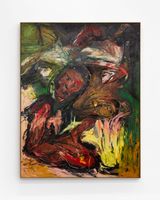
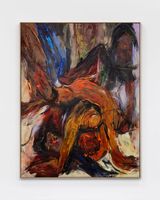
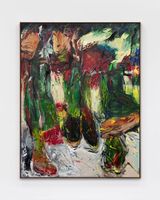
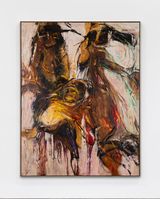
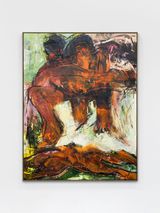
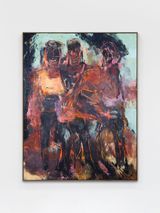
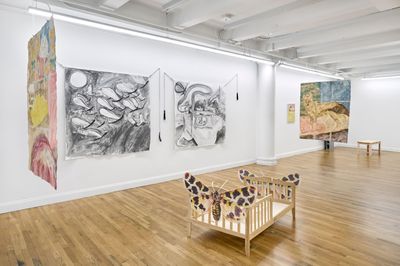
Before “AI art” was a common term, Christopher Kulendran Thomas built neural networks from scratch, training them using images of work by Sri Lankan artists and producing new compositions that he and his studio team then paint on to canvas. Kulendran bought the source artworks in Colombo from galleries that opened during the economic boom following the brutal end to the Sri Lankan civil war, and sees the expansion of the gallery market as a demonstration of how Sri Lankan elites are masking the violence on which their profits were built. The titles of these canvases are often simply the raw file name of the PNG.
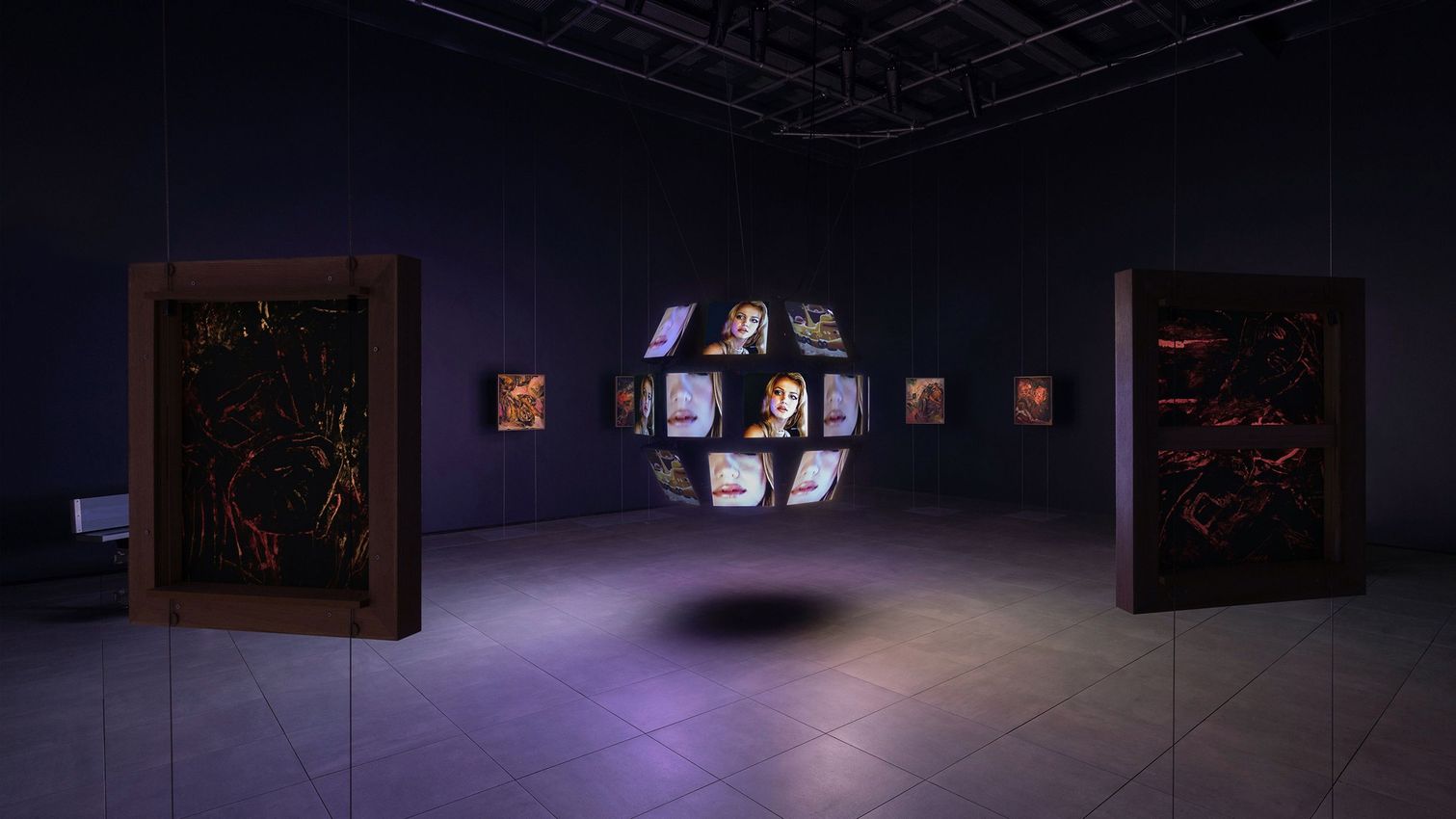
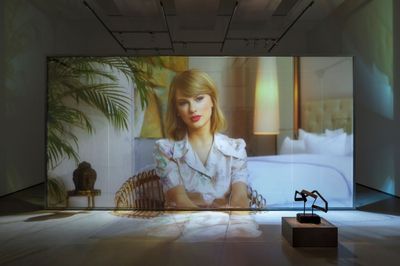
- 2019’s Being Human blends Kulendran Thomas’s AI-adjacent paintings with a video projection made in collaboration with Annika Kuhlmann featuring deepfakes including Taylor Swift (talking about authenticity) and cultural figures involved in the Colombo Art Biennale, which began during the post-war economic upturn. The installation asks which humans are actually protected by “human rights”. As the artist told Ocula magazine in 2026: the piece takes a “look at the relationship between contemporary art as the aesthetic expression of those values and human rights as the juridical expression of those values. And it kind of circles around this question of whether we have ever even been human or whether that’s a kind of ideological fiction.
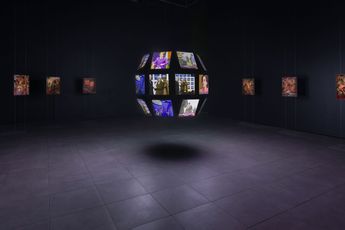
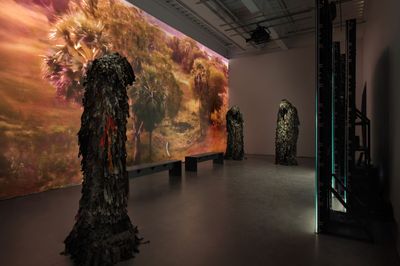
- At the centre of Peace Core (2024) is a rotating orb containing 24 televisions that continuously stream footage (mined using one of Kulendran Thomas’s own AI algorithms) from US TV broadcasts during the moments before the planes crashed into the World Trade Centre on 11 September 2001. Around the orb are abstract canvases based on Mullivaikkal beach, where thousands of Tamil civilians were killed on 18 May 2009 during the war.
Christopher Kulendran Thomas: Select Exhibitions
- Christopher Kulendran Thomas: Safe Zone, Artspace, Sydney (2025)
- Christopher Kulendran Thomas: Peace Core, Gagosian, New York City (2025)
- Being Human, MoMA, New York City (2025–2027)
- Exhale, Experimenter, Mumbai (2025)
- Christopher Kulendran Thomas: For Real, Kunsthalle Zurich (2023)
- Christopher Kulendran Thomas: Another World, ICA, London (2022)
- Ground Zero, Schinkel Pavilion, Berlin (2019)
- New Eelam, Brisbane Institute for Modern Art (2019)
- Christopher Kulendran Thomas, New Galerie, Paris (2017)
- Crisis of Reality, White Box, Friedrichshafen (2017)
- 60 million Americans can’t be wrong, Kunstverein Harburger Bahnhof, Hamburg (2016)
- When Platitudes Become Form Mercer Union, Toronto (2013)
Select Group Exhibitions
- Pixel Pioneers, Museum Boijmans Van Beuningen, Rotterdam (2026)
- New Humans: Memories of the Future, New Museum, New York City (2026)
- Second Body, David Kordansky Gallery, Los Angeles (2025)
- Data Dreams: Contemporary Art in the Age of AI, MCA Sydney (2025)
- 14th Taipei Biennial: Whispers on the Horizon (2025)
- Machine Painting, Modern Art, London (2024)
- Oh, Gods of Dust and Rainbows, Front International: Cleveland Triennial for Contemporary Art (2022)
- Uncanny Valley: Being Juman in the Age of AI, de Young Museum, San Francisco (2020)
- Time, Forward! V—A—C Zattere, Venice (2019)
- Parts of Speech, Museum of Contemporary Art Chicago (2019)
- Seventh Shenzhen Bi-City Biennale: City Smarts (2017)
- Citizen X—Human, Nature and Robot Rights, Øregaard Museum, Hellerup (2017)
- 11th Gwangju Biennale: The Eighth Climate (What does art do?) (2016)
- Ninth Berlin Biennale: The Present in Drag (2016)
- Co-Workers, Musée d’Art Moderne, Paris (2015)
- Rehearsals in Instability, Galerie Andreas Huber, Vienna (2015)
- Art Turning Left: How Values Changed Making 1789–2013, Tate Liverpool (2013)
Further Reading
- Christopher Kulendran Thomas’s Instagram
- Christopher Kulendran Thomas’s __website
- 2026 interview with Ocula magazine_
Christopher Kulendran Thomas FAQs
Who made a deepfake of Kim Kardashian?
Christopher Kulendran Thomas used a deepfake of Kim Kardashian in his 2022 film installation, The Finesse, which explores displacement, diaspora and historical narratives. Across five mirrored panels, deepfake Kardashian says: “I feel like us Armenians know that nothing can protect you when the narrative goes against you.” In another section of the film, Kulendran Thomas uses footage from OJ Simpson’s 1995 trial (Kim’s father was his defence attorney) spliced with deepfake Kim discussing both her Armenian ancestry and being an influencer.
Does Christopher Kulendran Thomas use AI?
Christopher Kulendran Thomas has trained his own neural networks to create his art, whether this is deepfake videos or canvases based on Sri Lankan source material. He told Artnews in 2025 that he is actually sceptical of “AI art” itself and that once AI becomes ubiquitous and we become use to using AI to think, it will change our perception of what we see.
What are the main themes in Christopher Kulendran Thomas’s work?
Christopher Kulendran Thomas draws on his Tamil parents’ own lived experience of fleeing conflict in Sri Lanka in order to highlight the unsuitability and instability of Western ideas of the individual as the basic unit of society. Making paintings using Sri Lankan source material and trained neural networks, he calls into question the ongoing legacy of British colonialism in Sri Lanka.
OCULA














Explore and Follow Artists Shaping Contemporary Art
A respected voice in contemporary art discourse.
Focusing on ambitious storytelling and insightful art-world commentary. Ocula Magazine publishes in-depth interviews, critical essays and timely analysis on the artists, exhibitions and ideas driving the global art world.
Learn more about Ocula Magazine
Showcasing the best of the art world.
Ocula partners with galleries from around the world to highlight their artists, artworks and exhibitions. Gallery membership is by application and invitation, with each member vetted by an independent panel.
Learn more about Ocula Membership
Specialises in the sale of major artworks.
Led by a team with deep ties to the world’s leading auction houses, galleries and collectors. Ocula’s advisory team offers bespoke services to high-net-worth clients from around the world who are looking to acquire the best of contemporary and modern art.
Learn more about our team and services