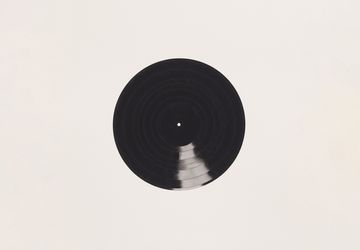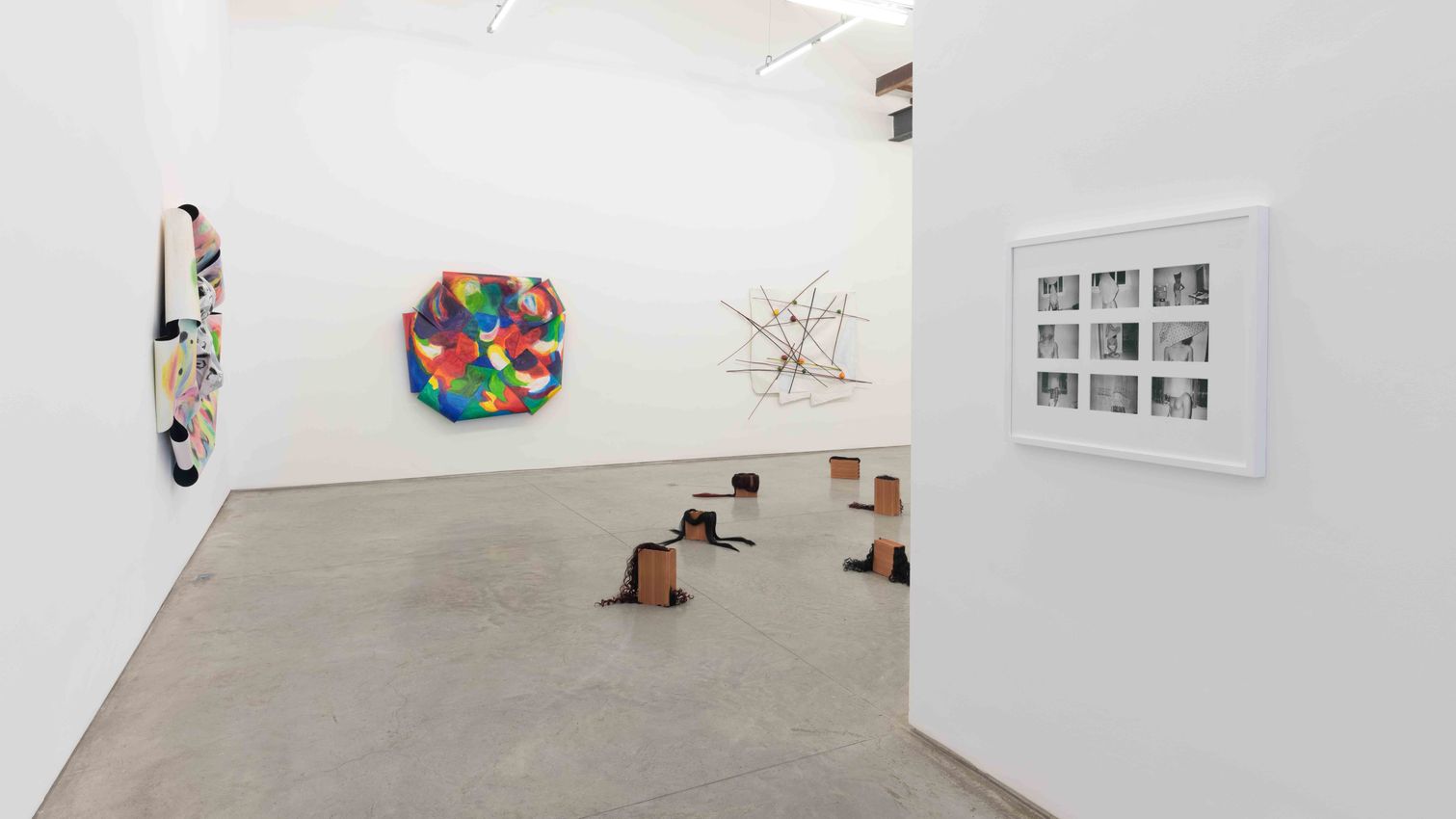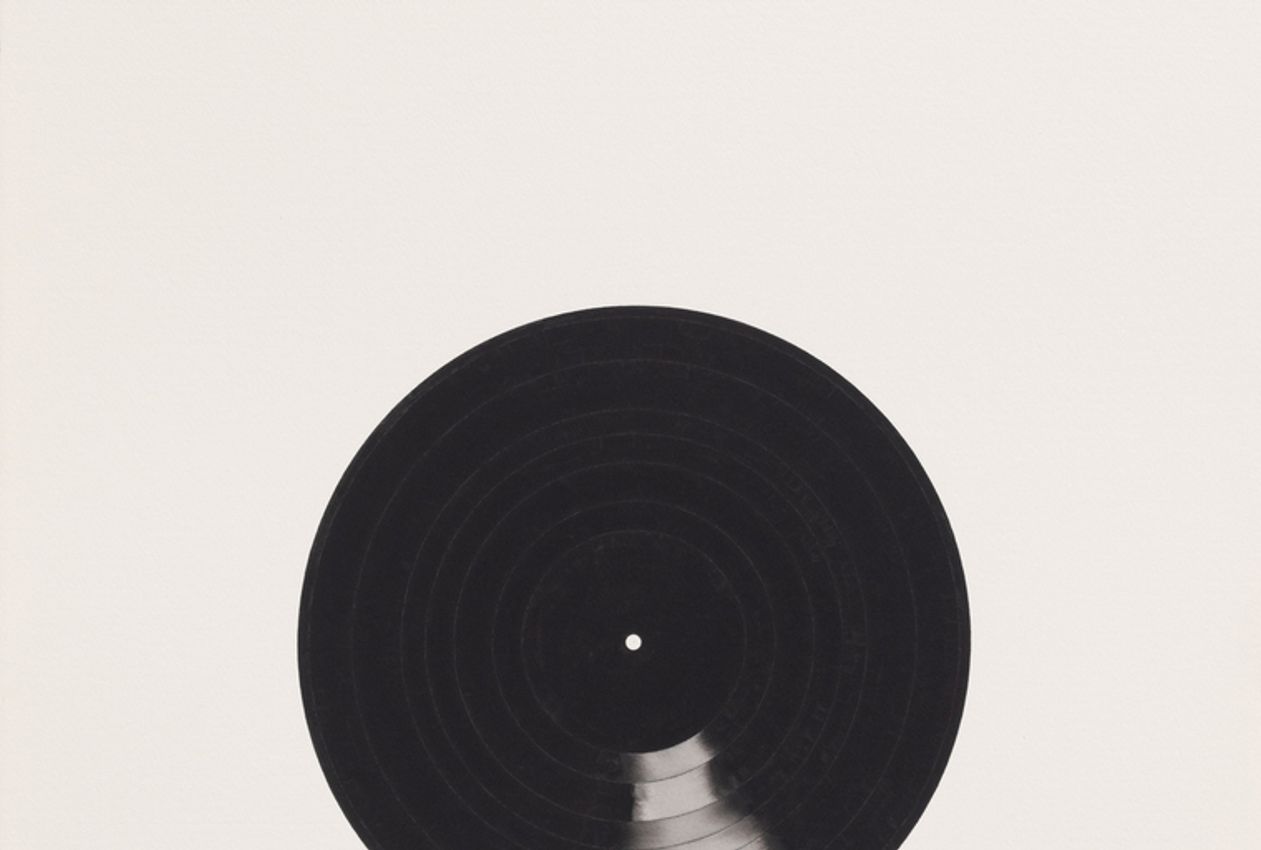
In Trilha, Iran do Espírito Santo’s new exhibition at Fortes D’Aloia & Gabriel in São Paulo, the artist presents a new series in which he represents vinyl records in watercolor. Each work was conceived by the artist according to specific songs and albums, which led to a sort of autobiographical soundtrack, highlighting compositions from the Brazilian repertoire, from MPB to classical music and rock. No two records have the same “fingerprint,” since each has its own specific grooves and width between tracks. Like the experience of listening to a record, Iran’s watercolors, though executed with surgical precision on a true-to-life scale, still carry crackles and some ambient noise, as the manual nature of the works inevitably leads to the appearance of little accidents. This is a loss in image fidelity, accentuating the physical process behind each piece’s creation. The main structure of meaning in these 12 watercolors, as in Iran’s oeuvre as a whole, lies beyond the immediately visible and takes root in the intellectual processes articulated by him as an artist and by ourselves as viewers. In the autobiographical dimension of this new body of work, the traces that music makes in memory are figured in the reflective sheen on the depictions of vinyl records, which Iran constructs by allowing the white of the paper to appear behind thinner coats of paint. These shining paths rotate successively, sectioning the circle discs like the hands on a clock. 12 paintings of 12 records and 12 tracks from each, like 12 hours out of the day or 12 months in a year. These watercolors, like an ear that is always listening, are constantly layering the singularity of perception over the plurality of experience.

Iran do Espírito Santo initiated his career in the 80’s, moving away from Neoexpressionist painting to question visual representation codes in his drawings, sculptures and installations, tightening the relationship between what is seen and what is understood by the viewer. With Base Fixa (2016), one of his most ambitious projects to date, the artist invokes the sheer magnitude of the physical scale through four sets of nuts and bolts made of stainless steel enlarged eighteen times from their original size. While in UHT (2018) – acronym for temporary housing unit – he reorganizes geometric volumes repeatedly drawing horizontal and vertical lines with a pencil.


Fortes D’Aloia & Gabriel, formerly Galeria Fortes Vilaça, presents a diverse and dynamic programme of exhibitions featuring Brazilian and international artists, alongside screenings, book launches, talks, and kids’ workshops. The gallery was founded in 2001 by Márcia Fortes and Alessandra D’Aloia, and took on its current name in 2016 when Alexandre Gabriel transitioned from Art Director to partner.

A respected voice in contemporary art discourse.
Focusing on ambitious storytelling and insightful art-world commentary. Ocula Magazine publishes in-depth interviews, critical essays and timely analysis on the artists, exhibitions and ideas driving the global art world.
Learn more about Ocula Magazine
Showcasing the best of the art world.
Ocula partners with galleries from around the world to highlight their artists, artworks and exhibitions. Gallery membership is by application and invitation, with each member vetted by an independent panel.
Learn more about Ocula Membership

Specialises in the sale of major artworks.
Led by a team with deep ties to the world’s leading auction houses, galleries and collectors. Ocula’s advisory team offers bespoke services to high-net-worth clients from around the world who are looking to acquire the best of contemporary and modern art.
Learn more about our team and services