





CY TWOMBLY
1928-2011, United States‘To my mind, one does not put oneself in place of the past; one only adds a new link.’—Cy Twombly
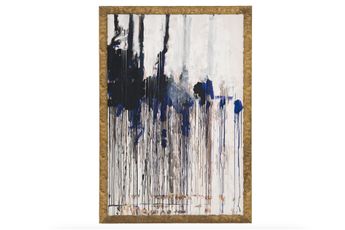
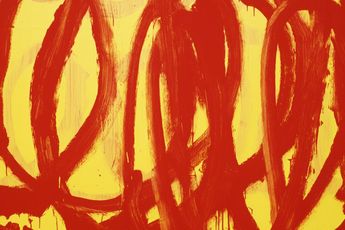
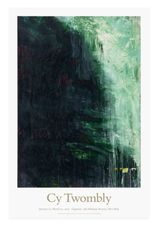
Cy Twombly (1928–2011) developed a gestural vocabulary in which each line and colour is infused with energy, spirituality, and meaning. Emerging as a prominent figure in the mid-1950s following extensive travels throughout Europe and North Africa, he produced works that are simultaneously personal and mythological, allowing narrative, language, and inner visions to erupt from his intimate, abstract notations.
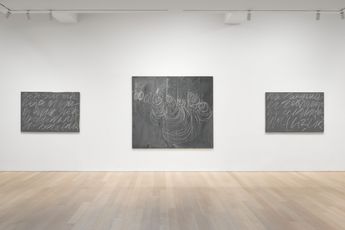
Twombly was born in 1928 in Lexington, Virginia, and studied art in Boston and New York, then at Black Mountain College in North Carolina in the early 1950s. Although he was a contemporary of Robert Rauschenberg and Jasper Johns, his work soon digressed from the aims of American postwar abstraction. While prevailing tendencies of the period, such as Pop art, sought to abandon historical narratives altogether, Twombly directed his focus toward ancient, classical, and modern poetic traditions. In the late 1950s he moved to Italy, where he produced colourful, diagrammatic works, such as Ode to Psyche (1960), that feature erotic allusions and sly jokes while maintaining an abstract charge. Shortly thereafter the sebaceous, bright colours of these works gave way to the more austere greys and blues of the ‘blackboard’ paintings, in which terse, white scrawls and loops recall the powdery effects of chalk on a blackboard. As Twombly continued to work in various locations over the following decades—including Rome, Lexington, and his final residence, in Gaeta, Italy—places, landscapes, and natural forms came to figure prominently in his drawings, collages, photographs, and watercolours.
For Twombly, the poetic and the rational were not mutually exclusive. Collage, which engaged him briefly in 1959, then began to appear more regularly in 1971, allies Twombly to the Dadaists and their descendants, such as Rauschenberg and Johns. Visual information from everyday life—travel postcards, reproductions of paintings, scientific illustrations, personal drawings, and more—entered his work as a way to explore the potential of both structure and meaning.
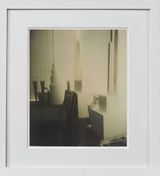
From his student days on, Twombly also captured his daily life in photographs. He recorded the verdant landscapes of Virginia and the coasts of Italy; close-up details of ancient buildings and sculptures; studio interiors; and still lifes of objects and flowers. Beginning in the early 1990s, he used specialised copiers to enlarge his Polaroid images on matte paper, resulting in subtle distortions that approximate the timeless qualities of his paintings and sculptures.
In 1995 the Cy Twombly Gallery opened across the street from the Menil Collection in Houston. A collaboration between the Menil, Dia Foundation, and Twombly himself, the gallery serves as a permanent home for a number of important works made between 1953 and 2004. Included is the series of paintings Analysis of the Rose as Sentimental Despair (1985), which features floral forms in deep reds, pinks, and purples, with quotations from Rainer Maria Rilke, Rumi, and Giacomo Leopardi. In 2010 Twombly was selected to install a permanent work at the Louvre: a painted ceiling for the Salle des Bronzes. The Ceiling spans 3,750 square feet and pays homage to the greatest Hellenic sculptors, from Phidias to Praxiteles, each of their names inscribed over an immense blue sky populated by floating, cosmic orbs.
Courtesy Gagosian

Recently Exhibited



Exhibiting Elsewhere






Cy Twombly in Ocula Magazine










Explore and Follow Artists Shaping Contemporary Art
A respected voice in contemporary art discourse.
Focusing on ambitious storytelling and insightful art-world commentary. Ocula Magazine publishes in-depth interviews, critical essays and timely analysis on the artists, exhibitions and ideas driving the global art world.
Learn more about Ocula Magazine
Showcasing the best of the art world.
Ocula partners with galleries from around the world to highlight their artists, artworks and exhibitions. Gallery membership is by application and invitation, with each member vetted by an independent panel.
Learn more about Ocula Membership
Specialises in the sale of major artworks.
Led by a team with deep ties to the world’s leading auction houses, galleries and collectors. Ocula’s advisory team offers bespoke services to high-net-worth clients from around the world who are looking to acquire the best of contemporary and modern art.
Learn more about our team and services