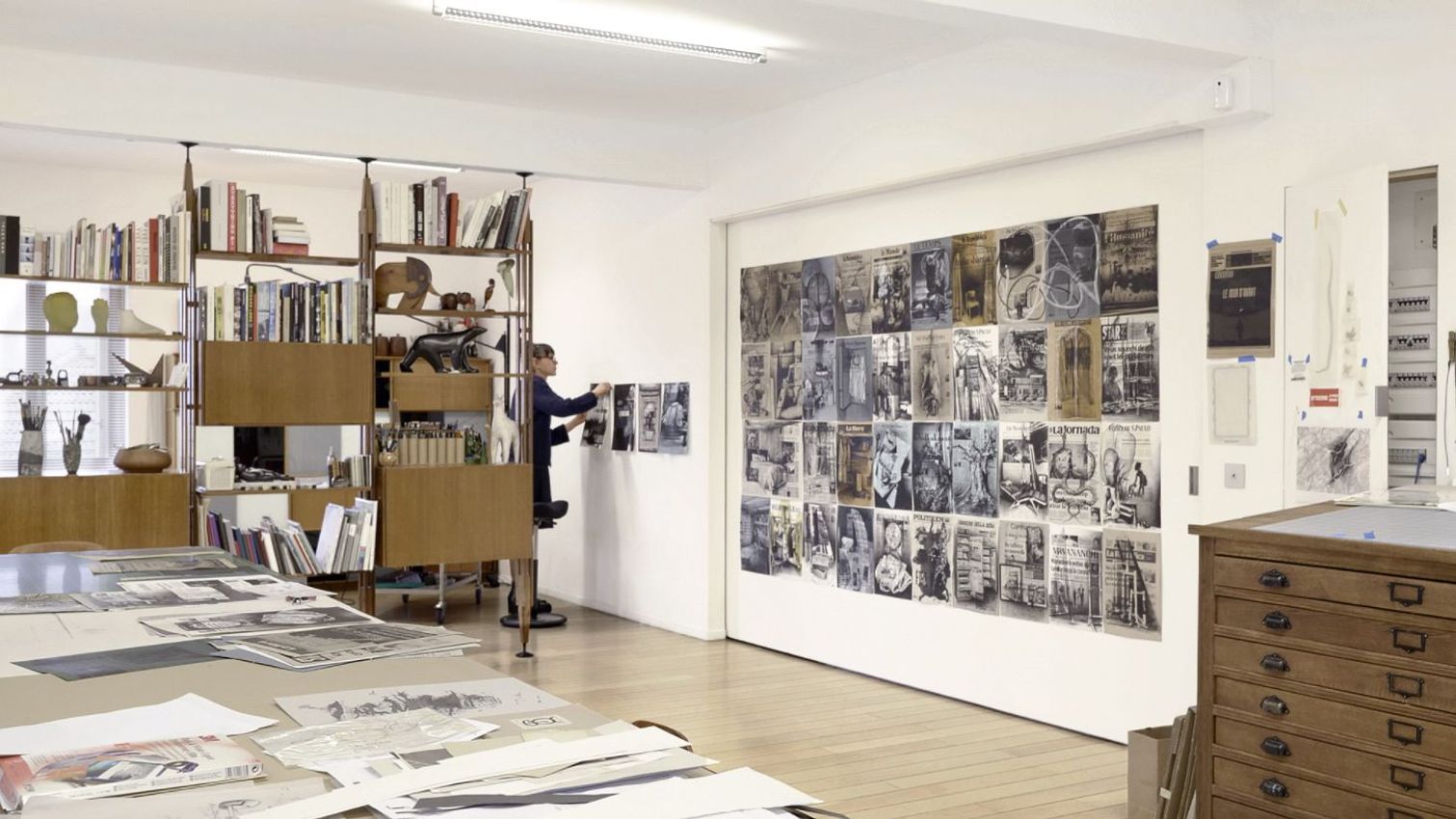
When quarantine was announced, newspapers from countries around the world that were being ravaged by the pandemic took on new meaning. I began, each day, to draw on the front page of a newspaper—it was a way of escaping the confinement, and of being connected to the strange atmosphere that was spreading around the globe with the virus. This world tour via headlines and front pages was like a journey in reverse. Suddenly, I could no longer meet the world unless the world came to me, through the newspapers.
—Tatiana Trouvé
Gagosian is pleased to present From March to May, a never-before-seen body of work by Tatiana Trouvé produced in direct response to the pandemic era.
At the beginning of the COVID-19 quarantine in March 2020, Trouvé, isolated in Paris, began a series of daily drawings using inkjet-printed reproductions of various international newspaper front pages as her starting point. As the pandemic marched on, spreading instability and uncertainty throughout the world, Trouvé continued to work ever more methodically in graphite, ink, and linseed oil.
Trouvé’s project is linked to certain modernist traditions. Connecting daily realities to poetry and the Symbolist movement, Pablo Picasso utilised scraps of Le Figaro in Cubist drawings and collages that used aleatory haphazardness to literally dematerialise neatly formatted columns of type into a chaotic jumble. In Hannah Höch’s provocative collages, newspaper cut-ups represent a feminist challenge to and reclamation of society’s dominant images and narrative.
From March to May extends these themes and connects them to Trouvé’s own temporality, while also underscoring the role that technological reproduction and human intervention play in shaping aesthetic experience. In another departure from her modernist forebears, Trouvé’s drawings are fundamentally rooted in today’s digital age; they acknowledge the instant and universal connection that online newspaper editions provided during the pandemic. As print issues became increasingly difficult to obtain in a world halted by quarantine, it was the ubiquity of digital media that allowed the news to circulate into people’s homes and lives despite the constrictive realities of isolation, thus taking on an even more precious and profound status.
Trouvé uses the newspaper like a serialised canvas, layering lines and figurative drawings over each formatted and printed front page from around the world. Beneath drawn and painted marks, ominous headlines swirl in and out of legibility, and familiar photographs mix surreally with Trouvé’s visions. Her drawings are both guided and interrupted by the arbitrary form of the printed page, inflecting the pragmatic character of newsprint with a dreamlike quality. In this suite of fifty-six works on paper, exterior and interior worlds fuse into one. Like Trouvé’s large-scale installations and sculptures, From March to May tests the exchange between memory and matter, combining abstract and quotidian elements. Sometimes immersive, sometimes setting the viewer at a distance, Trouvé’s art creates both real and imagined spaces that unsettle and distort standardised structures and perceptions of time.
To mark the New York exhibition, Gagosian will produce a special edition of From March to May in the form of a newspaper, underscoring the medium’s persistent presence as a vehicle for engagement with the outside world at large.
A conversation between Trouvé and Laura Hoptman, executive director of the Drawing Center, New York, will take place on Tuesday, September 21, 2021. Event registration details are forthcoming.
The Residents, a site-specific installation by Trouvé for Artangel in Orford Ness, England, opened on July 1, 2021. A major solo exhibition at Centre Pompidou, Paris, will open in June 2022.

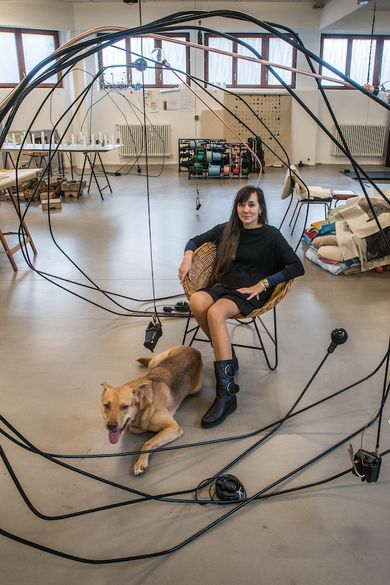
In disquieting, entropic mise-en-scènes, Tatiana Trouvé limns the boundaries between the mental and the physical, where material space and form converge with immaterial time and memory. Her situations combine intricate scenographic drawings, sculptures both linear and three-dimensional, and spaces that hint at invisible dimensions. Whether found or created, Trouvé’s ‘environmental dramas’ are melancholy yet highly charged, palimpsests containing echoes of other lived spaces and realities, which oscillate between the real, the imaginary, and the phantasmic.


A respected voice in contemporary art discourse.
Focusing on ambitious storytelling and insightful art-world commentary. Ocula Magazine publishes in-depth interviews, critical essays and timely analysis on the artists, exhibitions and ideas driving the global art world.
Learn more about Ocula Magazine
Showcasing the best of the art world.
Ocula partners with galleries from around the world to highlight their artists, artworks and exhibitions. Gallery membership is by application and invitation, with each member vetted by an independent panel.
Learn more about Ocula Membership

Specialises in the sale of major artworks.
Led by a team with deep ties to the world’s leading auction houses, galleries and collectors. Ocula’s advisory team offers bespoke services to high-net-worth clients from around the world who are looking to acquire the best of contemporary and modern art.
Learn more about our team and services