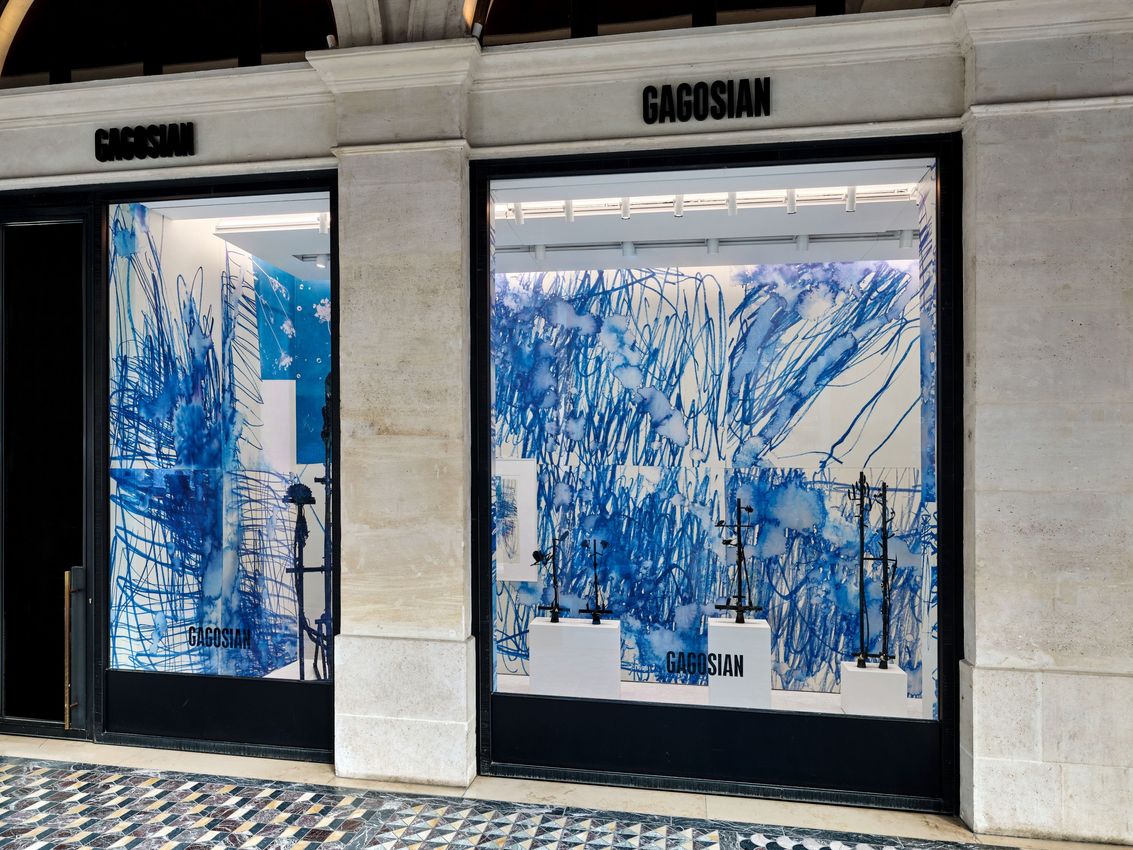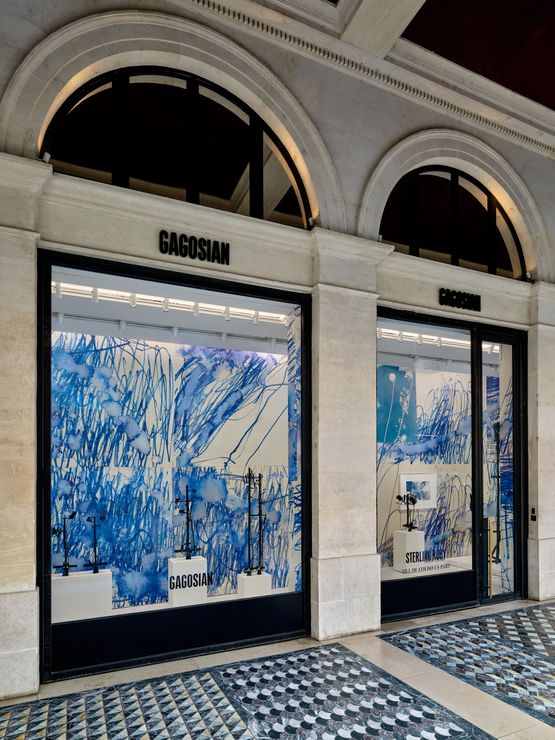
Gagosian is pleased to announce TILL DEATH DO US PART, an exhibition of new works by Sterling Ruby opening at the rue de Castiglione gallery in Paris on June 12. This suite of collages and cast bronze sculptures continues Ruby’s use of flowers as both raw and iconographic material. Derived from his expanding studio garden in Vernon, California, and extended time spent in the Eastern Sierras, the installation envelops visitors in an elegy to the floral.
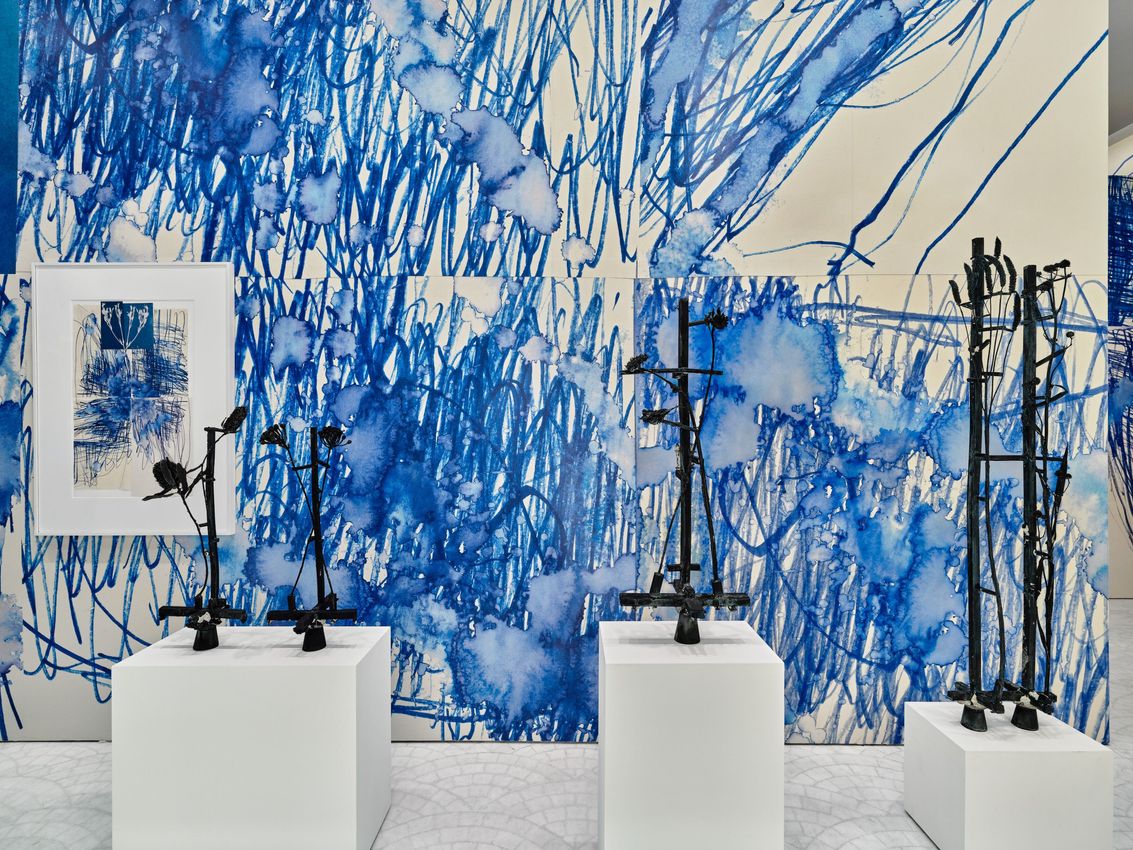
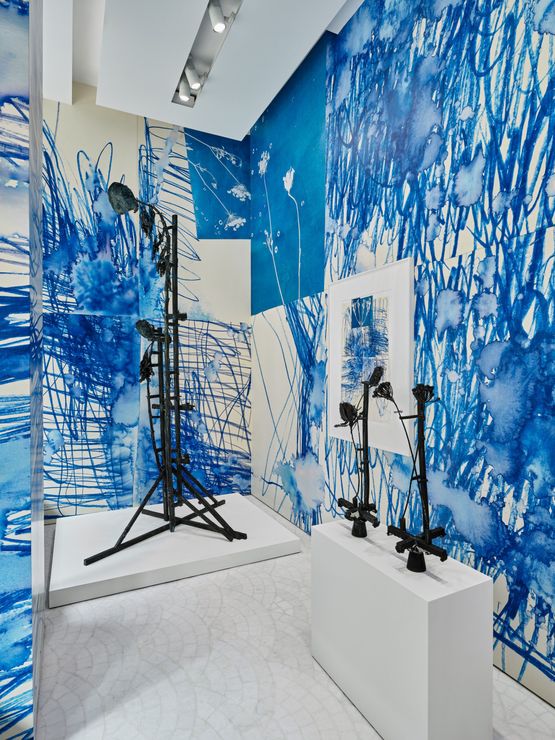
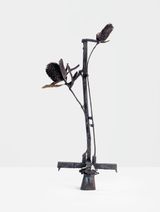
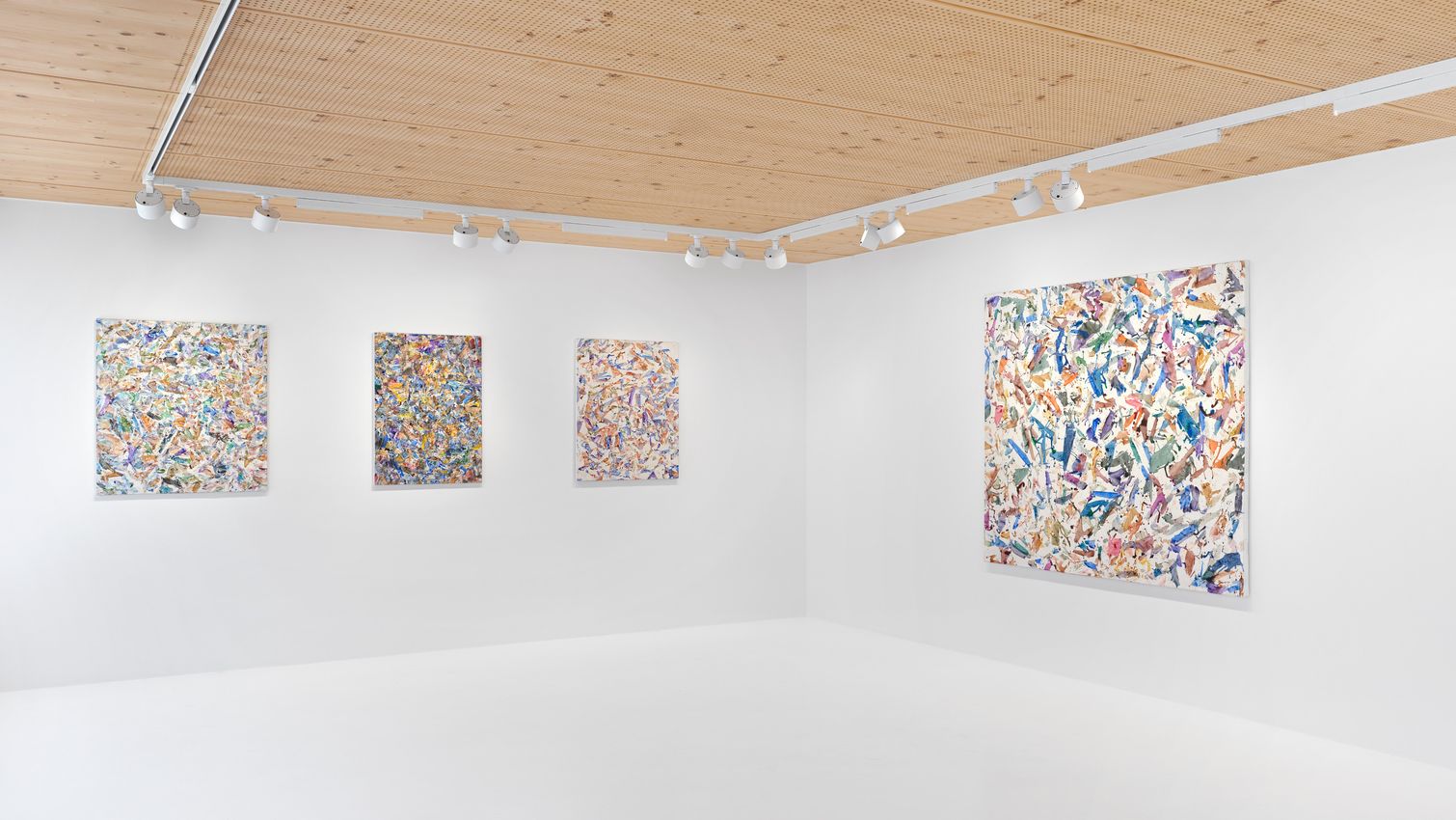
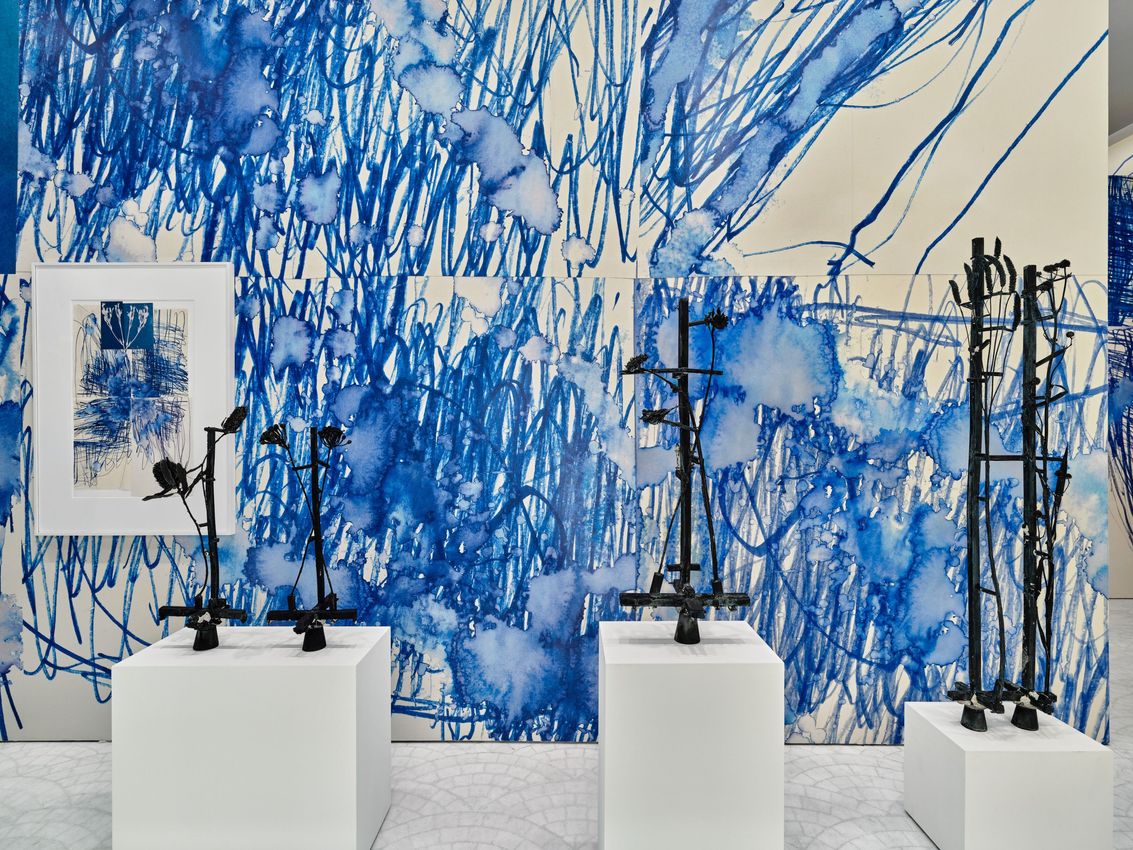
Visible through the gallery’s storefront windows, prints of the GHOSTS series (2026) are architecturally scaled and papered across the gallery walls, filling them with deep blue linear marks distinguished by a dense texture reminiscent of pastures undulating on a windy day. The works’ source collages, which combine traditional cyanotypes with washy drawn elements, hang on the walls over the field of blues. Occupying the space itself are several unique cast bronze sculptures from the series Bound Flowers. Couple. (2025–), which represent pairs of flowers bound in an embrace. This coupling provides a framework for the entire exhibition, each element functioning in relation to another, then another. These relationships are presented as a tandem dance, with forms mimicking, overlapping, intertwining, and even appearing to look at one another.
The most evocative examples of this tête-à-tête are the subtly emotive gestures of the bound flowers, which imply a more complex relationship: marriage. Flowers have been positioned in distinctive stances mimicking those of wedding portraits in which two bodies are posed together in a rigid commitment—“till death do us part.” Relationships remain central as Ruby refers to seventeenth-century Flemish and Dutch still-life painting, in which domestic arrangements carry a wide range of symbolism. Akin to these intricate historical works, the details of Ruby’s floral representations—the sculptures in particular—convey painstaking labor to which the unified naturalness of the specimens stands in contrast. Flowers are portrayed in various stages of decay, returning to their symbolism for the impermanence of life.
The process of live bronze casting remains integral to this series. Silica, used to encase and cremate each organic specimen during casting, remains embedded in crevices as a residue of loss. Pouring channels are preserved as both functional and symbolic elements. These guide molten bronze into the casting chamber while also acting as a figurative prison, locking the flowers in an everlasting pose. The darkened elements of Bound Flowers. Couple., their leaves wilted and petals shrunken, represent the end of life. Collapsing under the weight of impending incineration, sunflowers and banksias, prolific in Southern California, evoke recent wildfires. The characteristics of these hardy species allude to the conditions of their native region(s), featuring large blooms, with waxy bristles to retain moisture. At the same time, their adaptations respond to the challenges of those environments, with some species holding their seeds until they sense fire.
Ruby’s collages ironically flood the drought-tolerant flowers in Prussian blue, ultramarine, indigo, and violet. GHOSTS, much like the DRFTRS series (2013–), contains smaller elements that produce a dialogue with the larger field they float within. Here, the stem captured in each cyanotype, made from studio garden trimmings, connects with a rendered line to implicate the frenetic drawing as an extension of the flower. This empirical sensibility is felt as the lines overwhelm the space, indicating that the flower is not only a specimen but an icon for sentience.

Sterling Ruby’s work engages with issues related to the violence and pressures within society, autobiography, and art history. Drawing on diverse aesthetic strategies and mediums—glossy and colour-saturated poured-polyurethane sculptures, drawings, collages, richly glazed ceramics, graffiti-inspired spray paintings, and video—he maintains a constant tension within a multitude of elements. Throughout, he vacillates between fluid and static, minimalist and expressionist, pristine and dirty. Of the diverse forms that constitute his oeuvre, the paintings are the most formally abstract. Ruby has long been influenced by the sociological implications of urban demarcation, vandalism, and the power struggles of gang graffiti. In his paintings, acts of defacement are transformed into a painterly sublime.


A respected voice in contemporary art discourse.
Focusing on ambitious storytelling and insightful art-world commentary. Ocula Magazine publishes in-depth interviews, critical essays and timely analysis on the artists, exhibitions and ideas driving the global art world.
Learn more about Ocula Magazine
Showcasing the best of the art world.
Ocula partners with galleries from around the world to highlight their artists, artworks and exhibitions. Gallery membership is by application and invitation, with each member vetted by an independent panel.
Learn more about Ocula Membership

Specialises in the sale of major artworks.
Led by a team with deep ties to the world’s leading auction houses, galleries and collectors. Ocula’s advisory team offers bespoke services to high-net-worth clients from around the world who are looking to acquire the best of contemporary and modern art.
Learn more about our team and services