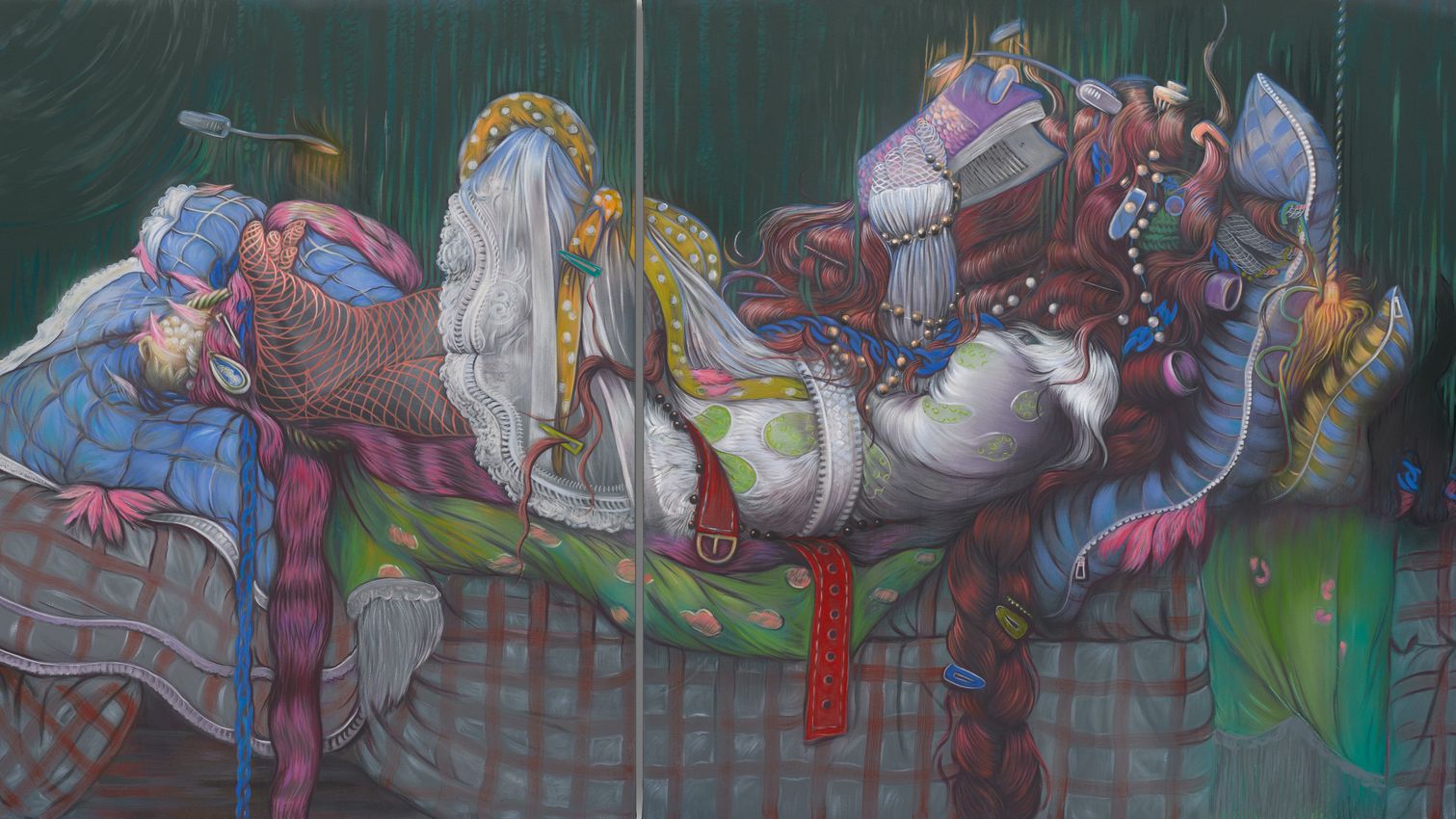
They are in between: in between animals and humans, in between resting and pouncing, in between sleep and wakefulness. I saw myself as the viewer, trying to get past them just before they saw me.
—Louise Bonnet
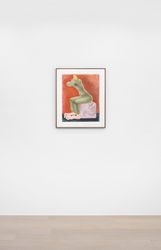
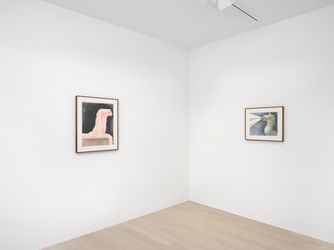
Gagosian is pleased to present Sphinxes, an exhibition of new drawings and a new oil painting by Louise Bonnet. This is the first time her work has been shown in Switzerland.
Inspired by a wide variety of sources—from the old masters to Surrealism to the satirical drawings of R. Crumb—Bonnet’s exaggerated forms walk a line between the beautiful and the grotesque, and between absurdist comedy and extreme psychological and physiological tension. In these new works, she positions the female body as a guardian of power, filtering the mythical creature’s symbolic associations through contemporary perceptions of gender, sexuality, and identity. Poised to protect or slay, each of Bonnet’s contorted sphinxes is rife with latent potential.
Crouching, kneeling, or sitting on pedestals, the subjects hearken back to their historical origins as legendary fusions of woman, lion, and falcon who served as merciless gatekeepers—as seen in the Greek myth of Oedipus, who had to solve the Sphinx’s deadly riddle in order to enter the city of Thebes—or, in the Egyptian tradition, as majestic protectors of imperial tombs. Here, however, the sphinx is metamorphosed into a fully human form that combines raw power with femininity.
In Kneeling Sphinx 2 (2021)—the sole painting in the exhibition—Bonnet isolates the sphinx against a spare background and renders her head as an enigmatic blond blur, concentrating instead on the surreal construction of her body. Her outstretched arms morph into a pair of elongated breasts that spray cones of milk, a touch of simultaneous humor and body horror that also alludes to shape-shifters from the science-fiction films that inspire Bonnet’s visual language. Placed on a cubic plinth, the sphinx appears statue-like in her stillness, yet her muscled back and richly rendered skin connote a vital corporeality.
In contrast to Bonnet’s earlier work—which often includes depictions of bloated forms and impossibly hyperextended limbs—these new drawings compress the body against itself like a tightly wound spring. Knees press firmly against stomachs, spines curl into serpentine shapes, and toes are clenched with a viselike grip. Yet Bonnet’s chosen medium of colored pencil also tempers these sphinxes with a certain intimacy; they appear lighter, softer, and more pliant than their painted counterparts, suggesting that power can be realized through gentleness as well as force.


The figures that populate Louise Bonnet’s paintings and works on paper walk a line between beauty and ugliness, between absurdist, knockabout comedy and extreme psychological and physiological tension. Inhabiting sparse, eerie landscapes and boxed in by the edges of the canvas or the page, they act out dramas of profound discomfort that plumb the depths of the artist’s subconscious. Drawing on a range of sources, from Old Master painting to Surrealism and underground comix, Bonnet toys with signifiers—of gender and sexuality in particular—in a playfully confrontational style. Her subjects are at once monumental in scale and diminished in capacity, their limbs grotesquely bloated and their eyeless faces partially obscured by dense caps of hair.


A respected voice in contemporary art discourse.
Focusing on ambitious storytelling and insightful art-world commentary. Ocula Magazine publishes in-depth interviews, critical essays and timely analysis on the artists, exhibitions and ideas driving the global art world.
Learn more about Ocula Magazine
Showcasing the best of the art world.
Ocula partners with galleries from around the world to highlight their artists, artworks and exhibitions. Gallery membership is by application and invitation, with each member vetted by an independent panel.
Learn more about Ocula Membership

Specialises in the sale of major artworks.
Led by a team with deep ties to the world’s leading auction houses, galleries and collectors. Ocula’s advisory team offers bespoke services to high-net-worth clients from around the world who are looking to acquire the best of contemporary and modern art.
Learn more about our team and services