



Press Release
Angelo Venosa will have his first solo exhibit at Galeria Nara Roesler, entitled Giusè, from February 20 to March 26. It will feature roughly 20 pieces divided into three new series in varying sizes and materials, process-based sculptures deriving from the research on form he developed throughout his career.

The history of Venosa’s output stands apart from that of so-called 80s Generation artists. Focusing on three dimensionality, the artist values procedures and the art-making experience as the constituents of his work. His creative process often combines technological elements and handicraft, opposing concept and the finished artwork.

As the artist himself put it in an interview to Paulo Sergio Duarte (2012): “I look at what I do, at what I’ve been doing, and the first thing I see is two seemingly opposite strains. One is more Cartesian, a logical, objective way to build the world, so to speak. And in the other one there’s this pressure of image, which is in complete contrast with the first one and is purposely more disorganized. But that disorder is not exactly disorderly.”

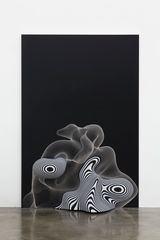
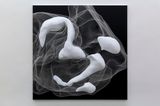
The three series of artworks featured in the show deal with these processual premises in different ways. The first one comprises layered solids jutting directly from the wall or the floor or sitting on a black stand where one sees the two-dimensional projection of the continuity of their form (they are called “pictures,” creating a connection between painting and sculpture), in an interplay of idea and matter. Here, Venosa works from an ideal form, created in a computer, to build the volumes through layer superimposition to arrive at a visually organic result.

The set comprising the biggest pieces in the exhibit showcases the development of Venosa’s research that strives for externally-structured bodies, i.e. hollow forms whose boundaries are set exclusively by their outer layer, like exoskeletons. In these pieces, the artist’s confrontation with the material becomes all the more evident, since the artworks are composed through the juxtaposition of layers of plywood screwed onto one another. Once again, the artwork’s original conception is forced against its material limits, which can only be truly configured during its making.

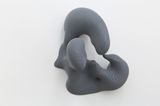
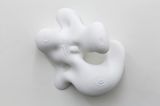
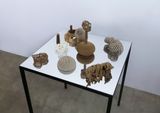
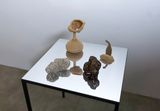
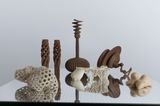
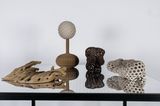
Finally, small elements produced using a 3D printer, resembling coral-like organic structures – here the idea of the exoskeleton appears again – create heterogeneous sets, like a Modern-Age curiosity cabinet. “They’re also a strong space for experimentation in the most direct, playful sense of the word,” as Venosa puts it.

The integration of wood and the plastic material that constitutes the print layers – which draw a parallel with the fact that the layered volumes in the first set of artworks are handmade –, the pieces take on an appearance between organic and artificial, in a trompe l’oeil effect. And they incorporate processing errors as part of the artwork (the so-called “stringings,” when threads from some layers jut out of the piece, like seam slippages), which subverts the objectivity of the technological process, adding inexactitude and chance.

Thus, the meaning that runs through these pieces and connects them to Angelo Venosa’s careers is the assimilation of indefiniteness as a component in a world that’s more and more averse to imperfection and based on certainty. In his process-based puzzles, which, like an optical illusion, disassemble the seeming coherence of their constituent elements at every moment, the artist constantly brings us back to the present moment, in the form of the experience of contact with the artwork, unpredictable like the artwork creation process itself. More than grasping a stationary meaning to the artwork, the important thing here is to find oneself instigated by its contradictions, which bridge the gap between cerebral, scientific assertiveness and the nature we are part of.

Installation Views

About the Artist

Angelo Venosa (b. 1954, São Paulo, Brazil. Lives and works in Rio de Janeiro, Brazil) is one of the few artists of the so-called ‘Generation 80s’ who dedicated himself to sculpture, to the detriment of the painting then in evidence. From the 1990s, he began to use materials such as marble, wax, lead and animal teeth, performing works that refer to anatomical structures, such as vertebrae and bones. Most recently, the artist began using 3D printing and computer-aided design to create plywood and metal structures and exoskeletons that resemble corals. He participated in exhibitions such as the 19th Bienal de São Paulo (1987), the 45th La Biennale di Venezia (1993) and the 5th Bienal do Mercosul, Porto Alegre (2005). A major retrospective in celebration of his 30-year career was held at the Museu de Arte Moderna do Rio de Janeiro (MAM Rio) in 2012, going through the Pinacoteca do Estado de São Paulo

View Artist Profile

Also Exhibiting at Galeria Nara Roesler

About the Gallery

Founded in São Paulo in 1989, Galeria Nara Roesler is a leading Brazilian gallery dedicated to showing the work of contemporary Brazilian and international artists. The gallery established another branch in Rio de Janeiro in 2014, followed by its first international outpost in New York City in 2015.

View Gallery Profile
Address
Avenida Europa 655
JD Europa
São Paulo
Brazil
Opening Hours
Mon - Fri, 10am - 6pm
Sat, 11am - 3pm
Book your visit via the link or by emailing agendamento@nararoesler.art
(1)
São Paulo Avenida Europa 655, JD Europa
Galeria Nara Roesler
Avenida Europa 655, JD Europa, São Paulo, Brazil
+55 112 039 5454
http://www.nararoesler.art

Opening hours
Mon - Fri, 10am - 6pm
Sat, 11am - 3pm
Book your visit via the link or by emailing agendamento@nararoesler.art
The art world in focus