Press Release

Galeria Nara Roesler | New York presents Theory of the Inevitable Convergence, an exhibition of works by Carlito Carvalhosa, Artur Lescher, and Marco Maggi that highlights untapped points of convergence between the narratives of the three artists.

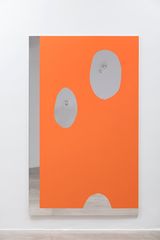
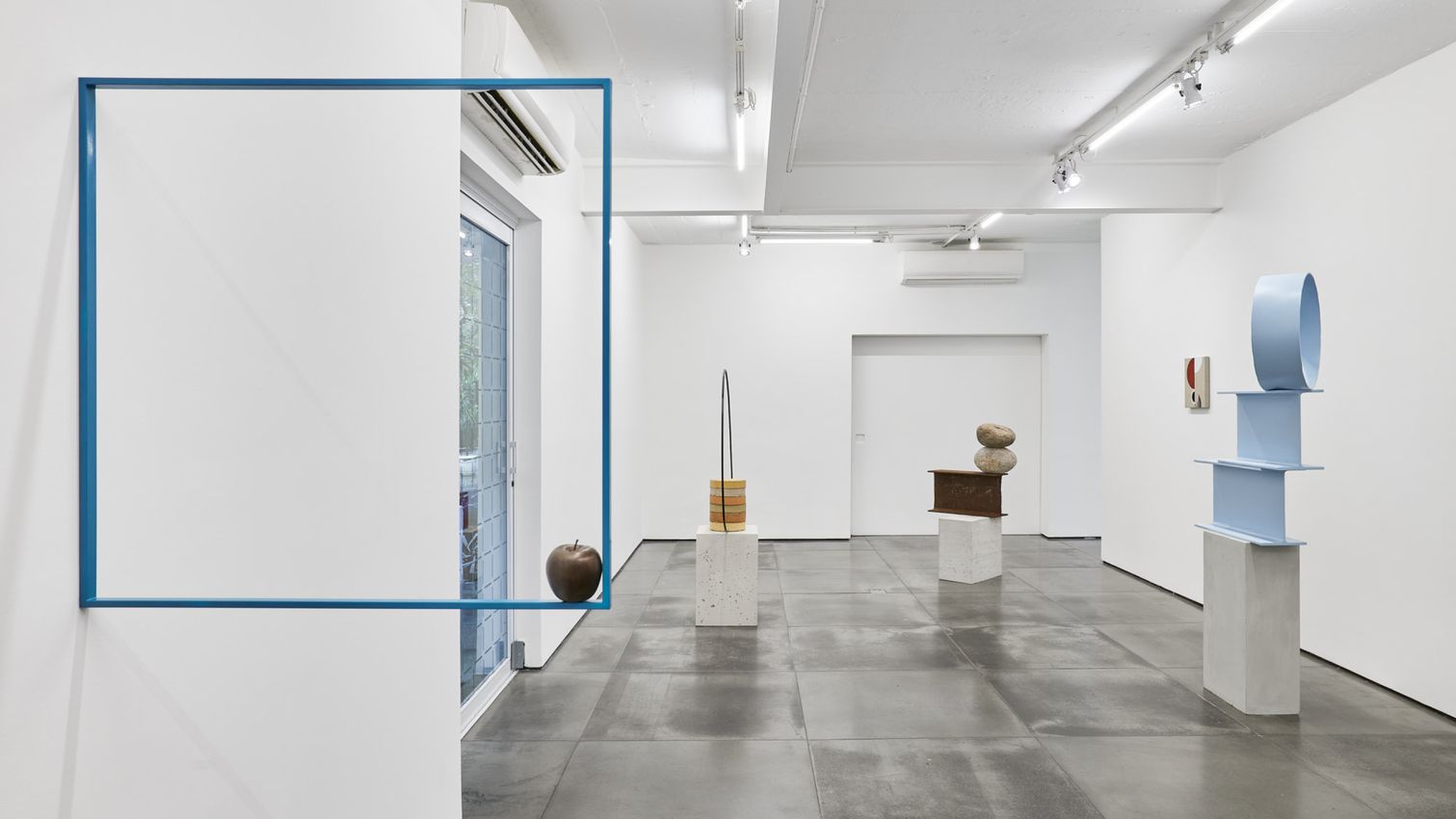
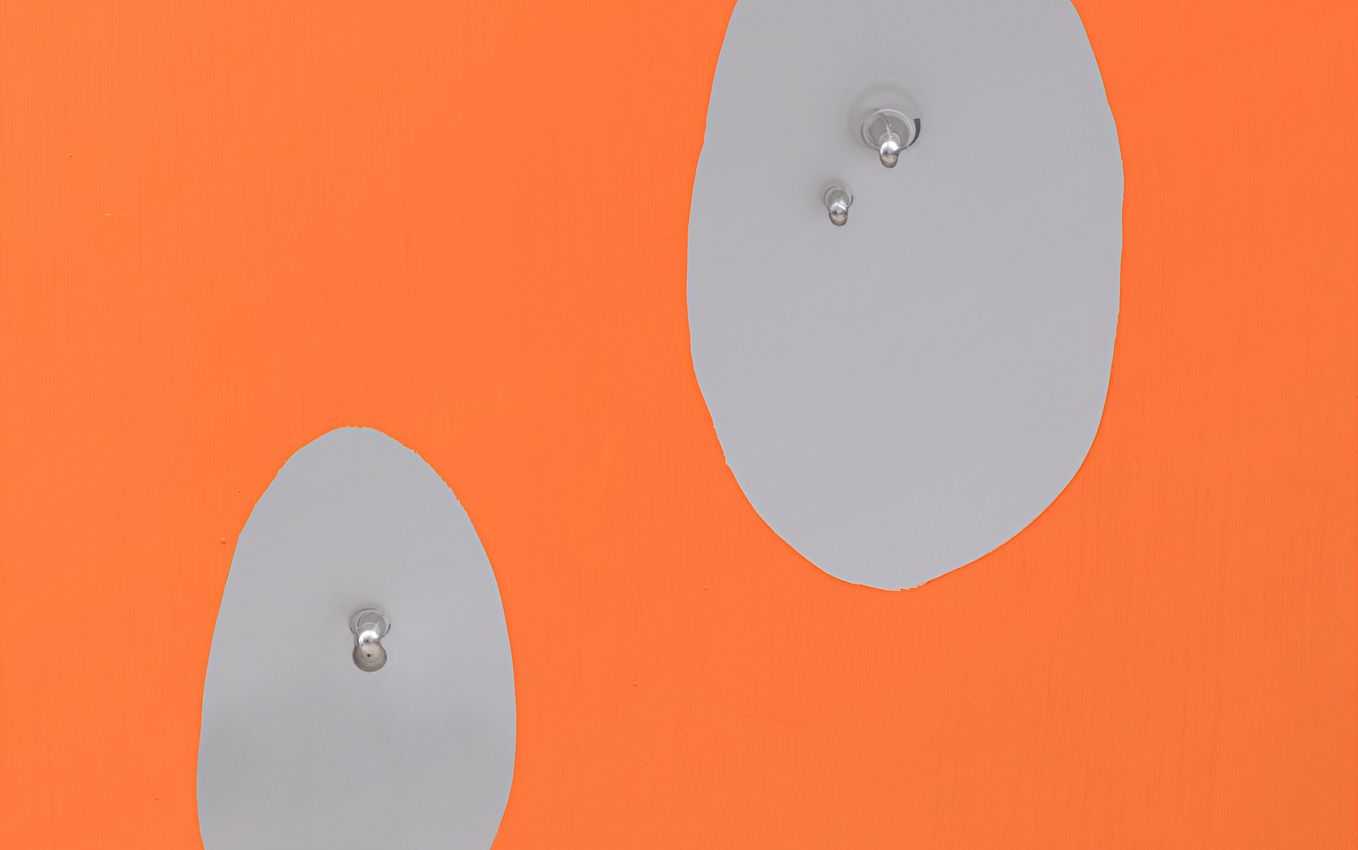
In addition to formal artistic intersections, the chosen works evoke important questions that the three artists have recurrently posed to the public, including the ways in which their works relate to the surrounding space, be it through interference and disruption or through suggesting an unknown place, linked or not to the physical realm. The works thus invite the viewer to experience new circumstances and, perhaps, rethink their relationship to the world around them. Arthur Lescher presents Finials, small sculptures on pedestals meant to reference architectural structures: the apse of a church or temple, a corporate building, or—as the artist ironically puts it—the tip of a missile, evoking the power and eloquence of man. Also on display are the artist’s Pendulums, which resemble vibrating instruments and magnetic sources, sensitive to the disturbances of the space around them as well as the transient state of the observer. Subject to the force of gravity, the pendulums could act as instruments of an invisible writing, incessantly suggesting a new history/memory for both the space in which they are situated and the works that surround them. Carlito Carvalhosa’s installation, in turn, comprises oils on mirrored aluminum, hanging or leaning against tubular lamps symmetrically arranged on the wall. The mirrored pieces offer a singular experience: the viewer is prevented from seeing his/her full reflection, only able to experience it partially or in a distorted manner due to the almost fully painted surfaces. Given the current social context, in which everyone constantly sees and shares images of themselves on different networks, Carvalhosa’s installation triggers a strange feeling within the viewer, who instantly pauses and enters something of a “non-place,” where the lack of narrative can be disconcerting.

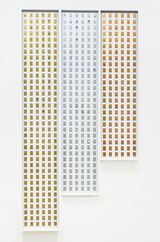
Marco Maggi presents Podium, a triptych of three panels, each a different size and color—gold, silver, and bronze. To create the work, the artist precisely and delicately carved signs into metallic sheets, which he then placed inside slide frames. Although the title and colors immediately suggest a narrative, when approaching the work, the viewer realizes that each slide offers a unique abstract image that has the ability to gain different meanings. In the words of the artist: “If there is no complicity with the spectator, the work does not exist.” He goes on to say, “When people ask me what I do, what my profession is, I answer that I am a promoter of pauses.” Podium is therefore an invitation to another temporality, creating the opportunity to lose oneself and get carried away by the abstract narrative of the artist.

The formality and rigor present in Maggi’s delicate geometric creation is also present in Lescher’s works, throughout their precise forms, which lack excess. These forms, composed of essentially reflective surfaces, in turn find a counterpoint in Carvalhosa’s painted aluminum while at the same time circling back to Maggi, who poses the same questions through his carvings in metallic sheets.

Using these convergences as starting points while simultaneously allowing the differences between their works to shine through, the artists invite the public to discover new possibilities and routes. In Maggi’s words, “We deserve a pause, and an insignificant drawing can work as a perfect training ground to increase our capacity to live in an illegible context.” Lescher emphasizes that “it is the flow of thought in its various states of perception that builds the senses. A cyclical form of time finds its place.” Carvalhosa concludes, “In the garden of the paths that bifurcate, there is the Theory of the Inevitable Convergence!”

About Artur Lescher

Artur Lescher (b. 1962, São Paulo, Brazil) lives and works in São Paulo. For more than thirty years, Lescher presents a solid work as a sculptor, which results from a research around the articulation of materials, thoughts and forms. In this sense, the artist has on the particular, uninterrupted and precise dialogue with both architectonic space and design, and on his choice of materials, which can be metal, stone, wood, felt, salts, brass and copper, fundamental elements to highlight the power of this discourse. According to the Art Historian Matthieu Poirier “The main quality of Artur Lescher’s pared-down, finely crafted works is that they produce a tangible field force—a magnetic field, one might say, considering the metals he uses [...] But it is, above all, a perceptual matter.” Even if Lescher’s work is strongly linked to industrial processes, achieving extreme refinement and rigor, his production does not have the form as the only purpose, actually, it goes beyond it. This contradiction opens space for myth and imagination, essential elements for the construction of his Minimal Landscape (Galeria Nara Roesler, 2006). By choosing names for his artworks, such as Rio Máquina, Metamérico or Inabsência (Projeto Octógono, Pinacoteca do Estado de São Paulo, 2012) Lescher proposes an extension of the work, suggesting a narrative, sometimes contradictory or provocative, that places the spectator in a hiatus, in a suspended condition. Artur Lescher participated in the 2005 edition of the Bienal do Mercosul in Porto Alegre, Brazil and in the 1987 and 2002 editions of the Bienal de São Paulo. He took part in several exhibitions in Latin America, Europe and in the United States, as well as in two solo shows, one at the Palais d’Iéna (2017), in Paris, and the other one at Instituto Tomie Ohtake (2006), in São Paulo.

About Carlito Carvalhosa

Carlito Carvalhosa (b. 1961, São Paulo, Brazil) lives and works in Rio de Janeiro. Recognized widely throughout Brazil, he emerged in the Brazilian art scene in the 1980s as a member of the São Paulo based collective Grupo Casa 7, alongside Rodrigo Andrade, Fabio Miguez, Nuno Ramos and Paulo Monteiro, period in which he produced large paintings with emphasis on the pictorial gesture. For more than twenty years the artist has been using diverse mediums and many kinds of objects—including electric lights, fabric, wax, wood and mirrors—to explore architectural space, the nature of materials in abstract forms and the spectator’s response to all of them. According to Portuguese curator Marta Mestre, what interests the artist is “the relationship between space and the act of building. Mobilized by the artist, the building is a process of reordering the world, supporting its chaos, thus, differentiating the activity in face of nature”. In addition, Mestre emphasizes that through Carvalhosa’s artworks “lies the thought of sculpture as construction, adding gesture and removing the void.” These observations are clear in Carvalhosa’s recent works, such as Sum of Days (2011), a monumental site-specific installation for the MoMA’s atrium, and Sala de Espera (2013) installed at Museu de Arte Contemporânea da Universidade de São Paulo, in which throughout the space, twenty-four wooden street posts were suspended in dialogue with Niemeyer’s architecture. Carvalhosa exhibited at the Havana Biennial, Cuba (in 1986 and 2012); the Bienal do Mercosul, Porto Alegre, Brazil (2001 and 2009); and the 18th Bienal de São Paulo, Brazil (1985). Some of his recent solo shows took place at Museu de Arte Contemporânea da Universidade de São Paulo, São Paulo, Brazil (2013); Projeto Contentores, Guimarães, Portugal (2012) and MoMA, New York, USA (2011).

Read More

Artists Exhibiting

About the Gallery

Founded in São Paulo in 1989, Galeria Nara Roesler is a leading Brazilian gallery dedicated to showing the work of contemporary Brazilian and international artists. The gallery established another branch in Rio de Janeiro in 2014, followed by its first international outpost in New York City in 2015.

View Gallery Profile
Address
22 East 69th Street, 3R
New York
United States
Opening Hours
The gallery is temporarily closed to the public. For any enquires, contact info@nararoesler.art or visit our website nararoesler.art
(1)
New York 22 East 69th Street, 3R
Galeria Nara Roesler
22 East 69th Street, 3R, New York, United States
+1 212 794 5038
http://www.nararoesler.art

Opening hours
The gallery is temporarily closed to the public. For any enquires, contact info@nararoesler.art or visit our website nararoesler.art
The art world in focus