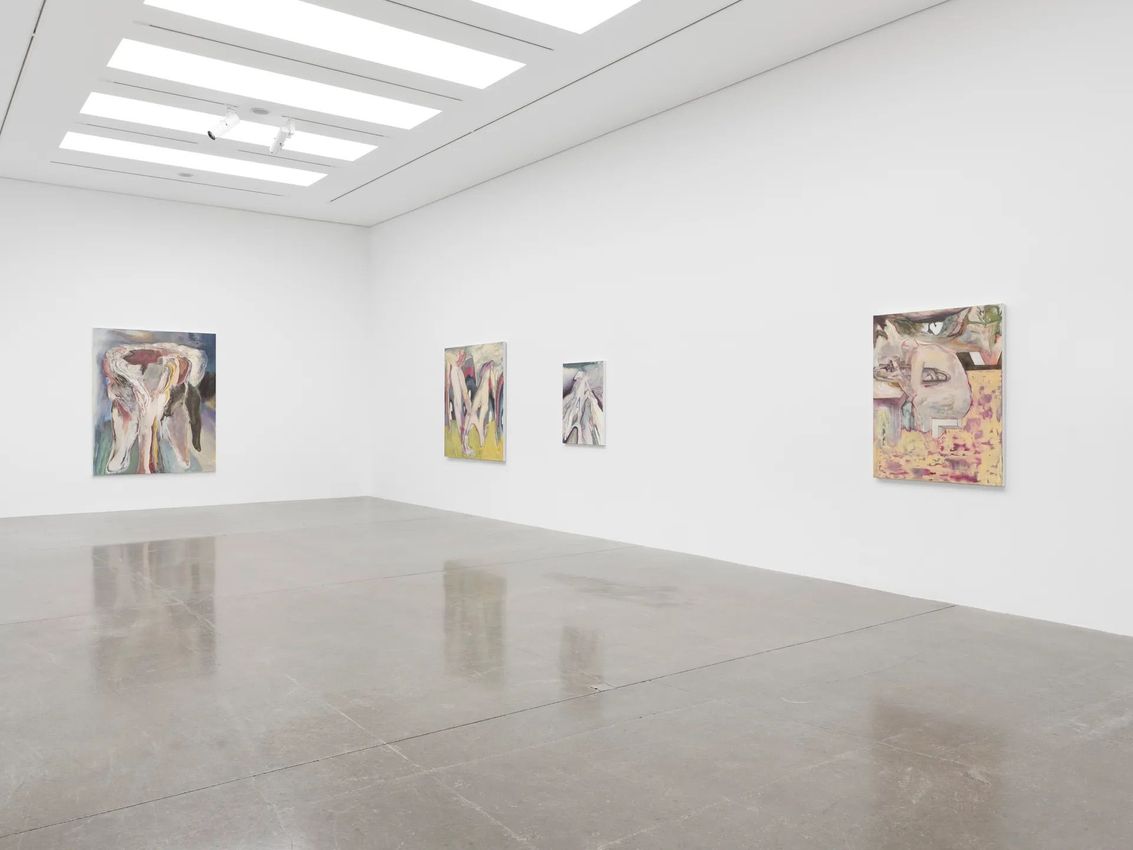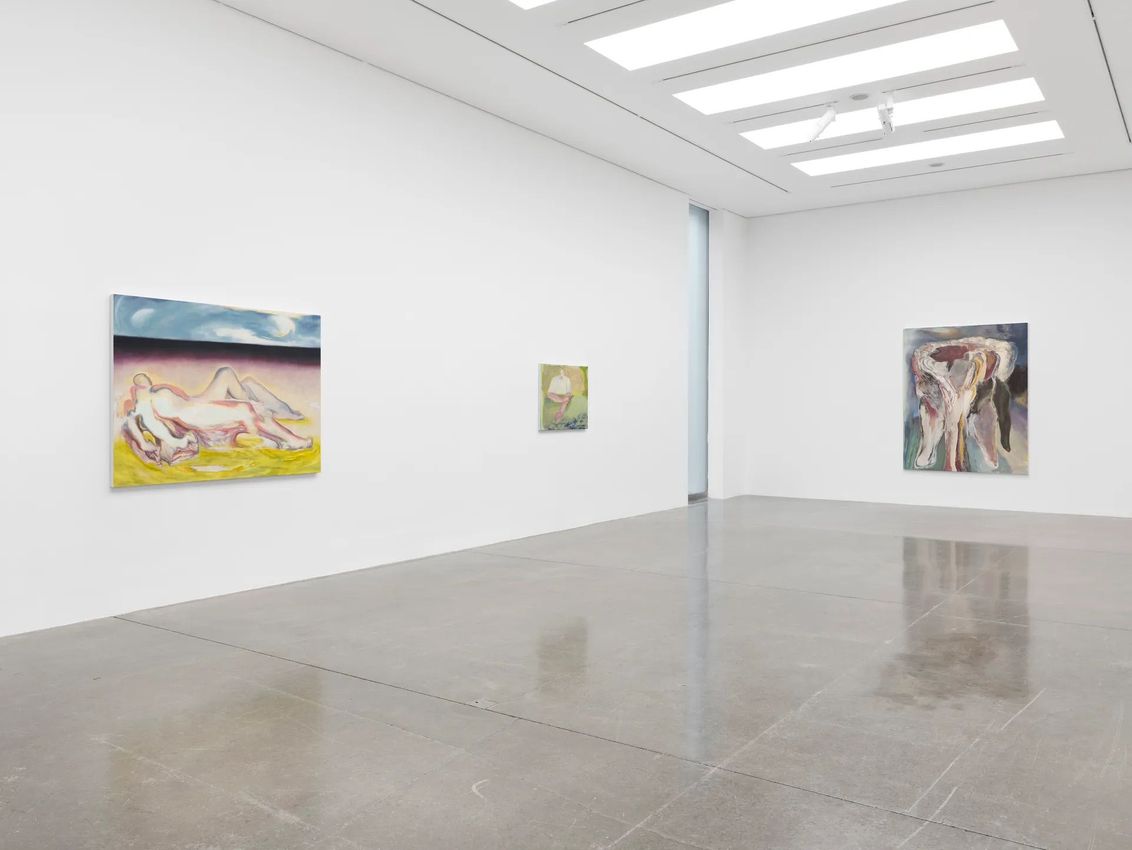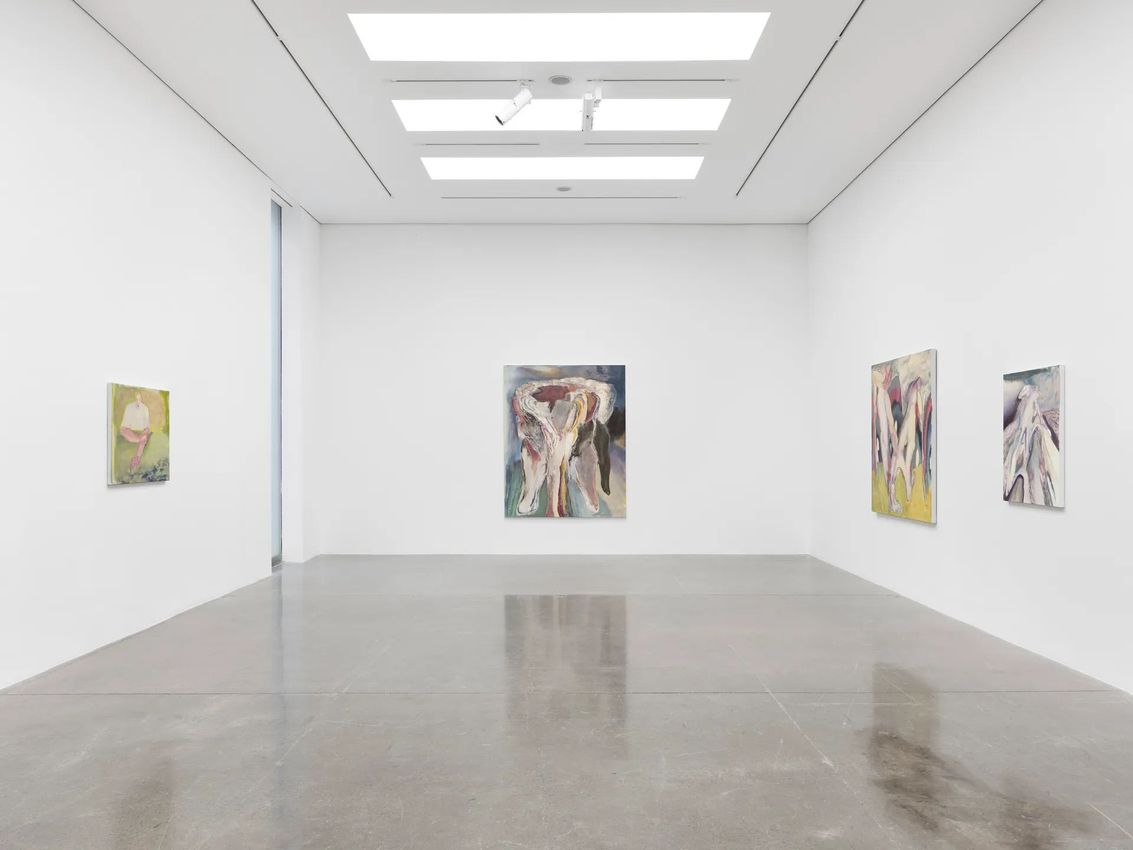
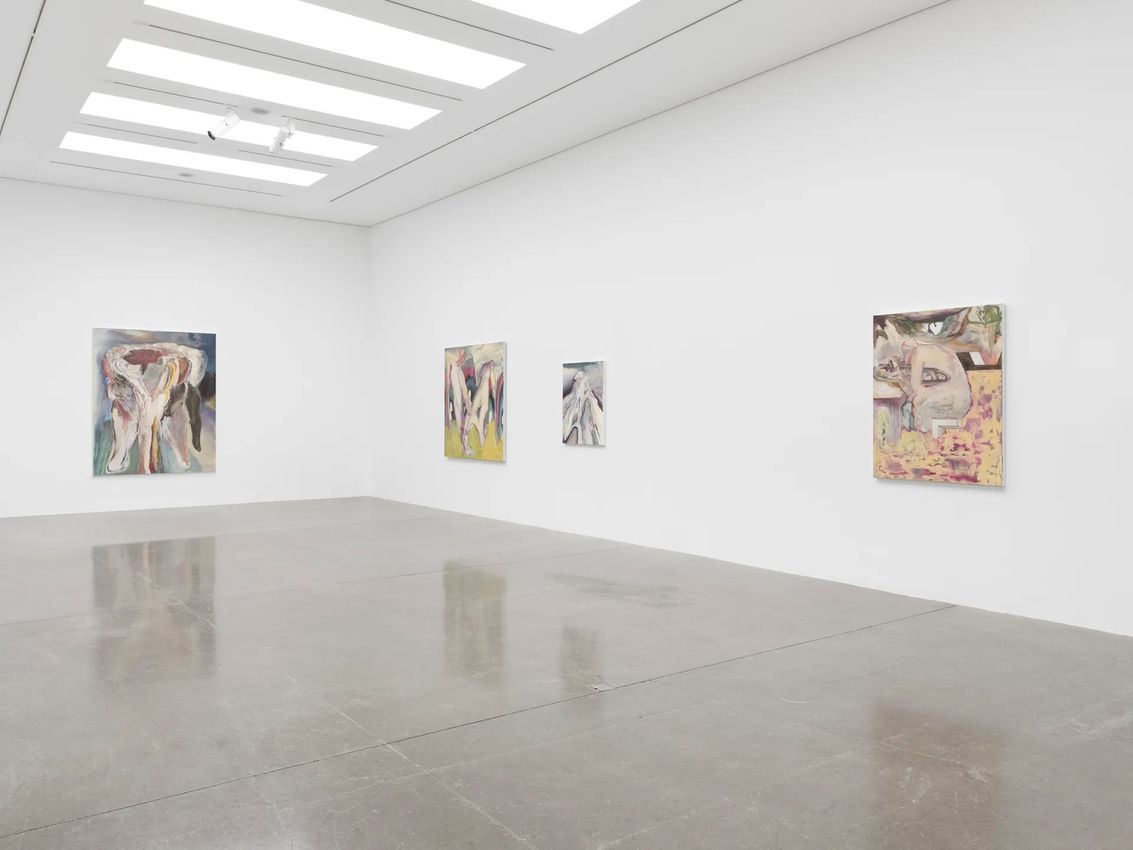
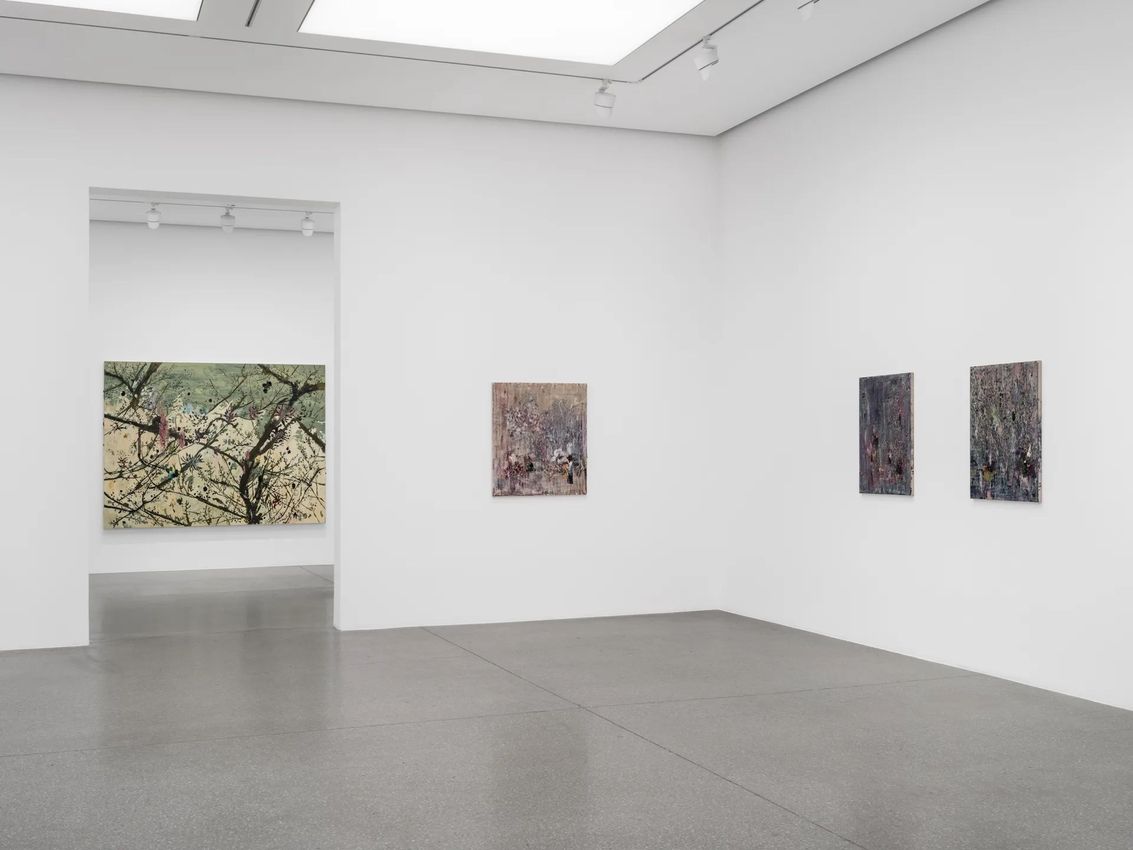
The work of Firenze Lai (b. 1984, Hong Kong) explores the social, political and spatial subtexts that shape individual and collective psyches across both physical and virtual worlds. Bringing together a new series of paintings and works on paper made in her London studio, ‘North and True North’ is the artist’s first solo exhibition in the UK. The figures that populate Lai’s canvases are often anonymous – sometimes even faceless – and situated within indeterminate environments that speak to the formless expanses of online existence. These bodies appear to merge with themselves or one another, become absorbed into larger systems or circuits, fragment, duplicate and drift between realms. Eschewing individual facial expressions in favour of symbolic, recognisable gestures, Lai seeks to understand her subjects’ realities through posture and movement, tracing how body language continually evolves in relation to how we live.
Although Lai’s paintings often address the digital condition, she avoids depicting technology directly, turning instead to its impact on human emotion and behaviour. ‘In the physical world, a chair, a room or tunnel holds your body and defines your space, guiding you and helping to maintain your balance’, she has remarked. ‘In the virtual realm, there are also structures and infrastructures that serve similar purposes’. In The True North (2024) this is evident in the figure’s grotesquely enlarged hand, which it uses to try and swivel its own body, recalling the familiar touch control used to rotate a smartphone map. The crouched, faceless figure reaches blindly for guidance, embodying a collective sense of disorientation in the face of perpetual, and often conflicting, online data. The title references the direction of the geographic North Pole, where the Earth’s axis of rotation meets the Northern Hemisphere: a fixed direction by which the lost can regain their bearings. Meanwhile, the exhibition title, ‘North and True North’, pits this against the ever-changing location of magnetic north. Here, certainty is both fixed and unfixed, caught between the search for a single source of ‘truth’ and the impossibility of finding one in the digital era.
The advent of artificial intelligence has shaped Lai’s recent work as a condition rather than a subject, a lens through which longstanding social and political concerns may be considered anew. In observing people ‘effectively living between the analogue and the digital world’, the artist increasingly sees ‘truth, or authenticity, as located within the body’. As a result, the backgrounds of her paintings have grown more abstract or schematic, with her compositions dictated by the exaggerated placement of her figures. In Grey Matter (2026), for example, a figure is seen hunched over a loosely defined desk, head bent, their back forming a pronounced curve. Their arms and hands seem to disappear into their surroundings, leaving the clasped object – which many viewers will recognise as a smartphone, given the cramped posture and single-minded absorption – barely discernible. The title’s reference to the region of the brain that supports thought, movement and memory contrasts with the figure’s supposedly mindless activity. As the artist notes, grey matter is ‘essential to what it means to be human, intellectually and psychologically’, but since the proliferation of AI, ‘our thinking process is no longer happening entirely in our head. It is taking place somewhere outside of us, perhaps in the space between our eyes and our hands’. Where the digital era altered bodies visibly, as with so-called ‘tech neck’, Lai’s recent work explores the more intangible, and at times irreversible, changes wrought by AI – a reshaping of cognition, intellectual capacity, and reality itself.
Lai’s figures serve as archetypes for collective psychological and physical states: ‘Each figure that I paint is the same person. It is you and I. A universal character taken at different moments’. Identity, she says, ‘is not a stable thing; I believe that it’s a trap most of the time’. This is most directly expressed in works on paper such as Vortex (2024), where a host of divergent, inchoate forms rise from the ground, distinct yet bound together, and in paintings such as Metamorphosis (2025) and Versions (2026). In the latter, a host of interlocking figures seem to converge around a circular void. Some heads and limbs overlap, while others conjoin or blur, as though a single figure were captured at successive moments in time. Here, identity is a constant negotiation: forever being reconciled and reconfigured. Similarly, in Metamorphosis, a body appears to replicate, shapeshifting into increasingly fragmented versions of itself until it resembles a glitch-like pattern indistinguishable from its surroundings.
This instability carries over into how Lai’s figures relate to one another in each composition, a dynamic the artist first works out on paper, testing how bodies ‘behave within the image’, before exploring through painting. In Countercurrent (2026), a group is viewed from a dramatically low angle, their legs stretched and gigantic while their heads shrink into the distance. Strands of neon yellow, red and green paint surround them, at once acting as a kind of force field and binding their limbs together. On the right side of the canvas one figure’s arm lifts as though it is being pulled away by a magnet, disrupting the group’s cohesion, a disturbance that is reflected in the work’s title. The scene speaks to a life spent on online platforms, where users learn, debate, and form opinions on the basis of misinformation as much as on information. These figures are bound together within the same system, even as it pulls them in different directions and sets them against one another.
Throughout her work, Lai explores how people switch between these systems, ‘how they live within them, and how sometimes they fall through the cracks’, examining sociopolitical and displacement-related concerns that long predate contemporary technologies. In The Match Man (2022), made in Hong Kong shortly before Lai’s move to London, a bent figure with oversized hands emerges from a bruised purple ground, accepting a gift or bowing to shield the body from an unseen benefactor, or foe. While her figures may at times appear lost, disoriented or threatened, the artist often identifies in them strategies for coping and self-protection. ‘I am aware that our reality is bending, but I’m quite optimistic, nevertheless’, she notes. ‘I tend to see the strength in people, and it is their will to survive that I want to paint. I’d like to think that the figures in my works are managing just fine’.
Firenze Lai (b. 1984, Hong Kong) lives and works in London. She studied at the Hong Kong Art School from 2004 to 2006. Solo exhibitions of her work have been held at MAMC+, Saint-Étienne, France (2019) and Mirrored Gardens, Guangzhou, China (2015). Lai’s work has been featured in group exhibitions including Louisiana Museum of Modern Art (2025); The Art Gallery of New South Wales, Sydney (2025); Haus der Kulturen der Welt, Berlin (2025); M+, Hong Kong (2024); Centre Pompidou Málaga, Andalusia, Spain (2023); Ikon Gallery, Birmingham, UK (2022); Kadist, San Francisco, California (2020); BWA Wrocław, Poland (2020); Centre Pompidou, Paris (2020); Tai Kwun Contemporary, Hong Kong (2019); 57th Venice Biennale, Italy (2017); New Museum Triennial, New York (2015); 10th Shanghai Biennale, Power Station of Art, Shanghai, China (2014) and Para Site, Hong Kong (2013).


Firenze Lai is a contemporary artist whose figurative paintings chart the tensions of the human condition against the backdrop of city life, psychical states, and collective identity.


An international art powerhouse, White Cube was established in 1993 in London by art dealer Jay Jopling. In its space on Duke Street, it served as the early exhibition venue for many now internationally acclaimed British artists, including Tracey Emin, Gilbert & George, Rachel Kneebone and Antony Gormley, who still show with the gallery today.
A respected voice in contemporary art discourse.
Focusing on ambitious storytelling and insightful art-world commentary. Ocula Magazine publishes in-depth interviews, critical essays and timely analysis on the artists, exhibitions and ideas driving the global art world.
Learn more about Ocula Magazine
Showcasing the best of the art world.
Ocula partners with galleries from around the world to highlight their artists, artworks and exhibitions. Gallery membership is by application and invitation, with each member vetted by an independent panel.
Learn more about Ocula Membership

Specialises in the sale of major artworks.
Led by a team with deep ties to the world’s leading auction houses, galleries and collectors. Ocula’s advisory team offers bespoke services to high-net-worth clients from around the world who are looking to acquire the best of contemporary and modern art.
Learn more about our team and services