



As if reflecting upon his own constant simultaneous engagement with the dialectic of abstraction and figuralism, Eggerer here occupies the point where both might begin or end. From the point of view of the focus of the new paintings, the four strokes of the letter M, all answers are defiantly arbitrary. Eggerer, focusing on the material of language as form, penetrates into the uneasy core of a traditional dialectic.
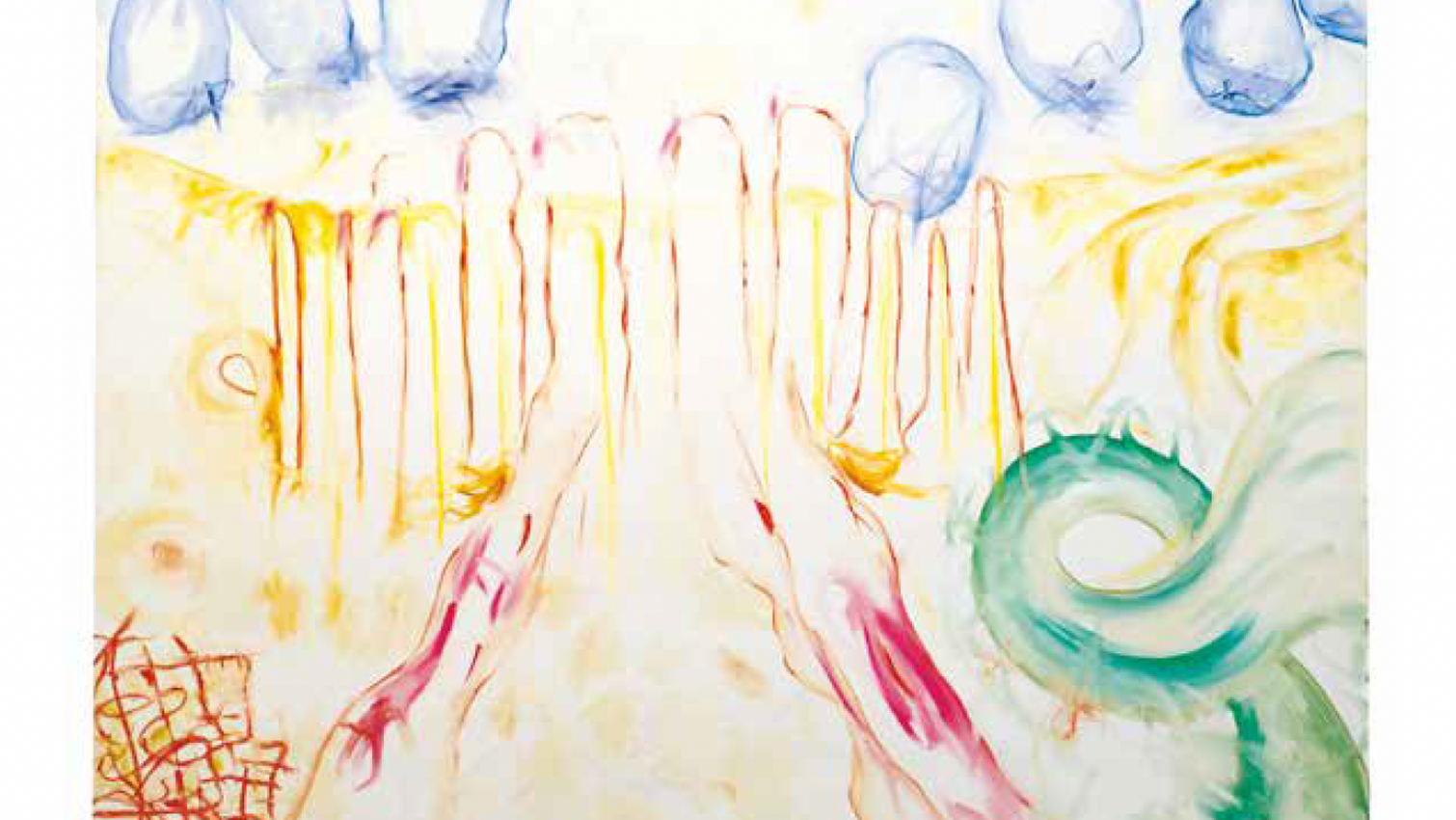
The broad fields of earth colours intersticed with vibrato lines, feature landscape components.Their multiple potential horizons hold a tense ground; the fields the lines presumably define might be contracting and/or expanding. As in outer space, it is potentially non-sensical to distinguish up to down from left to right, foreground from background.
The tenuous lines refer to the body. As if entering the tunnels of a pyramid, we stand on the absurd floor plan of a long-standing erection whose architectural aims are cartoon-like and alien. If not absurd, the lines of elbows and knees bend awkwardly like bones in an uncovered tomb.
What Napoleon saw in the crypt at Giza, what Alexander saw before and what Crowley saw later presumably could not be articulated in ordinary language. It is certain that after a night alone in the crypt of Giza, Bonaparte emerged in the morning a physical wreck. Some days later he abandoned his army in Egypt and returned to Paris to seize the destiny of the Revolution by the most brutal and cynical means. On his death bed, the defeated proponent of the letter N revived. When asked, he appeared ready to tell what he had glimpsed in the Chamber of Kings.
But Napoleon kept silent. What did he see?
From above and below, Eggerer’s pyramid shows a mirrored M. At the congruence of the V’s, at its very solidity, M is the most slippery and tenuous of foundations.
M, the thirteenth letter of the modern German and English alphabets, as Ben Jonson put it in 1635 , ‘is pronounc’d with a kind of humming inward, the lips clos’d. Open, and full in the beginning: obscure in the end: and meanly in the midd’st.’
The letter is never silent, even when it hides in words like mnemonic and anemone. Related to the idea of Mother by spelling and long tradition, it is for many the closest letter to pre-literate expression.
In contemporary physics, M-Theory, the so-called Mother of all Super-Strings, purports to explain every event in all the universes via the pure math of super-miniscule string-braneswiggling through the universe’s 11 dimensions. Interestingly, though the theory arose as recently as the 1990’s, there is no consensus as to what exactly the M stands for. Membrane? Magic? Matrix? Mother? Monster? As with the name of 007’s control, we are left in the dark.
‘The trail leading to the unified field theory of all reality,’ as Dr. Michio Kaku puts it, ‘is littered with the wreckage of failed expeditions and dreams.’ Certainly, from deep in the pyramid, Eggerer’s dreaming glimpses into the letter’s arbitrary mechanics map out no escape from the revolutions of M.
Four collages feature figures engaged in yoga or other physical exercise among sculptures by Antony Caro. These precise and provisional works are the exhibition’s only gesture to ordinary figuralism and abstraction. Here, by reference to Caro, the miscegenation of the separatist purities of form and content is performed as an archaeology of modernism.
Press release courtesy Galerie Buccholz. Text: Mark von Schlegell
Thomas Eggerer was born in 1963 and studied at the Art Academy in Munich, Germany before moving to the US in the mid 90s where he eventually became a member of the artist collective Group Material. By the late 1990s his focus returned to painting and he has been exhibiting this work extensively over the last fifteen years.


Galerie Buchholz is an art gallery specializing in international contemporary art, with exhibition spaces in Cologne, Berlin and New York City. The gallery was founded in Cologne in 1986 by Daniel Buchholz, and today is run jointly with Christopher Müller.

A respected voice in contemporary art discourse.
Focusing on ambitious storytelling and insightful art-world commentary. Ocula Magazine publishes in-depth interviews, critical essays and timely analysis on the artists, exhibitions and ideas driving the global art world.
Learn more about Ocula Magazine
Showcasing the best of the art world.
Ocula partners with galleries from around the world to highlight their artists, artworks and exhibitions. Gallery membership is by application and invitation, with each member vetted by an independent panel.
Learn more about Ocula Membership

Specialises in the sale of major artworks.
Led by a team with deep ties to the world’s leading auction houses, galleries and collectors. Ocula’s advisory team offers bespoke services to high-net-worth clients from around the world who are looking to acquire the best of contemporary and modern art.
Learn more about our team and services