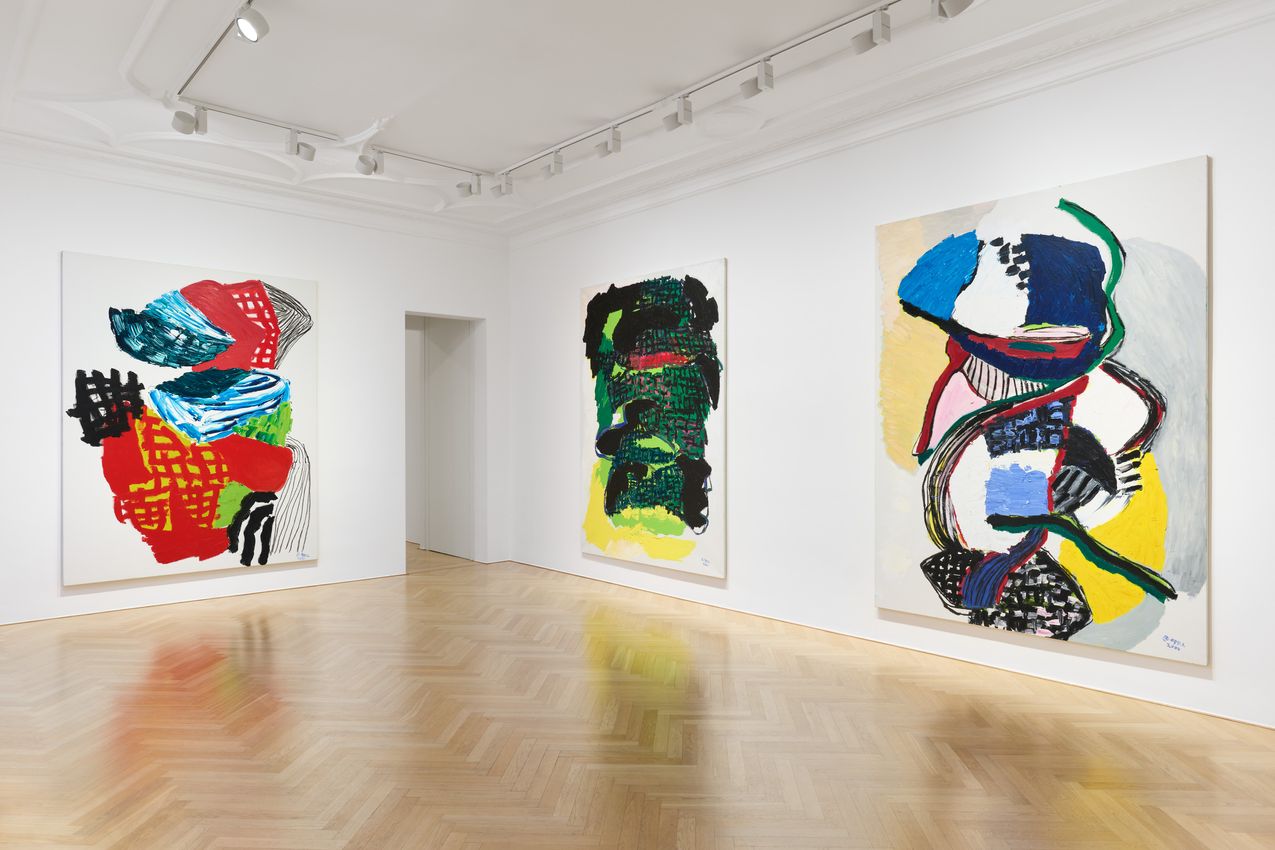
Galerie Max Hetzler is pleased to announce Encounter in Spring and what follows, an exhibition of work by Karel Appel (1921–2006), centring around a selection of paintings spanning from 1958 until 2006.
A founding figure of the avant-garde group CoBrA (1948–1951), Appel began his career in the aftermath of the Second World War. Over the course of six decades, the artist experimented widely, drawing on sources as diverse as folk art, outsider art and Jazz’s spirit of improvisation, and working across painting, sculpture, drawing, and stage design. Distinguishable for his astonishing capacity to innovate, Appel never settled in a signature style, media or subject. Alternating between abstraction and figuration, he adopted a material-oriented approach in his practice and promoted a genuine form of expression.
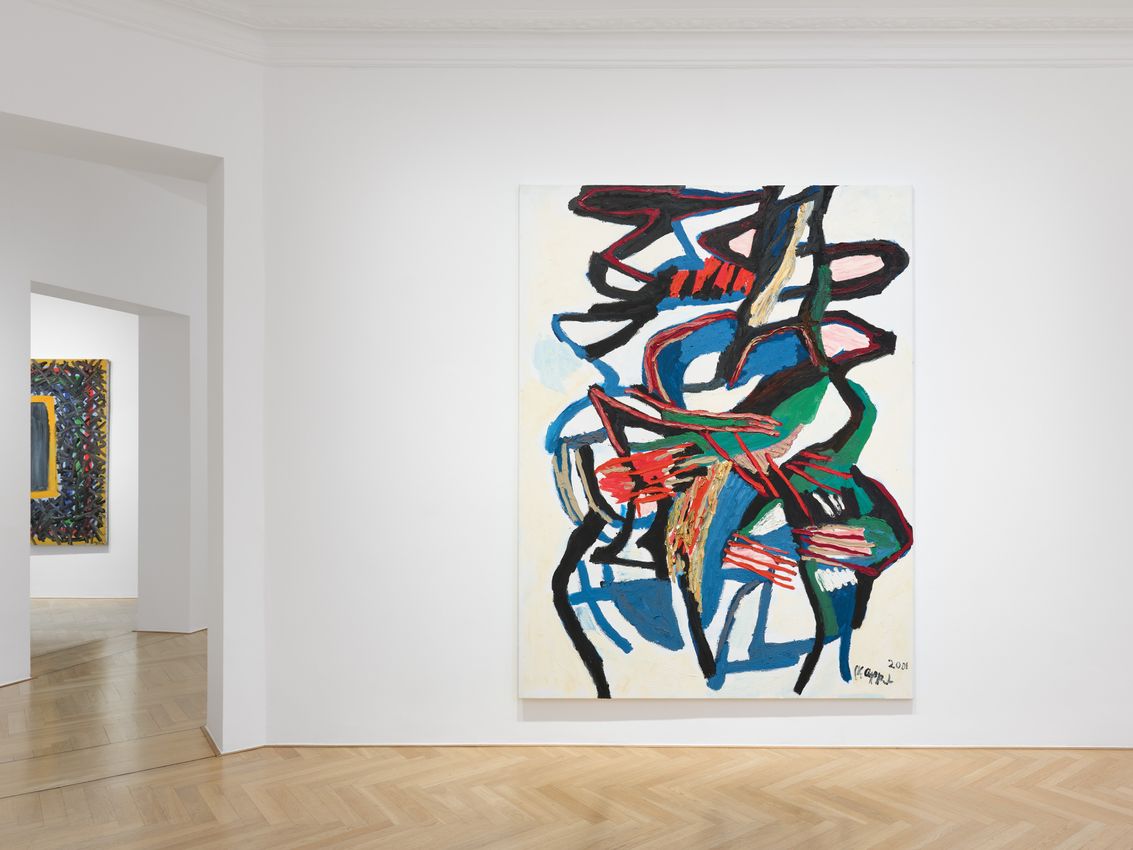
The exhibition’s starting point is the monumental and mesmeric painting_Rencontre au printemps_ (Encounter in Spring), which was commissioned in 1958 for the inauguration of the UNESCO headquarters in Paris. To mark the occasion, UNESCO invited Appel–among luminaries including Jean Arp, Alexander Calder, Isamu Noguchi, Roberto Matta, Joan Miró, Henry Moore, and Pablo Picasso–to make a contribution. Appel painted the ambitious work, not onsite or in his Paris studio, which couldn’t accommodate its size, but in SamFrancis’ studio in Villejuif. He had, by this point, just returned from his first trip to New York for his second exhibition at Martha JacksonGallery and was profoundly marked by his encounter with the painters of the New York School. As such, Encounter in Spring constitutesAppel’s first painting on such a momentous scale and remains one of the highlights of the UNESCO art collection.
Apple executed a sister painting, Encounter of Worlds, of the same size and year, which is in the collection of the Neue Nationalgalerie inBerlin. Key works in his oeuvre, the paintings introduce a pictorial language that comes very close to abstraction and is animated by the same spirit of Action Painting. While they might seem a far cry fromCoBrA, founded only ten years earlier in Paris, both imply, at their essence, its rallying creed for freedom and spontaneity.
As its title suggests, the sweeping abstract gestures of Encounter inSpring seem to unfurl beneath the viewer’s gaze into an abundance of forms found in nature and landscapes. Treading the threshold between impression and expression, Appel consistently associated real-world experience with what is visible on the canvas and what to a cursory glimpse might appear abstract. This liminal quality binds the works that comprise this exhibition. Viewed in chronological sequence, they reveal the overarching influence of Appel’s discovery of American painting on his first visit to the continent in 1957, and beyond. This is strikingly evident in the richly textured surface of Shattered World, 1960, with its thick with impasto paint that appears to have been applied directly from the tube to the left side of the canvas, as much as the primitively rendered face which emerges from the crude brushstrokes and vibrant palette of Visage-Paysage no.4, 1977.
In the Trees series from 1979, Appel’s formerly expressive free line sand solid areas of monochrome brushwork are here substituted for simplified, nearly analytical structures made from a sequence of short parallel brush marks which converge on ascending, vertical formats. The artist had previously come cross enlarged reproductions of details from paintings by Vincent van Gogh – a discovery which paved the way for this new sense of expression, merging discipline with spontaneity. Inthe late ‘90s, works including Up to the Sky no.3, 1998, and Birth of aLandscape, 1999, present densely animated, near-impressionist landscapes, which pulsate with thick swathes of paint. By the 2000s,Appel’s idiom had evolved once more into looser compositions of colour and form: works such as Nimble Acrobat, 2000, and Thought’sBoomerang, 2000, appear light and airy, with large swathes of raw canvas still visible, while in Evening Forest, 2003, real wood branches are embedded on the surface of the work. Brimming with creative innovation, this exhibition encapsulates the work of an artist whose imaginative and experimental approach to the painterly medium never ceased.
The exhibition will be accompanied by a joint-publication for previous exhibitions of Karel Appel’s work at Galerie Max Hetzler: Paris/NewYork in London (2022); Object Paintings in Berlin (2021); and LateNudes, 1985–1995 in Berlin (2020).
We would like to thank the Estate of Karel Appel for their generous support.
Karel Appel (1921–2006) lived and worked in Paris and New York,among other places. Retrospective exhibitions of the artist’s work havebeen held at the Musée d’Art Moderne de Paris in 2017; and theGemeentemuseum Den Haag, The Hague, in 2016. Further soloexhibitions have been held at important institutions worldwide,including the Emil Schumacher Museum Hagen; The PhillipsCollection, Washington D.C. (both 2016); Staatliche GraphischeSammlungen, Pinakothek der Moderne, München (2016); CentrePompidou, Paris (2015); Museum Jorn, Silkeborg (2013); CobraMuseum, Amstelveen (2008); Albertina, Vienna (2007);Gemeentemuseum Den Haag, The Hague (2005); National Museum,Belgrade; Palais des Beaux-Arts, Brussels (both 2004); KunstforumWien, Vienna (2002); Stedelijk Museum, Amsterdam (2001); andStedelijk Museum voor Actuele Kunst, Ghent (2000), among others.
Karel Appel’s work is represented in public collections internationally, including the Art Gallery of Ontario, Toronto; Centre Pompidou, Paris; Hirshhorn Museum and Sculpture Garden, Washington D.C.; Moderna Museet, Stockholm; Musée d’Art Moderne de Paris; The Museum ofModern Art, New York; Neue Nationalgalerie, Berlin; Pinakothek der Moderne, Munich; The Phillips Collection, Washington D.C.; SolomonR. Guggenheim Museum, New York; LACMA, Los Angeles; Hara Museum ARC, Shibukawa, Gunma, Japan; and Tate, London, among others. The artist’s work is part of the collections of all major Dutchmuseums, in particular the Gemeentemuseum Den Haag, The Hague;Rijksmuseum, Amsterdam; and the Stedelijk Museum, Amsterdam.


Galerie Max Hetzler is a global contemporary art gallery representing nearly sixty artists across six spaces in Berlin, Paris and London, with an exhibition space and artist residency in Marfa. Established in Stuttgart in 1974, in its early years the gallery championed the generation of influential German artists emerging at the time including Albert Oehlen, Günther Förg and Martin Kippenberger and their international counterparts Christopher Wool, Jeff Koons, Robert Gober and Cady Noland amongst others.

A respected voice in contemporary art discourse.
Focusing on ambitious storytelling and insightful art-world commentary. Ocula Magazine publishes in-depth interviews, critical essays and timely analysis on the artists, exhibitions and ideas driving the global art world.
Learn more about Ocula Magazine
Showcasing the best of the art world.
Ocula partners with galleries from around the world to highlight their artists, artworks and exhibitions. Gallery membership is by application and invitation, with each member vetted by an independent panel.
Learn more about Ocula Membership

Specialises in the sale of major artworks.
Led by a team with deep ties to the world’s leading auction houses, galleries and collectors. Ocula’s advisory team offers bespoke services to high-net-worth clients from around the world who are looking to acquire the best of contemporary and modern art.
Learn more about our team and services