



The work of Daniel Knorr, who has participated in the documenta and Venice Biennale, is as broad as it is multifaceted. His installation and sculptural works, photographs, performances, and public art projects focus on sociopolitical and societal issues that range from biopolitics all the way to the art system.
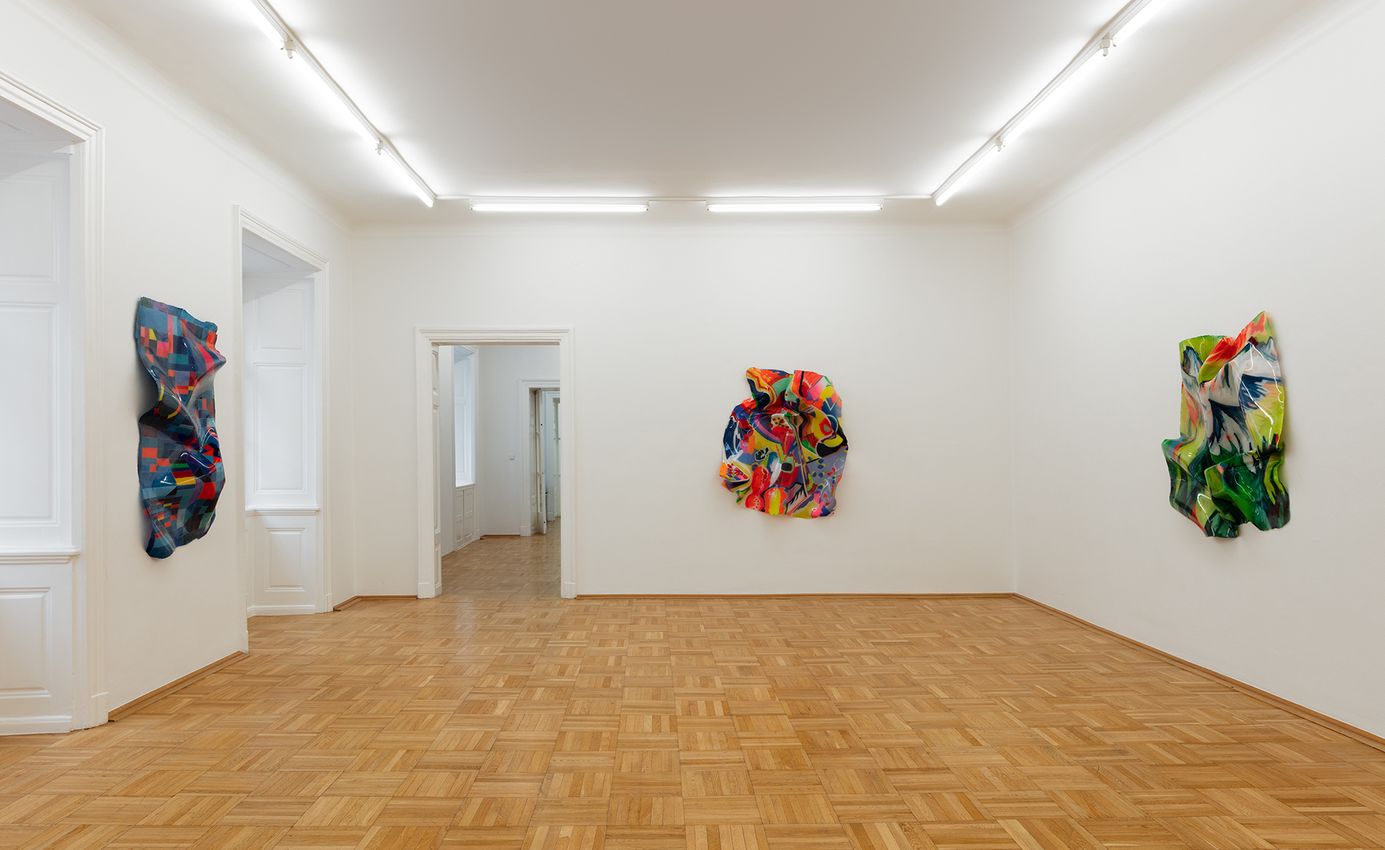
Daniel Knorr’s fourth solo exhibition in the gallery features three groups of works that have emerged out of his Depression Elevations series. Like Depression Elevations, the first series, called Canvas Sculptures, does not rely on a classic support. For these wall objects, Knorr employs a special technique in which he separates the painting from its ground – in other words, the canvas. The material he uses for this enables him to form and fold these three-dimensional works freely in all directions. Reinterpretations of modernism hint at different art historical elements expressed in the form of luminous colors on the smooth surfaces of these expansive wall objects.
The second series, called Depression Elevations Berlin Wall Nuggets, was created in 2020 and captures traces of the Berlin Wall and its surroundings. The artist sought out streets and places where the Wall constructed during the Cold War traversed and left marks. He collected forms of small depressions, which he these to make casts in his studio. The resulting small colorful objects made of synthetic resin loosely resemble the little pieces of the Berlin Wall often sold as souvenirs. As in other works in which he explores socio-political issues, here Knorr reacts to the history of this city, which continues to serve as a symbol of decades of global conflict, by reuniting previously separated elements in a material form that is both physically perceptible and surprisingly sensuous.
In the third series, Drippings, which was also created this year, Knorr reverses his working method for Depression Elevations. In place of a depression, he begins with the smooth surface of a glass plate, adding colorful liquids that take on the shape of the glass’s movements until they finally run over and form drop deposits resembling a miniature stalagmite landscape. The resulting round works are reminiscent of cells, biological structures, or colorful pufferfish. Behind the industrial surface, on the backside of the work, so to say, objects and structures evolve that represent a world that appears to be growing together but is still strange to us. Perception of these works resembles a scientific research project in which we discover new forms, structures, and connections that are hermetically sealed in their microcosm, out of our reach.
The Galerie nächst St. Stephan represents a living tradition of exploring the art of the modern era. It has been located since the 1920’s in the same place in the centre of Vienna at Grünangergasse.

A respected voice in contemporary art discourse.
Focusing on ambitious storytelling and insightful art-world commentary. Ocula Magazine publishes in-depth interviews, critical essays and timely analysis on the artists, exhibitions and ideas driving the global art world.
Learn more about Ocula Magazine
Showcasing the best of the art world.
Ocula partners with galleries from around the world to highlight their artists, artworks and exhibitions. Gallery membership is by application and invitation, with each member vetted by an independent panel.
Learn more about Ocula Membership

Specialises in the sale of major artworks.
Led by a team with deep ties to the world’s leading auction houses, galleries and collectors. Ocula’s advisory team offers bespoke services to high-net-worth clients from around the world who are looking to acquire the best of contemporary and modern art.
Learn more about our team and services