Press Release

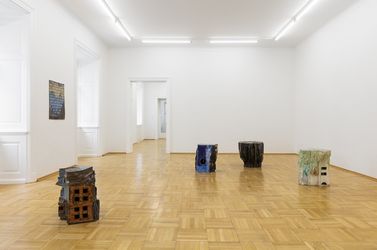
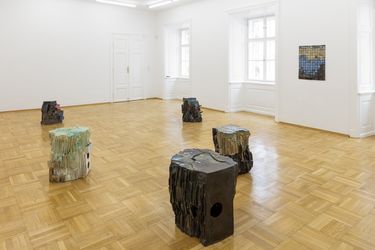
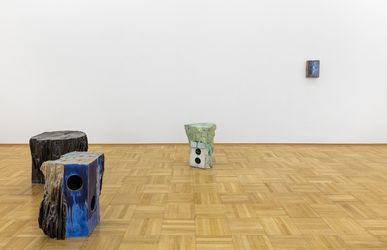
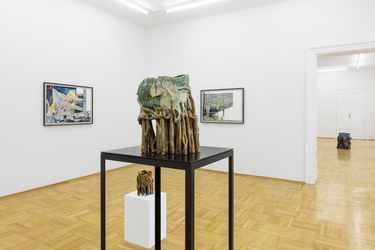
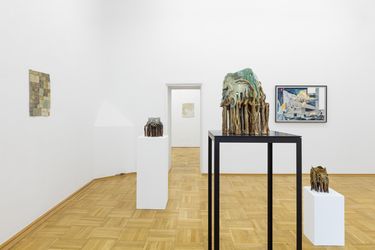
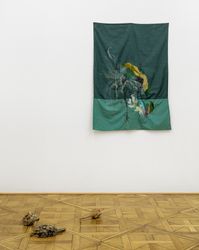
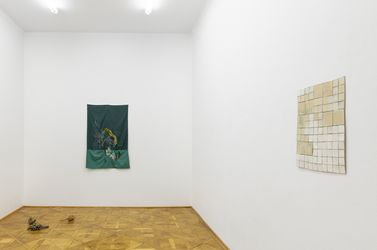
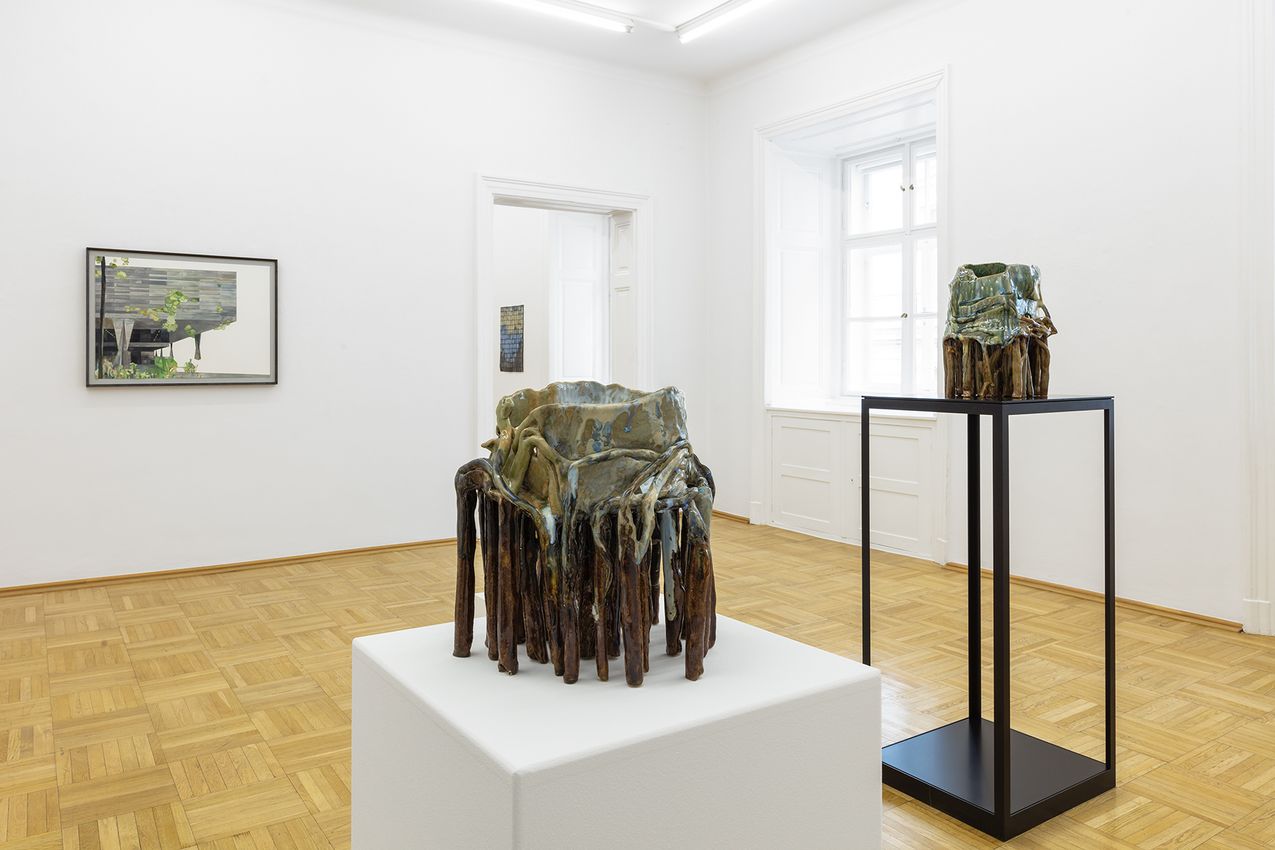
Utopian architectural models, housing structures made by animals, buildings made of organic materials: once the chain of associations has begun, Isa Melsheimer’s new ceramic works invoke a host of possible identifications, scales, stories, and purposes. We see them as buildings despite the fact that these sculptures have only a few features that clearly designate them as such. They oscillate between fragment and model, between made and grown, between artificial and natural, frozen under a glaze that reminds us of efflorescences, oxidized rock, lichen, or sedimentary strata. Crystalline forms and lamellar parts meet unarguably architectural elements, while openings on the sides allow a view into the inner life of their construction reminiscent of structural engineering. Some of the monumental ceramics are almost waist-high; others are stretched out horizontally. In their arrangement in small groups, they suggest different types of housing developments in urban and rural spaces.

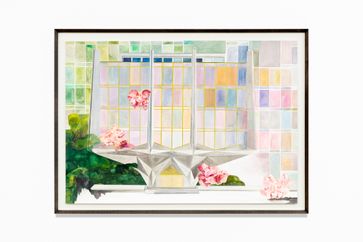
At first glance, the ceramic works fit seamlessly into the artist’s long-term exploration of our built environment, the conditions of its development and the changes in how it is judged. In this environment, cultural tastes, the zeitgeist of society, technological feasibility, visions of urban planning, economic arguments, and political will are manifested. Although a building is ostensibly associated with consistency and permanence, it undergoes a continuous change after it is completed – not only in regard to its material qualities and outer appearance, but also concerning its aesthetic assessment. Nonetheless, an aesthetic judgement is often still decisive in the decision-making process for a building and overrides other arguments, like functionality or practicability. This is the background for Melsheimer’s new ceramics, which for the first time do not reflect concrete buildings or architectural styles, unlike her sculptures based on buildings designed by the architects Werner Kallmorgen, Ulrich Müther, and Heinz Islar or those in her work series Communication with the Rotten Past. Instead, they are based on her investigation of animal architecture, building structures made by animals. These are, for the most part, not built according to aesthetic criteria, but must fulfill other functions. They are also remodeled and adapted when needed and thus reflect a topical issue in the current architectural discourse surrounding sustainability in which, under the theme of repair, adaptations, additions, alterations, or repairs take the place of new buildings. Possible marks of time also have their place here and can be made productive as embedded elements that provide new incentives. When understood as a continuous process of improvement, architecture no longer adheres to the idea of a fixed solution and instead opens itself up to becoming an architectural act that potentially is never finished.

Just as future demands on a building are unforeseeable, so are the actors who will someday react to it through adaptations and hence become co-creators. In their hybrid appearance located somewhere between model-like experimental arrangements of human dwellings and housing structures made by other creatures – or between human-made, animal-made, and grown – the ceramics suggest that this architectural process is located in a world that is no longer anthropogenic. Rather, the artist seems to be thinking about Donna Haraway’s age of the Chthulucene in which all possible species and creatures can exist and act collaboratively. Architecture in the Chthulucene would not be completed in terms of time or form and, as a sediment, would be a genuinely sculptural process, because it is additive. By incorporating non-human organisms, it would unveil previously unknown aesthetics, materials, and ideas of what constitutes a work. Isa Melsheimer’s ceramics hint at where this journey could take us.

Verena Gamper

ISA MELSHEIMER********was born 1968 in Neuss, Germany. She lives and works in Berlin.

In 2008, she was awarded the Art Prize of the City of Nordhorn and in 2015 the Marianne Werefkin Prize.

Melsheimer has received numerous grants, including from the Deutsche Akademie Villa Massimo in Rome, the Goethe Institute Lisbon, the Villa Aurora in Los Angeles, and the Chinati Foundation in Marfa.

She has been teaching at the Muthesius University of Fine Arts and Design in Kiel since 2022.

Selected solo exhibitions: Centre International d’Art et du Paysage de Île de Vassivière, Beaumont-du-Lac (2022); MAMAC-Musée d’Art Moderne et d’Art Contemporain, Nice (2021); KINDL–Zentrum für zeitgenössische Kunst, Berlin (2020); Kunstverein Heppenheim (2018); Städtische Galerie Delmenhorst (2018); Fogo Island Art Gallery, Newfoundland (2018); Mies van der Rohe Haus, Berlin (2017); Ernst Barlach Haus, Hamburg (2015); Ikob Museum of Contemporary Art Eupen (2014); Santa Monica Museum of Art, California (2012); Kunsthaus Langenthal, Switzerland (2010); Carré d’art – Musée d’art contemporain, Nîmes (2010).

Selected collections: Bonnefanten Museum, Maastricht; CNAP Centre national des arts plastiques, Paris; Carré d’art Musée d’art contemporain de Nîmes; Arp Museum Bahnhof Rolandseck, Remagen; Künstlerhaus Schloss Balmoral, Bad Ems; Mudam Musée d’Art Moderne Grand-Duc Jean, Luxemburg; Museum Kunstpalast, Düsseldorf; Museum Ludwig, Cologne; Falckenberg Collection, Hamburg; Sammlung zeitgenössischer Kunst der Bundesrepublik Deutschland, Bonn; S.M.A.K. Stedelijk Museum voor Actuele Kunst, Gent.

VERENA GAMPER********was born in Merano in 1977. She studied art history and social and cultural anthropology in Vienna, Berlin, and Rome. She has curated many exhibitions of modern and contemporary art and was a curator at the Kunsthalle Krems and a curator of AIR Lower Austria from 2014 to 2017. She was also a curator at the Leopold Museum and head of its research center from 2018 to 2023. In February 2023, she became the curator of the 20th century collection at the Belvedere, Vienna.

Courtesy Galerie nächst St. Stephan Rosemarie Schwarzwälder

Read More

Installation Views

About the Artist

Known for her engagement with the history of architectural styles—especially the legacy of Modernism and 1950s—70s examples of concrete architecture—Isa Melsheimer’s works are expressions of her intense research as well as formal investigations. The artist acts as archeologist of often forgotten or neglected buildings, recreating their distinctive shapes both from her study and from her vivid re-imagining of the forms and the spirit of the structures.

View Artist Profile Isa Melsheimer contemporary artist
About the Gallery

The Galerie nächst St. Stephan represents a living tradition of exploring the art of the modern era. It has been located since the 1920’s in the same place in the centre of Vienna at Grünangergasse.

View Gallery Profile
Address
Grünangergasse 1
2nd Floor
Vienna
Austria
Opening Hours
Tues - Fri, 11am - 6pm
Sat, 11am - 4pm
(1)
Vienna Grünangergasse 1, 2nd Floor
Galerie nächst St. Stephan Rosemarie Schwarzwälder
Grünangergasse 1, 2nd Floor, Vienna, Austria

Opening hours
Tues - Fri, 11am - 6pm
Sat, 11am - 4pm
The art world in focus