Press Release

How can we establish networks within society in an urban environment by interacting with other people every day? How are social spaces created, and who decides in what way and for how long they can be used? Sonia Leimer’s current works visualize the “social capital” in cities, to use a term coined by the urbanist and activist Jane Jacobs in the 1960s. Leimer’s fourth solo exhibition in the gallery revolves around urban development and direct democracy – relevant issues in society that are more pressing today than ever before. These new works offer us the chance to explore the key questions of who occupies the urban realm, and what scope of action these spaces allow.

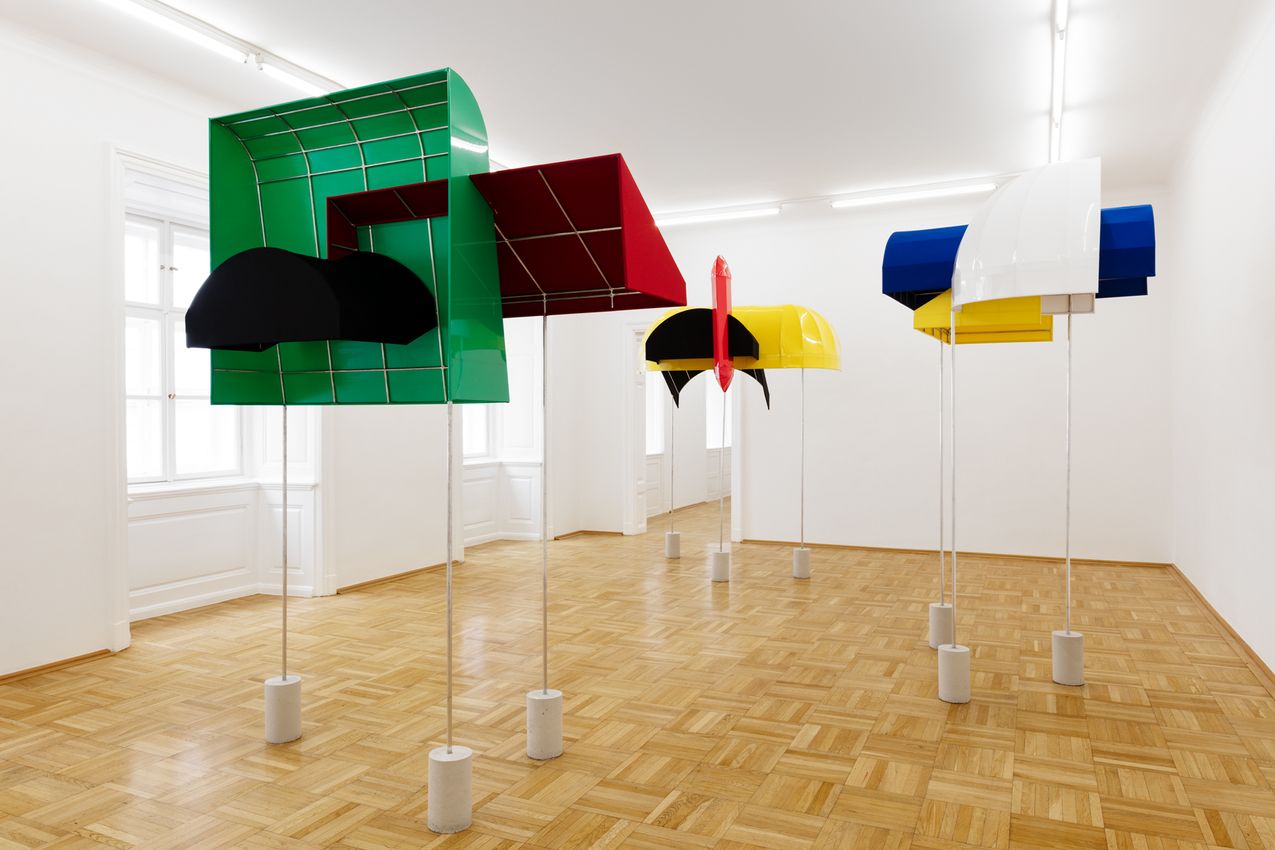
In this light, the rooms of the gallery act as places where urban life is condensed. Five large free-standing objects, which oscillate between sculpture and architecture, form a kind of obstacle course that guides visitors through the first two rooms. Canopy-like structures at eye level are each mounted on top of three concrete pillars and poles. The artist assembled these canopies, which resemble the awnings in front of businesses and other buildings, out of geometric construction elements made of robust acrylic fabric and PVC. These public places invite us to stop and stay for a moment or two. They offer protection from the sun, shelter from the rain, or they provide a place to take a short break. Free from any spatial or functional context, Leimer’s capricious pseudo-canopy objects seem to stake a territorial claim in the gallery, while creating a social and architectural space at the same time. By interacting with the objects, visitors assume the role of promenaders who take up and occupy the space for a while. These Awnings, which is also the title of this group of installation-like works, thus delineate a gray area in which there is a push and pull between inside and outside, and between public and personal appropriation.

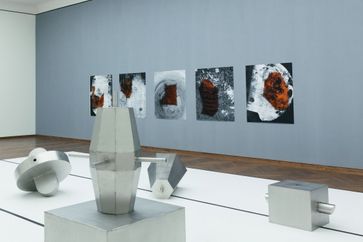
The temporary appropriation of urban spaces is also a theme in Leimer’s work Sharpen, which consists of a video and several drawings made by the artist. These images that she observed during an artist residency in New York capture ephemeral situations in urban spaces. The video presents a collage-like portrait of a citizen of New York City named Chung Man Keung, who worked as a knife sharpener and cobbler, but also made drawings. In the short film made with a mobile phone, we are shown the only proof of his existence: remnants of his works on paper that he attached to the gray outer walls of a building. We also meet Eugenia Lai, a friend of the artist’s who lives in New York, who talks about visiting the old man, who appears to have disappeared. The video also shows drawings that Chung made by copying images from newspapers. In this personal portrait of a man’s precarious job and life on the margins, Leimer creates a memorable narrative of structural transformations and the vibrant social fabric of Chung’s neighborhood. The installation heightens our awareness of how fragile and difficult existential and economic conditions in urban environments can be – and how personal spaces, which are the foundations of a city’s “social capital,” are often erased overnight and disappear entirely, without a trace.

Read More
About the Artist

Born in 1977 in Meran, Italy, lives and works in Vienna, Austria.

View Artist Profile Sonia Leimer contemporary artist
About the Gallery

The Galerie nächst St. Stephan represents a living tradition of exploring the art of the modern era. It has been located since the 1920’s in the same place in the centre of Vienna at Grünangergasse.

View Gallery Profile
Address
Grünangergasse 1
2nd Floor
Vienna
Austria
Opening Hours
Tues - Fri, 11am - 6pm
Sat, 11am - 4pm
(1)
Vienna Grünangergasse 1, 2nd Floor
Galerie nächst St. Stephan Rosemarie Schwarzwälder
Grünangergasse 1, 2nd Floor, Vienna, Austria

Opening hours
Tues - Fri, 11am - 6pm
Sat, 11am - 4pm
The art world in focus