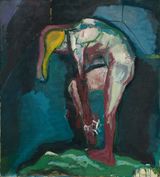
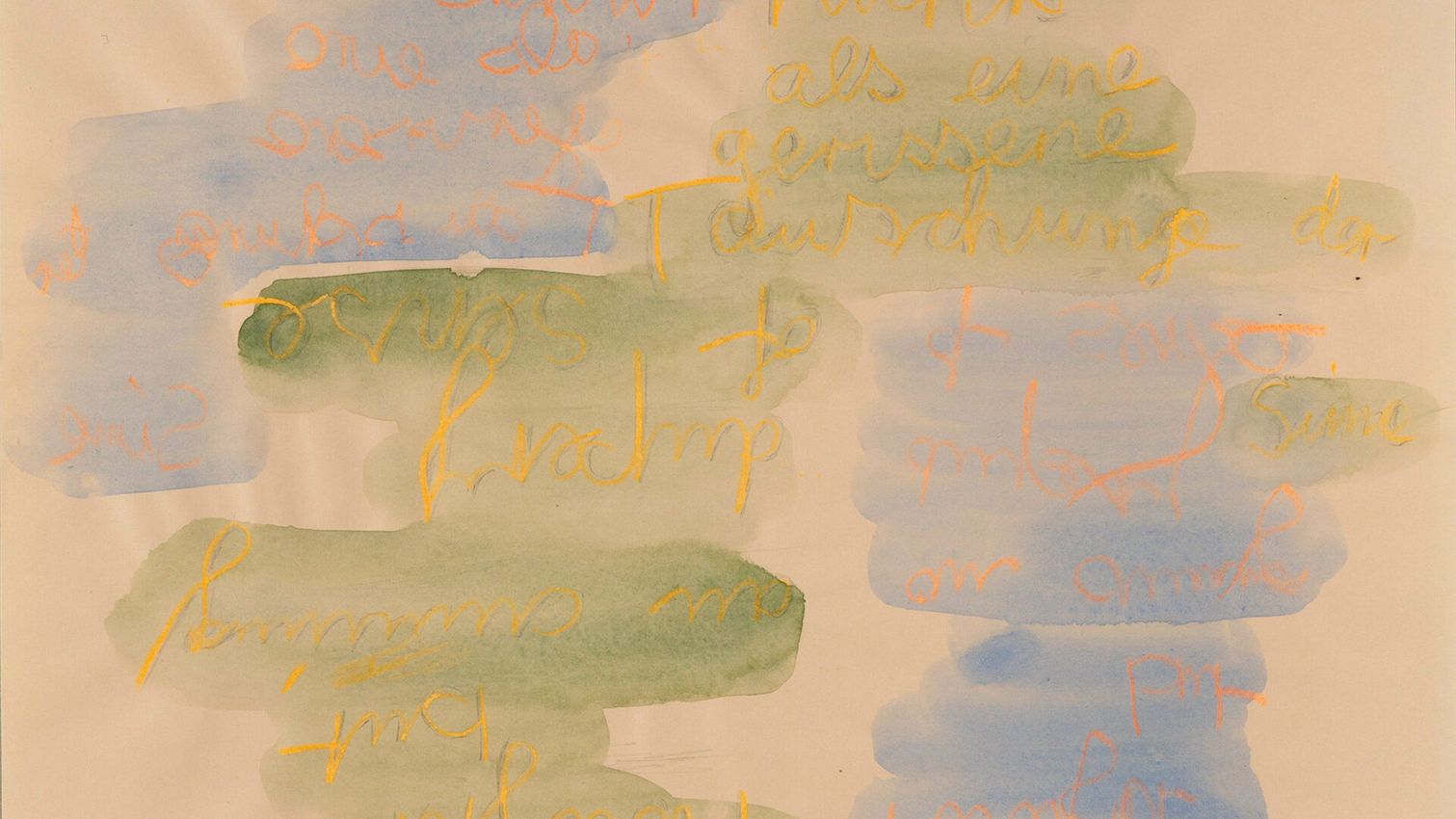
Sabine Herrmann’s new paintings, all from 2026, call on us to fully engage with them. Even if the artist begins with sense, and has an idea in her mind what the painting should look like, the result is pure sensation, an emotional space where, from time to time, there is something reminiscent of figuration. Our own imagination can read there what it finds and invents. The artist gives us freedom, which in turn is challenging. But the experience of freedom after the Berlin wall came down has shaped her and her subsequent work. She renounced figuration and bravely turned toward free painterly expression, developing a technique all her own.
The paintings on paper are characterised by great transparency. The colours, inevitably layered on top of one another on a two-dimensional sheet of paper, develop their own dynamics. What lies below seems to be on top, what is on top is below. They depict a three-dimensional space which our gaze can penetrate deeply.
Even if all works have titles, these don’t serve to explain anything. They emerge associatively while the finished painting is contemplated – they don’t stand at the beginning. But for the artist it’s nonetheless important to give the thing a name and to connect language and painting. In this way, she recovers the sensation and lends it sense, which however was not decisive during the creative process.
If I don’t want to engage, the interplay of colours offers aesthetic pleasure to the eye. Looking is enough; the emotion will come later.
Sabine Herrmann (born in 1961) studied painting at HfBK Dresden, from 1982 to 1986 at Kunsthochschule Berlin, and from 1990 to 1991 at l’Ecole Nationale Supérieure d’Art de la Villa Arson in Nice. She lives and works in Berlin. After her graduation, she travelled and worked in Ireland, Italy, Japan, and the United States. Important milestones of her artistic career were exhibition at the Federal Chancellery in Berlin in 2002, Gegenstimmen at Martin-Gropius-Bau Berlin, Die wilden 80er Jahre at Potsdam-Museum in 2016, and her solo show at Brandenburgisches Landesmuseum für moderne Kunst in Cottbus. Her works are part of the permanent exhibition of Hamburger Bahnhof – Nationalgalerie der Gegenwart.
Her works can be found in public art collections such as Nationalgalerie der Gegenwart, Landesmuseum Berlinische Galerie, Kunstmuseum Ahrenshoop, Akademie der Künste Berlin, Brandenburgisches Landesmuseum für moderne Kunst, Märkisches Museum Berlin (Stiftung Stadtmuseum Berlin), the art collection of the LBS Potsdam, Stiftung Kunstforum der Berliner Volksbank, as well as private collections like Sammlung Seitz, Reutlingen.
Growing up in East Berlin, Sabine Herrmann experienced the division of Germany at first hand. Her artistic influence was shaped by the 80s of the GDR, which were filled with political tension, a love of experimentation and a spirit of solidarity and optimism. After reunification, she asserted herself independently with her work, as her biography with international museum exhibitions proves. Typical of her work are expressive broad brushstrokes, but also fine expressive pencil drawings. It is of impressive solidity, contemplative and political at the same time. She writes the names of female artists on paper in various sizes, one on top of the other, and addresses their lack of public recognition and visibility.

Established by Susanne Albrecht in 1986 off the heels of her studies in philosophy, art history, and Italian philology at Freie Universität Berlin and Ludwig-Maximilians-Universität München, Galerie Albrecht represents young European and Asian artists as well as influential established European and American post-War and contemporary artists.

A respected voice in contemporary art discourse.
Focusing on ambitious storytelling and insightful art-world commentary. Ocula Magazine publishes in-depth interviews, critical essays and timely analysis on the artists, exhibitions and ideas driving the global art world.
Learn more about Ocula Magazine
Showcasing the best of the art world.
Ocula partners with galleries from around the world to highlight their artists, artworks and exhibitions. Gallery membership is by application and invitation, with each member vetted by an independent panel.
Learn more about Ocula Membership

Specialises in the sale of major artworks.
Led by a team with deep ties to the world’s leading auction houses, galleries and collectors. Ocula’s advisory team offers bespoke services to high-net-worth clients from around the world who are looking to acquire the best of contemporary and modern art.
Learn more about our team and services