Galleria Continua is pleased to host the second solo exhibition in Beijing of Giovanni Ozzola.
Ozzola is a multidisciplinary artist; his work involves the public through diverse sensory and cognitive experiences. Photographic images, sculptural objects, and video installations are experienced by the viewer in their essential nature and express an ability to communicate with people’s emotional memory.
The work of Giovanni Ozzola demonstrates the irrefutable signs of his endless research and observation. The importance of light, its presence or absence, as it reveals and hides landscapes, objects and (more rarely) people, enlightening the uniqueness of every instant. In his favourite subjects, we recognize recurrent and cyclical themes: Time, Nature, and the furtive intervention of human beings; doors and windows, broken walls and cracks that open up to the view of a perfect intimidating seascape or the undulating motion of the desert. Sceneries at the mercy of temporary and transitory climates, such as a sunset, a distant storm, the imminent approach of the night, and calima. Night visions of rivers, shrubs, and flowers, garages, bunkers and wrecked houses covered by graffiti, tormented love messages on walls coloured by mould and lichens.Minimalist spaces where the Light and the Darkness are protagonists in a composition of essential elements, perhaps clandestinely present or passing by; buildings undergoing construction whose gaze is alone and silent whilst facing the outside, towards the sky, towards the sea, towards the wind...
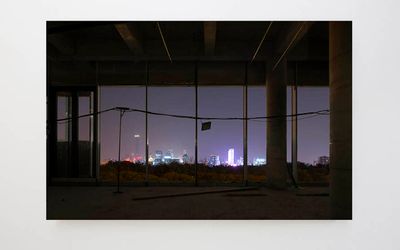
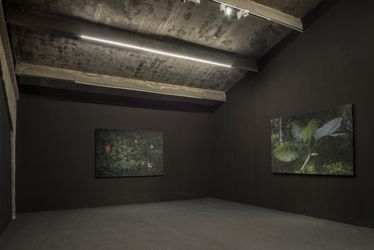
This last theme reappears in the photographic works of Ozzola for his Beijing solo exhibition. A construction site in which the bare concrete structure does not allow the viewer to identify the location, but whose windows to the outside area dizzying look onto a solid horizon, the Beijing skyline, just as the sun is about to set and it announces the darkness, and the artificial coloured lights of the city take over the otherwise dark sky.
In the series Vanitas, the stealthy view of the camera lens on the flowers at night becomes even more mysterious and sensual through the introduction of a new material: the artist’s photographs are imprinted on velvet rather than on paper. The choice to add an element that by its nature plays with light helps make even more dramatic the view of the subject. According to how the observer positions himself in the room the artworks’ light changes. Inpainting terms by Vanitas we mean a Still Life, a pictorial genre closely related to a sense of precariousness and the transience of life vanitasvanitatum et Omnia vanitas, a warning of the ephemeral condition of existence, a message of which flowers are symbolic conveyors.
Untitled - estoy pecando and Untitled with colour are Ozzola’smost recent works. They are made to reveal themselves in a more physical and pictorial form. The method the artist uses this time refers to an eighteenth-century technique of “fresco tear’ that was performed with the use of hot glue. Once more Ozzola chooses sites of abandonment, uninhabited and marginal locations, his interventions are made with different media among which silicon penetrates into the lacerations on the walls into the engraved inscriptions and graffiti, capturing traces from the wall, colours and writing obtaining their visibility in negative.
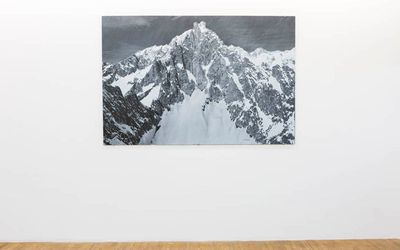
Ozzola’s choice to use slates, for his work Monte Bianco, is linked to the stone’s history and special characteristics. Used in ancient times as a basis for writing, it is composedof layers of rock, representing the accumulation of time, like experiencesin man’s life. Engraved on Ozzola’s slates, as if it was earth its self, we find portraits of travel routes thatroam the unknown, adventures and visions of stormy seas or mountain peaks. The natural anthracite colour of this stone allows for an excellent base to bring out the light, the reflection of the moon on the crest of waves or on the frozen peaks of a mountain... Once more, the pure poetry of light and the moment is captured.
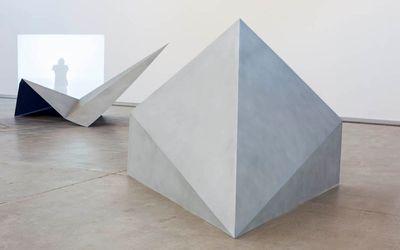
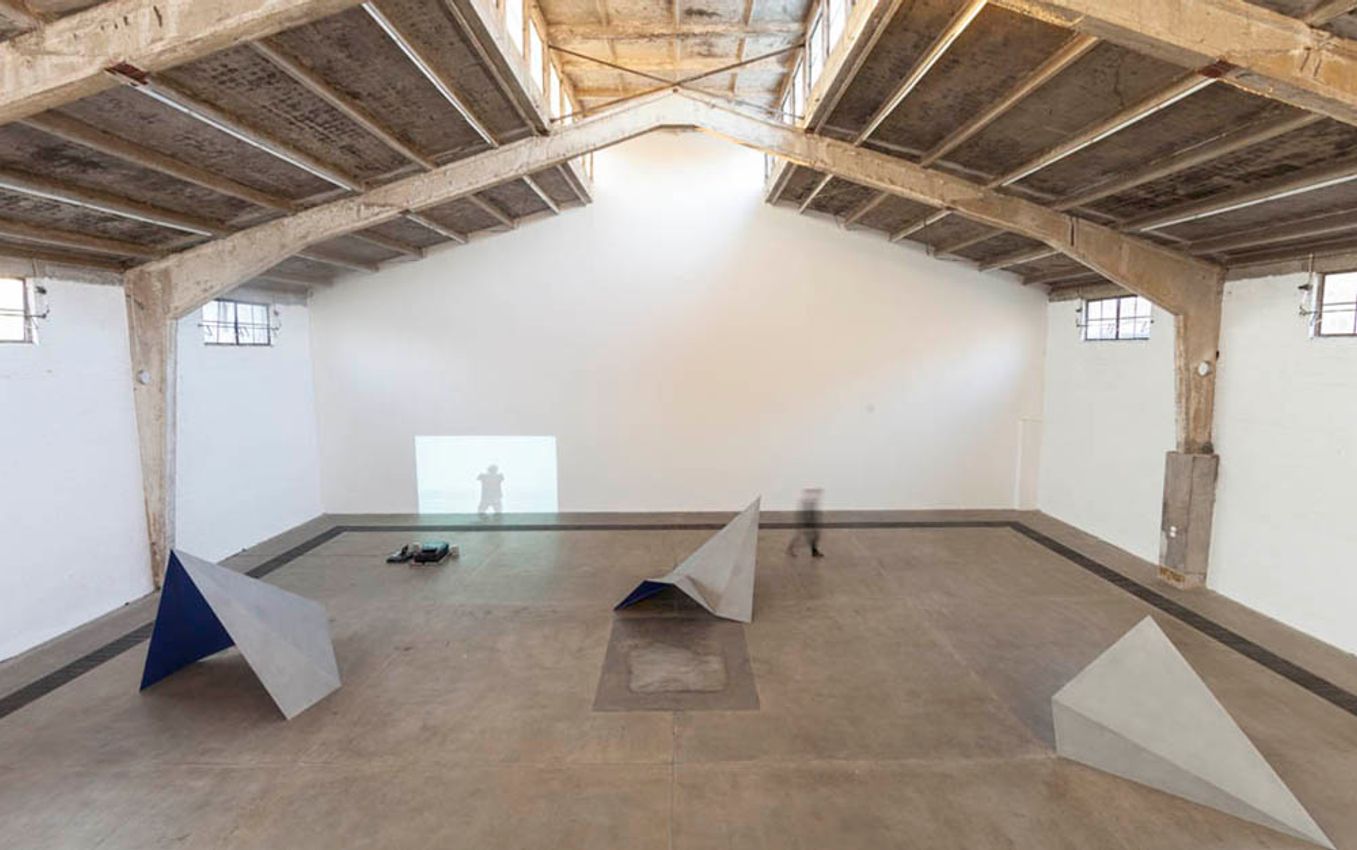
Closely related to his photographic work, other sculptural works and video installations narrate visions of Light and its perception, the furtive presence of humans on earth. Stealth - invisible shipwrecks, ‘invisible’ geometric figures, a workthat Ozzola realised after frequent visits to the IDS centre in Pisa, reveals fragments of aerial and naval forms created so as not to be identifiable by radar and remain invisible (Stealth technology). These simple and at the same time absurd forms, like wrecks surrendered to time, multiply and emerge from the ground as if from the bottom of thesea, thanks to the breaking of light on their oblique and sharp surfaces. Like stormy waves, they break off the floor and climb upwards. Their interioris a blue colour like the reflection of the ocean at night.
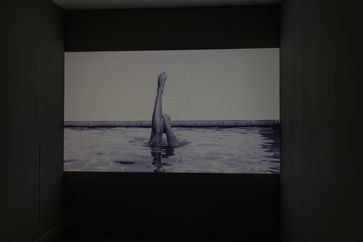
The video work, placed on the ground floor, is titled Sin tiempo. It was made by Ozzola in honour of anantique language from the Canary archipelago. It is a whistled language that was mainly used to communicate at great distances through the deep valleys that cross the island of Gomera. Not much is known of the original language but the Guanches whistled before the arrival of the Spanish settlers. (From 2009, it was recognised as a masterpiece of the Oral and Intangible Heritage of Humanity by UNESCO). _Sin Tiempo _approaches this wonderful oral language with the sensitivity and purecuriosity, devoid of judgment, that the artist applies to all of his research. The unusual view from the camera becomes the wind its self andit rises over the sea as it advances to reach the opposite coast. In the distance, the silhouette of a human presence becomes clearer. The young Guanche, whose whistle very fewpeople are able to understand, findshis eternal witnesses and companion inthe sea and in the wind. His thoughts and poetry are contained in the deep culture of this archipelago, today the artist’s home.
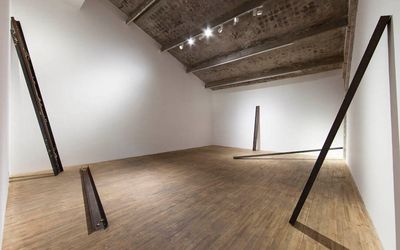
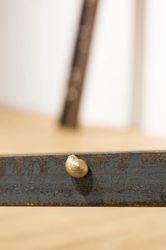
Paying attention to the small details that in life can sometimes amaze, noticeable traces of life are born leaning on rebar, milling cutters, girders, and chains... They are allmaterials born from human cleverness, abandoned and contaminated by time, corroded by water. These disused objects are inhabited by snails, Chiocciole - your lips make menervous, small creatures that carryon their back the perfect mathematical expression of the golden ratio. Yet these wonderful forms of life seem to be attracted to their opposite, nourished by rust.
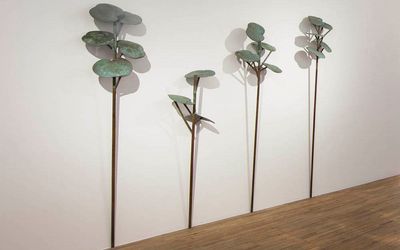
Plants - tu lunares son estrellas, Bronze leafs are artificially created following mother nature’s steps, likethe lymph nourishing the steam running upwards until it reaches the leafs, sothe liquefied bronze slowly reachesthe capillary extremities of the mould filling each gap, giving the expected shape to the work. Once again the light plays a fundamental role, reflecting on the little bronze shells and open leafs, making them shine and emerge as if they were alive in this very moment.
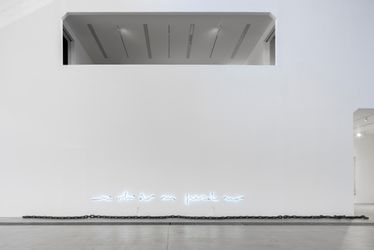
In, Ni olvido, ni perdono, a shaded neon light is hanging on a rusted navalchain. Memories of life’s journeys navigating through furious and quiet oceans. In life man wants to be ableto forget and forgive, but there are forces and energies that like solid chains won’t allow letting go.
In Ozzola’s work, sculptural installations, as much as photographs, are places of meditation where opposite realities live side-by-side, coexisting harmoniously.


After spending several years in London, Ozzola came back to Italy in 2001, where he began to build a personal artistic path that led him, in 2001 to participate in the exhibition Happiness: A Survival Guide for Art and Life, curated by David Elliott and Pier Luigi Tazzi, at the Mori Art Museum of Tokyo.

It was in the year 1990 that three friends, Lorenzo Fiaschi, Mario Cristiani and Maurizio Rigillo, decided to open a gallery in a quite unexpected location, far from the big cities and smoothly running art circuits – in San Gimignano, a town steeped in history and somehow out of time, in the heart of Tuscany. Over these 25 years of activity, generosity and altruism have formed the basis for numerous and multifaceted artistic collaborations.

A respected voice in contemporary art discourse.
Focusing on ambitious storytelling and insightful art-world commentary. Ocula Magazine publishes in-depth interviews, critical essays and timely analysis on the artists, exhibitions and ideas driving the global art world.
Learn more about Ocula Magazine
Showcasing the best of the art world.
Ocula partners with galleries from around the world to highlight their artists, artworks and exhibitions. Gallery membership is by application and invitation, with each member vetted by an independent panel.
Learn more about Ocula Membership

Specialises in the sale of major artworks.
Led by a team with deep ties to the world’s leading auction houses, galleries and collectors. Ocula’s advisory team offers bespoke services to high-net-worth clients from around the world who are looking to acquire the best of contemporary and modern art.
Learn more about our team and services